Results by title

36 books match the query 'Natural law'
cover of A Second Look at First Things: A Case for Conservative Politics: The Hadley Arkes Festschrift

A Second Look at First Things

A Case for Conservative Politics: The Hadley Arkes Festschrift

Francis J. Beckwith

St. Augustine's Press, 2013
[more]
cover of Aquinas on Imitation of Nature: Source of Principles of Moral Action

Aquinas on Imitation of Nature

Source of Principles of Moral Action

Wojciech Golubiewski

Catholic University of America Press, 2022

Aquinas on Imitation of Nature highlights and explores the doctrine of the imitation of nature, a crucial aspect of Aquinas’ metaethics and fills the gap in research on Aquinas’ moral doctrine and theory of action. It conveys Aquinas’ doctrine of the imitation of nature as a natural feature of right practical reason regarding moral thinking and action, indeed as an indispensable feature of virtuous flourishing in individual and communal aspects of human life. The book starts with an overview of some of recent interpretations of Aquinas’ moral doctrine and natural law, introducing the need to explore the role of the imitation of nature in human practical reasoning and action in this area of Aquinas’ teaching. The chapters that follow are based on a careful reading of selected texts of Aquinas, and gradually develop a thorough and comprehensive picture of his doctrine of the imitation of nature as a source of practical principles. The final chapter provides various examples of how Aquinas understands the imitation of nature in the realm of moral reasoning and action. The originality of this volume comes from its account of Aquinas’ medieval doctrine of the imitation of nature, in light of which the principles of right practical reason and virtuous action are congruent with and epistemologically dependant upon the basic terms of the movements of natural, sensible, non-rational agents. Through its thorough reading of Aquinas on the imitation of nature, the book aims to open new ways of appropriation of the metaphysical and natural tenets of his moral doctrine in the areas of theory of action, practical reason, natural law, and contemporary virtue ethics.
[more]
cover of Aquinas' Cruciform Theology of the Natural Law

Aquinas' Cruciform Theology of the Natural Law

Kevin E. O'Reilly

Catholic University of America Press, 2026

The predominant understanding of St. Thomas’s account of the natural law to date has been that it is basically philosophical in character. In Thomas Aquinas’s Cruciform Theology of the Natural Law, Kevin E. O’Reilly, OP, argues that Thomas’s construal of the natural law is, on the contrary, thoroughly theological in its inspiration. In order to establish this point the author first unpacks the significance of the scriptural quotations employed by Thomas in his very first article devoted to the natural law (ST I-II, q. 91, a. 2). Exegesis of one of those quotations, namely Ps. 4:6 – "Offer up the sacrifice of justice" – intimates that the degree to which one grasps the demands of the natural law is intimately bound up with the extent to which one is conformed to the Crucified Christ. Consideration of the notion that the natural law is the participation of the eternal law in the rational creature yields the same conclusion. Thus, while the eternal law pertains to God’s essence, it is nevertheless expressed by and therefore appropriated to the Word uttered by the Father. This Word is the divine Wisdom ultimately disclosed on the Cross. It becomes apparent that the eternal law is thus cruciform in nature. So too is the natural law as a cognitive participation therein. This cognitive participation engages the life of faith and charity as well as the Gifts of the Holy Spirit. Examination of Thomas’s account of the three degrees of charity as well as his treatment of the Gifts of the Holy Spirit and the beatitudes that are correlated with them underscores the important role that the dynamics of cruciformity play in illuminating the demands of the natural law. Cruciformity and moral illumination are intimately connected.
[more]
cover of Discourse on the Origins of Inequality (Second Discourse), Polemics, and Political Economy

Discourse on the Origins of Inequality (Second Discourse), Polemics, and Political Economy

Jean-Jacques Rousseau

Dartmouth College Press, 1993
Includes the Second Discourse (complete with the author’s extensive notes), contemporary critiques by Voltaire, Diderot, Bonnet, and LeRoy, Rousseau’s replies (some never before translated), and Political Economy, which first outlined principles that were to become famous in the Social Contract. This is the first time that the works of 1755 and 1756 have been combined with careful commentary to show the coherence of Rousseau’s “political system.” The Second Discourse examines man in the true “state of nature,” prior to the formation of the first human societies, tracing the “hypothetical history” of political society and social inequality as they developed out of natural equality and independence.
[more]
cover of Edmund Burke and the Natural Law

Edmund Burke and the Natural Law

Peter J. Stanlis

University of Michigan Press, 1958
Edmund Burke—brilliant prophet, party leader, and rhetorician—in his defense of the American Colonies as in his opposition to the French Revolution spoke directly to the modern age. Yet he has been, when not neglected, persistently misunderstood: his principles of prudence garbled, his distrust of abstract law misinterpreted, his appeals to nature misrepresented, his concept of the law of nations ignore. This study of his ideas presents at last his true position as a philosopher, relating his convictions to the great tradition of Christian and classical civilization and showing their relevance for today.
[more]
cover of Exploring the Nature of Law: Thomistic Juridical Realism and the Elements of Law's Ontology

Exploring the Nature of Law

Thomistic Juridical Realism and the Elements of Law's Ontology

Petar Popovic

Catholic University of America Press, 2025
This is a book about the nature of the reality or the phenomenon referred to as “law” by lawyers and legal officials, but also by members of communities living under law, to the extent that they conceptualize the realm of “law” as something sufficiently distinguishable from other different or broader realities and phenomena. The book belongs to the legal-philosophical field dedicated to the study of the very nature of law, that is, to the most basic or abstract part of the philosophy of law, which is sometimes referred to as “the philosophy of philosophy of law” or “general jurisprudence.” The scope of the book is to explore the essential features of law’s nature, namely, all those realities that pertain to law’s essence, the properties that make law into what it is. Despite the fact of plurality of legal-philosophical conceptions of law circulating in legal theory today, the book is optimistic about the very prospect of exploring the nature of law. It maintains that law has an essence and that it is possible to explore and describe this unique essence in an intelligible and reasonably detailed fashion, by identifying the basic elements of law’s ontology. The book advances the claim that Aquinas’s account of legal ontology denotes the most accurate understanding of the phenomenon that we call “law”—which the Angelic Doctor referred to as ius, constituted as such on the basis of the various manifestations of lex. Aquinas’s approach to understanding law’s nature that can be labeled “Thomistic juridical realism” and it may be categorized as a version of a natural-law theory of law. The book argues that a contemporary reading of Aquinas may indeed fruitfully contribute to an improved understanding of our present-day legal-philosophical analyses and discussions on the nature of law.
[more]
cover of From Human Dignity to Natural Law: An Introduction

From Human Dignity to Natural Law

An Introduction

Richard Berquist

Catholic University of America Press, 2019
From Human Dignity to Natural Law shows how the whole of the natural law, as understood in the Aristotelian Thomistic tradition, is contained implicitly in human dignity. Human dignity means existing for one’s own good (the common good as well as one’s individual good), and not as a mere means to an alien good. But what is the true human good? This question is answered with a careful analysis of Aristotle’s definition of happiness. The natural law can then be understood as the precepts that guide us in achieving happiness. To show that human dignity is a reality in the nature of things and not a mere human invention, it is necessary to show that human beings exist by nature for the achievement of the properly human good in which happiness is found. This implies finality in nature. Since contemporary natural science does not recognize final causality, the book explains why living things, as least, must exist for a purpose and why the scientific method, as currently understood, is not able to deal with this question. These reflections will also enable us to respond to a common criticism of natural law theory: that it attempts to derive statements of what ought to be from statements about what is. After defining the natural law and relating it to human or positive law, Richard Berquist considers Aquinas’s formulation of the first principle of the natural law. It then discusses the love commandments to love God above all things and to love one’s neighbor as oneself as the first precepts of the natural law. Subsequent chapters are devoted to clarifying and defending natural law precepts concerned with the life issues, with sexual morality and marriage, and with fundamental natural rights. From Human Dignity to Natural Law concludes with a discussion of alternatives to the natural law.
[more]
cover of God and the Natural Law: Reading of Thomas Aquinas

God and the Natural Law

Reading of Thomas Aquinas

Fulvio Di Blasi

St. Augustine's Press, 2006

It seems that to retain credibility in a post-Kantian and analytic world, contemporary natural law theory has tried to show its independence both from God and from human nature. But can there be a natural-law theory without the “natural” – not grounded in facts of nature – and without “law” – not in need of a Legislator? In God and the Natural Law, Fulvio Di
Blasi begins with an original analysis of the current debate in ethics, jurisprudence, and politics in order to set the stage for a sound understanding of the concept of natural law. This leads to the heart of the book: a recovery of the authentic meaning of the two main concepts of classical natural-law theory as synthesized by Thomas Aquinas – the will of God and the order of nature.
 
The wide revival of practical philosophy and ethics of objective-values in recent decades has involved a robust rediscovery of classical natural-law theory. This rediscovery is marked by two main traits: an emphasis on the autonomy of practical reason (as a reaction to modern voluntarism centered on the external will of the legislator); and an emphasis on the originality of practical reason (as a reaction to the idea of a rational deduction of
moral truths from the facts of nature). Without denying an autonomous character to ethics, or the need for a strong critique of moral rationalism, Di Blasi argues that Aquinas’s thought remains unintelligible if we remove from it either God or the metaphysical understanding of
nature.
 
[more]
cover of Hegel’s Theory of Normativity: The Systematic Foundations of the Philosophical Science of Right

Hegel’s Theory of Normativity

The Systematic Foundations of the Philosophical Science of Right

Kevin Thompson

Northwestern University Press, 2019
Hegel’s Elements of the Philosophy of Right offers an innovative and important account of normativity, yet the theory set forth there rests on philosophical foundations that have remained largely obscure. In Hegel’s Theory of Normativity, Kevin Thompson proposes an interpretation of the foundations that underlie Hegel’s theory: its method of justification, its concept of freedom, and its account of right. Thompson shows how the systematic character of Hegel’s project together with the metaphysical commitments that follow from its method are essential to secure this theory against the challenges of skepticism and to understand its distinctive contribution to questions regarding normative justification, practical agency, social ontology, and the nature of critique.
[more]
cover of Knowing the Natural Law

Knowing the Natural Law

Steven Jensen

Catholic University of America Press, 2015
Knowing the Natural Law traces the thought of Aquinas from an understanding of human nature to a knowledge of the human good, from there to an account of ought-statements, and finally to choice, which issues in human actions. The much discussed article on the precepts of the natural law (I-II, 94, 2) provides the framework for a natural law rooted in human nature and in speculative knowledge. Practical knowledge is itself threefold: potentially practical knowledge, virtually practical knowledge, and fully practical knowledge.
[more]
cover of Law and Religion in a Secular Age

Law and Religion in a Secular Age

Rafael Domingo

Catholic University of America Press, 2023
Law and Religion in a Secular Age seeks to restore the connection between spirituality and justice, religion and law, theology and jurisprudence, and natural law and positive law by building a new bridge suitable for pluralistic societies in the secular age. The author argues for a multidimensional view of reality that includes legal, political, moral, and spiritual dimensions of human nature and society. Each of these dimensions of life needs to recognize the existence, influence, and function of the others, which act as a filter or check on the excesses of each other. This multidimensionality of reality clarifies why no legal theory can fully account for law from the legal dimension alone, just as no moral theory makes perfect sense of morality from the moral dimension—and, for that matter, nothing in physics can fully interpret the physical dimension of reality. The premises of a legal system cannot be fully explained by the legal dimension alone because the fundamental conditions and qualities of justice, freedom, and dignity touch all the dimensions of reality in which the human person acts, including the moral and the spiritual, not just the legal. Building on this multidimensional theory of reality, the author explores the core differences and the essential interconnections between law, morality, religion, and spirituality and some of the legal implications of these connections. Rafael Domingo reminds readers of the vital role of religion in shaping the conceptual framework of Western legal systems, underscores the spirit of Christianity that inspired legal institutions, principles, and values, and recalls the contributions of specific Christian jurists as central figures for the development of justice in society. Law and Religion in a Secular Age aims to be a valuable antidote against the dominant legal positivism that has cornered public morality, the defiant secularism that has marginalized religion, and any other legal doctrine that diminishes the spiritual dimension of law and justice.
[more]
cover of Liberty and Law

Liberty and Law

Brian Tierney

Catholic University of America Press, 2014
Liberty and Law examines a previously underappreciated theme in legal history - the idea of permissive natural law. The idea is mentioned only peripherally, if at all, in modern histories of natural law. Yet it engaged the attention of jurists, philosophers, and theologians over a long period and formed an integral part of their teachings. This ensured that natural law was not conceived of as merely a set of commands and prohibitions that restricted human conduct, but also as affirming a realm of human freedom, understood as both freedom from subjection and freedom of choice. Freedom can be used in many ways, and throughout the whole period from 1100 to 1800 the idea of permissive natural law was deployed for various purposes in response to different problems that arose. It was frequently invoked to explain the origin of private property and the beginnings of civil government.
[more]
cover of Natural Law and Thomistic Juridical Realism: Prospects for a Dialogue with Contemporary Legal Theory

Natural Law and Thomistic Juridical Realism

Prospects for a Dialogue with Contemporary Legal Theory

Petar Popovic

Catholic University of America Press, 2022

This book proposes a rather novel legal-philosophical approach to understanding the intersection between law and morality. It does so by analyzing the conditions for the existence of a juridical domain of natural law from the perspective of the tradition of Thomistic juridical realism. In order to highlight the need to reconnect with this tradition in the context of contemporary legal philosophy, the book presents various other recent jurisprudential positions regarding the overlap between law and morality. While most authors either exclude a conceptual necessity for the inclusion of moral principles in the nature of law or refer to the purely moral status of natural law at the foundations of the legal phenomenon, the book seeks to elucidate the essential properties of the juridical status of natural law. In order to establish the juridicity of natural law, the book explores the relevant arguments of Thomas Aquinas and some of his main commentators on this issue, above all Michel Villey and Javier Hervada. It establishes that Thomistic juridical realism observes the juridical phenomenon not only from the perspective of legal norms or subjective individual rights, but also from the perspective of the primary meaning of the concept of right (ius), namely, the just thing itself as the object of justice. In this perspective, natural rights already possess a fully juridical status and can be described as natural juridical goods. In addition, from the viewpoint of Thomistic juridical realism, we can identify certain natural norms or principles of justice as the juridical title of these rights or goods. The book includes an assessment of the prospective points of dialogue with the other trends in Thomistic legal philosophy as well as with various accounts of the nature of law in contemporary legal theory.
[more]
cover of Natural Law: Reflections On Theory & Practice

Natural Law

Reflections On Theory & Practice

Jacques Maritain

St. Augustine's Press, 2001

Can there be universal moral principles in a culturally and religiously diverse world? Are such principles provided by a theory of natural law? Jacques' response to both questions is "yes".

These essays, selected from the writings of one of the most influential philosophers of the past hundred years, provide a clear statement of Maritain's theory of natural law and natural rights. Maritain's ethics and political philosophy occupies a middle ground between the extremes of individualism and collectivism. Written during a period when cultural diversity and pluralism were beginning to have an impact on ethics and politics, these essays provide a defense of natural law and natural right that continues to be timely.

The first essay introduces Maritain's theory of connatural knowledge -- knowledge by inclination -- that lies at the basis of his distinctive views on moral philosophy, aesthetics, and mystical belief. The second essay gives Maritain's principal metaphysical arguments for natural law as well as his account of how that law can be naturally known and universally held.

The third essay in this collection explains the roots of the natural law and shows how it provides a rational foundation for other kinds of law and for human rights. In the fourth essay, reflecting his personalism and integral humanism, Maritain indicates how he extends his understanding of human rights to include the rights of the civic and of the social or working person.
[more]
cover of Natural Moral Law in Contemporary Society

Natural Moral Law in Contemporary Society

Holger Zaborowski

Catholic University of America Press, 2010
The essays of this volume examine natural moral law, different natural law theories, and the role that natural law can and should play in our contemporary society
[more]
cover of Natural Right and History

Natural Right and History

Leo Strauss

University of Chicago Press, 1965

In this classic work, Leo Strauss examines the problem of natural right and argues that there is a firm foundation in reality for the distinction between right and wrong in ethics and politics. On the centenary of Strauss's birth, and the fiftieth anniversary of the Walgreen Lectures which spawned the work, Natural Right and History remains as controversial and essential as ever.

"Strauss . . . makes a significant contribution towards an understanding of the intellectual crisis in which we find ourselves . . . [and] brings to his task an admirable scholarship and a brilliant, incisive mind."—John H. Hallowell, American Political Science Review

Leo Strauss (1899-1973) was the Robert Maynard Hutchins Distinguished Service Professor Emeritus in Political Science at the University of Chicago.
[more]
cover of On the Dignity of Society: Catholic Social Teaching and Natural Law

On the Dignity of Society

Catholic Social Teaching and Natural Law

F. Russell Hittinger

Catholic University of America Press, 2024
In this collection of essays, Francis Russell Hittinger shows that Catholic social teaching is not only an articulate defense of the dignity of the human person, but perhaps more fundamentally an elucidation of the dignity of society. Indeed, Hittinger enables us to see that one cannot properly defend the dignity of the person without also showing the dignity of societies in which human persons – as naturally familial, political, and ecclesial animals – seek their own perfection in communion with others. Hittinger has been a renowned scholar of Catholic social doctrine for some time now, and the essays presented here are the fruit of his mature thinking on the topic over the course of many years. As each chapter shows, Hittinger’s historically important body of work on Catholic moral and social philosophy and theology is rooted in natural law theory and Thomistic philosophy, but also animated by St. Augustine’s thought and thus consistently sensitive to historical contexts and arenas for moral and theological disputation. These magisterial essays therefore integrate historical studies of the development of Catholic social teaching with systematic exposition of the theological coherence of that tradition, while also articulating the essential role of philosophy and natural law within both. The volume is divided into three parts. The first part is comprised of six essays on Catholic social teaching, the second part is made up of six essays on natural law and its role in social doctrine, and the third part includes two essays discussing the first principles of the Church’s teaching on social issues. This collection will no doubt become a standard in the field of scholarship on Catholic social teaching.
[more]
cover of On the Spirit of Rights

On the Spirit of Rights

Dan Edelstein

University of Chicago Press, 2018

By the end of the eighteenth century, politicians in America and France were invoking the natural rights of man to wrest sovereignty away from kings and lay down universal basic entitlements. Exactly how and when did “rights” come to justify such measures?
 
In On the Spirit of Rights, Dan Edelstein answers this question by examining the complex genealogy of the rights that regimes enshrined in the American and French Revolutions. With a lively attention to detail, he surveys a sprawling series of debates among rulers, jurists, philosophers, political reformers, writers, and others who were all engaged in laying the groundwork for our contemporary systems of constitutional governance. Every seemingly new claim about rights turns out to be a variation on a theme, as late medieval notions were subtly repeated and refined to yield the talk of “rights” we recognize today. From the Wars of Religion to the French Declaration of the Rights of Man and of the Citizen to the 1948 Universal Declaration of Human Rights, On the Spirit of Rights is a sweeping tour through centuries of European intellectual history and an essential guide to our ways of thinking about human rights today.
[more]
cover of Perfecting Human Actions: St. Thomas Aquinas on Human Participation in Eternal Law

Perfecting Human Actions

St. Thomas Aquinas on Human Participation in Eternal Law

John Rziha

Catholic University of America Press, 2009
During the last few centuries, a practical dichotomy between God and humans has developed within moral theory. As a result, moral theory tends to focus only on humans where human autonomy is foundational or only on God where divine commands capriciously rule. However, the moral theology of Thomas Aquinas overcomes this dichotomy. For Thomas, humans reach their perfection by participating in God's wisdom and love. Perfecting Human Actions explores the ways humans participate in eternal law--God's wisdom that guides and moves all things to their proper action. The book begins with a thoughtful examination of the philosophic recovery of the notion of participation in Thomistic metaphysics. It then explains Thomas's theological understanding of the notion of participation to show how humans are related to God. It is discovered that when performing human actions, humans participate in the eternal law in two ways: as moved and governed by it, and cognitively. In reference to participation as moved and governed, humans are directed by God to their proper end of eternal happiness. This mode of participation can be increased by perfecting the natural inclinations through virtue, grace, and the gifts of the Holy Spirit. In reference to cognitive participation, humans as rational creatures can know their proper end and how to attain it. Through this knowledge of moral truths, the intellect participates in the eternal law. Cognitive participation is perfected by the intellectual virtues (especially faith) and the gifts of the Holy Spirit (especially wisdom). The book concludes by showing how the notion of human participation in the eternal law is a much better foundation for moral theory than the contemporary notion of autonomy.
[more]
cover of Proportionalism and the Natural Law Tradition

Proportionalism and the Natural Law Tradition

Christopher Kaczor

Catholic University of America Press, 2002

Consequentialism and Catholic ethics seem to be natural enemies. The Catholic prohibition against intentionally killing the innocent, lying, committing adultery, and so on contradicts the very essence of consequentialism that no act may be assessed as good or evil independently of its consequences. However in the 1960s within the Catholic tradition itself, there arose a method in ethics called proportionalism which practically, if not theoretically, affirmed that which consequentialists have long affirmed and Catholic ethicists had so long denied, namely one may do evil that good may come. According to proportionalists, so long as the good effects are proportioned to the bad effects of the act, the act is licit even if evil is used as a means to achieve the good.


In this book, Christopher Kaczor argues against the plausibility of proportionalism and its first proponents, namely Peter Knauer, Joseph Fuchs, Bruno Schüller, Louis Janssens, and Richard McCormick. Examining the genealogy of the movement, he disputes a received history that depicts proportionalism as a recovery of Thomas Aquinas. Instead, contends Kaczor, proportionalism is best seen as the organic successor to the moral manuals of the pre-Vatican II era. Proportionalism arises not from Thomas but rather extends many of the tendencies and presuppositions of the manuals. In particular, it retains their marginalizing of the account of human action as a knowing-willing involving a number of stages not always consciously recognized yet carefully described by Thomas in Summa theologiae, Prima Secundae, 6-17. Kaczor shows that a great deal of the plausibility of proportionalism rests on a fragile foundation that is rapidly eroding, an education in the moral manuals.
[more]
cover of St. Thomas Aquinas and the Natural Law Tradition: Contemporary Perspectives

St. Thomas Aquinas and the Natural Law Tradition

Contemporary Perspectives

John Goyette

Catholic University of America Press, 2004
To explore and evaluate the current revival, this volume brings together many of the foremost scholars on natural law. They examine the relation between Thomistic natural law and the larger philosophical and theological tradition. Furthermore, they assess the contemporary relevance of St. Thomas's natural law doctrine to current legal and political philosophy.
[more]
cover of The Concept of <i>Ius</i> and the Nature of Law in Thomas Aquinas

The Concept of <i>Ius</i> and the Nature of Law in Thomas Aquinas

Loic-Marie Le Bot, OP

Catholic University of America Press, 2025
This collection of essays constitutes the fruit of a scholarly conference held in Rome in April 2023, which was organized by the Pontifical University of Saint Thomas Aquinas, the Pontifical University of the Holy Cross, and the Angelicum Thomistic Institute. The essays offer a scholarly reflection on various historical and doctrinal aspects of Aquinas’s concept of ius, and on the extent to which this concept helps to illuminate his account of the nature of law, that is, of the juridical phenomenon. Each essay addresses, from the viewpoint of its specific topic, the implications of the Angelic Doctor’s description of ius as the object of justice, as presented in the Secunda secundae of his Summa theologiae (starting from question 57, article 1). Following Aquinas’s own insights, the focus on the virtue of justice is thus deemed crucial for understanding the essence or the ontological fabric of law. Justice is simultaneously analyzed as always remaining inherently connected to its moral and divine-salvific aspects. The volume is divided in three parts. The first part of the collection contains essays that are dedicated to the analysis of Aquinas’s concept of ius in a historical perspective. The second group of essays in this collection examine some further doctrinal and contextual issues pertinent to the essence of ius. Each attempt to elucidate the ontology of law should be supported by the aptitude of the resulting accounts of law’s nature to provide workable platforms for legal practices. This line of reasoning represents the rationale for the third part of this collection, which focuses on the matters of applying Aquinas’s concept of ius in systemic and practical legal settings of State law and canon law.
[more]
cover of The Ethics of St. Thomas Aquinas: Happiness, Natural Law, and the Virtues

The Ethics of St. Thomas Aquinas

Happiness, Natural Law, and the Virtues

Leo Elders

Catholic University of America Press, 2019
"Elders brings to his study an almost encyclopedic knowledge of the history of philosophy. Although he advises his readers not to look for any novel interpretations of Thomas, the book is full of surprises. Time and again, he offers a concise history of the moral issue under consideration...A more authoritative introduction to the moral philosophy of Aquinas is not likely to be found. In fact, it is a delight to read." - Philosophy in Review
[more]
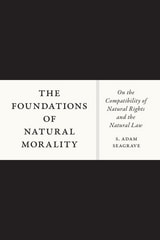
cover of The Foundations of Natural Morality: On the Compatibility of Natural Rights and the Natural Law

The Foundations of Natural Morality

On the Compatibility of Natural Rights and the Natural Law

S. Adam Seagrave

University of Chicago Press, 2014

Recent years have seen a renaissance of interest in the relationship between natural law and natural rights. During this time, the concept of natural rights has served as a conceptual lightning rod, either strengthening or severing the bond between traditional natural law and contemporary human rights. Does the concept of natural rights have the natural law as its foundation or are the two ideas, as Leo Strauss argued, profoundly incompatible?

With The Foundations of Natural Morality, S. Adam Seagrave addresses this controversy, offering an entirely new account of natural morality that compellingly unites the concepts of natural law and natural rights. Seagrave agrees with Strauss that the idea of natural rights is distinctly modern and does not derive from traditional natural law. Despite their historical distinctness, however, he argues that the two ideas are profoundly compatible and that the thought of John Locke and Thomas Aquinas provides the key to reconciling the two sides of this long-standing debate. In doing so, he lays out a coherent concept of natural morality that brings together thinkers from Plato and Aristotle to Hobbes and Locke, revealing the insights contained within these disparate accounts as well as their incompleteness when considered in isolation. Finally, he turns to an examination of contemporary issues, including health care, same-sex marriage, and the death penalty, showing how this new account of morality can open up a more fruitful debate.
[more]
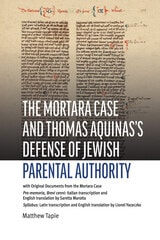
cover of The Mortara Case and St. Thomas Aquinas's Defense of Jewish Parental Authority: with Original Documents from the Mortara Case: <i>Pro-memoria, Syllabus, Brevi cenni</i>

The Mortara Case and St. Thomas Aquinas's Defense of Jewish Parental Authority

with Original Documents from the Mortara Case: <i>Pro-memoria, Syllabus, Brevi cenni</i>

Matthew Tapie

Catholic University of America Press, 2024
The Mortara case refers to Pope Pius IX’s 1858 removal of a six-year-old Jewish boy, Edgardo Mortara, from his parents in Bologna, Italy. Six years after Edgardo was born, it was reported that the family’s Christian housekeeper had baptized the boy after he had fallen ill as an infant and was allegedly in danger of death. Since canon law and civil law stipulated that a baptized child must be raised Catholic, Pius IX used his power as head of the papal states to remove the boy. In advocating for the return of the child, the Mortaras submitted to the Vatican a two-part document, which appealed to the teachings of Thomas Aquinas against baptism of Jewish children invitis parentibus (against the will of the parents). The papal counsel’s reply denied the request, citing Aquinas’s teaching to argue that Edgardo’s baptism was valid, and that he belonged to the Church. Today, some Catholic theologians defend or at least excuse the Pope’s decision with appeal to the works of Aquinas. Which side had the correct interpretation of Aquinas’s teaching? And how does this answer impact Catholic theology and Catholic Jewish-relations today? The Mortara Case and St. Thomas Aquinas's Defense of Jewish Parental Authority adjudicates the claims of both sides of the debate through an analysis of Aquinas’s teaching as it is interpreted in the Italian and Latin original documents from the 1858 case, which are housed in the Vatican Apostolic Archives, and reproduced here, with facing English translations, for the first time. Tapie demonstrates that, for Aquinas, Jewish parental rights are an order of the natural law, which Aquinas likened to a spiritualis uterus (spiritual womb). Through the metaphor of the spiritual womb, Aquinas merged the Roman institution of parental rights with the theological concept of the natural law. Tapie concludes by examining baptism invitis parentibus in the current Code of Canon Law with attention to the Second Vatican Council’s teaching on religious freedom and the Jewish people.
[more]
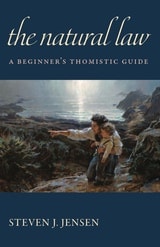
cover of The Natural Law: A Beginner's Thomistic Guide

The Natural Law

A Beginner's Thomistic Guide

Steven J. Jensen

Catholic University of America Press, 2025
Drawing upon the timeless wisdom of Thomas Aquinas, The Natural Law offers clear insights into perplexing ethical dilemmas. The compelling conclusions of Aquinas emerge through a critical examination of contemporary ethical frameworks including moral relativism, utilitarianism, and Machiavellian politics. In part one, which elucidates the core principles of natural law ethics, the reader will discover fundamental truths underpinning the concepts of right and wrong, which are rooted in the very fabric of our humanity. Part two navigates the ethics of harm, grappling with contentious issues such as capital punishment, just war, and self-defense, while at the same time addressing moral quandaries like sacrificing one life in order to save another. This section also resolves thorny practical questions surrounding human actions. How can we tell the difference between an action and its consequences? How do we determine exactly what it means to kill another person? Part three ventures into the intricacies of human societies. The reader will explore the importance of authority and rules in guiding social interactions, from the nurturing bonds of the family to the shifting complexities of political society. The principles examined will shed light upon controversial topics within sexual ethics, such as transgenderism, faithful spousal intimacy, and cloning. The Natural Law invites readers on an engaging journey of critical inquiry. By challenging prevailing assumptions and provoking self-reflection, it will reshape your understanding of ethics and human nature, ultimately revealing your role and purpose within the universe.
[more]
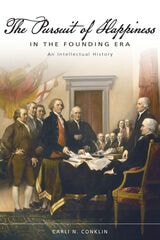
cover of The Pursuit of Happiness in the Founding Era: An Intellectual History

The Pursuit of Happiness in the Founding Era

An Intellectual History

Carli N. Conklin

University of Missouri Press, 2020

Scholars have long debated the meaning of the pursuit of happiness, yet have tended to define it narrowly, focusing on a single intellectual tradition, and on the use of the term within a single text, the Declaration of Independence. In this insightful volume, Carli Conklin considers the pursuit of happiness across a variety of intellectual traditions, and explores its usage in two key legal texts of the Founding Era, the Declaration and William Blackstone’s Commentaries on the Laws of England.

For Blackstone, the pursuit of happiness was a science of jurisprudence, by which his students could know, and then rightly apply, the first principles of the Common Law. For the founders, the pursuit of happiness was the individual right to pursue a life lived in harmony with the law of nature and a public duty to govern in accordance with that law. Both applications suggest we consider anew how the phrase, and its underlying legal philosophies, were understood in the founding era. With this work, Conklin makes important contributions to the fields of early American intellectual and legal history.
[more]
cover of The Social Contract in the Ruins: Natural Law and Government by Consent

The Social Contract in the Ruins

Natural Law and Government by Consent

Paul R. DeHart

University of Missouri Press, 2024

Most scholars who write on social contract and classical natural law perceive an irreconcilable tension between them. Social contract theory is widely considered the political-theoretic concomitant of modern philosophy. Against the regnant view, The Social Contract in the Ruins, argues that all attempts to ground political authority and obligation in agreement alone are logically self-defeating. Political authority and obligation require an antecedent moral ground. But this moral ground cannot be constructed by human agreement or created by sheer will—human or divine. All accounts of morality as constructed or made collapse into self-referential incoherence. Only an uncreated, real good can coherently ground political authority and obligation or the proposition that rightful government depends on the consent of the governed. Government by consent requires classical natural law for its very coherence. 
[more]
cover of The Stoic Idea of the City

The Stoic Idea of the City

Malcolm Schofield

University of Chicago Press, 1999

The Stoic Idea of the City offers the first systematic analysis of the Stoic school, concentrating on Zeno's Republic. Renowned classical scholar Malcolm Schofield brings together scattered and underused textual evidence, examining the Stoic ideals that initiated the natural law tradition of Western political thought. A new foreword by Martha Nussbaum and a new epilogue written by the author further secure this text as the standard work on the Stoics.

"The account emerges from a jigsaw-puzzle of items from a wide range of authorities, painstakingly pieced together and then annotated in a series of appendixes, the whole executed with fine scholarship, clarity, and good humor."—Times Literary Supplement
[more]
cover of Toward "Natural Right and History": Lectures and Essays by Leo Strauss, 1937–1946

Toward "Natural Right and History"

Lectures and Essays by Leo Strauss, 1937–1946

Leo Strauss

University of Chicago Press, 2018

Natural Right and History is widely recognized as Strauss’s most influential work. The six lectures, written while Strauss was at the New School, and a full transcript of the 1949 Walgreen Lectures show Strauss working toward the ideas he would present in fully matured form in his landmark work. In them, he explores natural right and the relationship between modern philosophers and the thought of the ancient Greek philosophers, as well as the relation of political philosophy to contemporary political science and to major political and historical events, especially the Holocaust and World War II.

Previously unpublished in book form, Strauss’s lectures are presented here in a thematic order that mirrors Natural Right and History and with interpretive essays by J. A. Colen, Christopher Lynch, Svetozar Minkov, Daniel Tanguay, Nathan Tarcov, and Michael Zuckert that establish their relation to the work. Rounding out the book are copious annotations and notes to facilitate further study.
 
[more]
cover of Traditions of Natural Law in Medieval Philosophy

Traditions of Natural Law in Medieval Philosophy

Dominic Farrell

Catholic University of America Press, 2022

Reflection on natural law reaches a highpoint during the Middle Ages. Not only do Christian thinkers work out the first systematic accounts of natural law and articulate the framework for subsequent reflection, the Jewish and Islamic traditions also develop their own canonical statements on the moral authority of reason vis-à-vis divine law. In the view of some, they thereby articulate their own theories of natural law.

These various traditions of medieval reflection on natural law, and their interrelation, merit further study, particularly since they touch upon many current philosophical concerns. They grapple with the problem of ethical and religious pluralism. They consider whether universally valid standards of action and social life are accessible to those who rely on reason rather than divine law. In so doing, they develop sophisticated accounts of many central issues in metaethics, action theory, jurisprudence, and the philosophy of religion. However, do they reach a consensus about natural law, or do they end up defending incommensurable ethical frameworks? Do they confirm the value of arguments based on natural law or do they cast doubt on it?

This collection brings together contributions from various expert scholars to explore these issues and the pluralism that exists within medieval reflection on natural law. It is the first one to study the relation between the natural law theories of these various traditions of medieval philosophy: Jewish, Islamic, Byzantine, and Latin.

Each of the first four essays surveys the ‘natural law theory’ of one of the religious traditions of medieval philosophy—Jewish, Islamic, Byzantine, and Latin—and its relation to the others. The next four essays explore some of the alternative accounts of natural law that arise within the Latin tradition. They range over St. Bonaventure, Peter of Tarentaise, Matthew of Aquasparta, John Duns Scotus, and Marsilius of Padua.
[more]
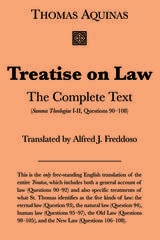
cover of Treatise on Law: The Complete Text

Treatise on Law

The Complete Text

Thomas Aquinas

St. Augustine's Press, 2009

This is a new English translation of St. Thomas Aquinas’s Treatise on Law, found in Questions 90–108 of the First Part of the Second Part of the Summa Theologiae. In fact, it is the only free-standing English translation of the entire Treatise, which includes both a general account of law (Questions 90–92) and also specific treatments of what St. Thomas identifies as the five kinds of law: the eternal law (Question 93), the natural law (Question 94), human law (Questions 95–97), the Old Law (Questions 98–105), and the New Law (Questions 106–108). All other extant editions of Treatise on Law stop with the human law, and are thus approximately one-third the size of the full Treatise.
 St. Thomas’s account of law is firmly embedded within a general moral theory that begins with a rich conception of human flourishing, i.e., the good for human beings (Questions 1–5). This good consists, first and foremost, in our ultimate and intimate union with the Persons of the Blessed Trinity – a union that in our present state we can grasp intellectively and pursue affectively only with God’s supernatural assistance. It is within this framework that we order our loves and pursue the more proximate goals they open up to us as human beings in this life. Given the appropriate goals, the next question is how we can get from where we are, in the grips of the consequences of Original Sin, to where we want to be. The answer is: by means of (a) human actions that are good, i.e., rightly ordered toward our ultimate end and (b) the habits that these actions either engender or flow from. In analyzing human actions (Questions 6–21) and their relation to the passions (Questions 22–48), St. Thomas gives a general account of what he calls the ‘intrinsic principles’ of human actions and their associated habits – both virtues (Questions 49–70) and vices (Questions 71–89). It is only then that he turns to what he calls the ‘extrinsic principles’ of good human actions, viz., law (Questions 90–108) and grace (Questions 109–114).
 According to St. Thomas, law, far from supplanting virtue as a basic principle of action, serves as an independent principle of action that complements virtue and is itself capable of being factored into practical deliberation. The reason is that all of God’s
precepts, prohibitions, and punishments are aimed at promoting the good of the whole universe and, more particularly, the good for human beings, both individually and within the various forms of social life. Because of this, law serves as both a restraint on bad actions and a spur to good action, i.e., a restraint on actions that take us away from virtue and genuine human flourishing and a spur to actions that promote virtue and flourishing.
 There are many benefits of having the whole treatise rather than just the first few questions, as has been the standard practice in previous editions of the Treatise on Law. To mention just a few of these benefits, the question on the moral precepts of the Old Law (question 100) helps to illuminate in many different ways the earlier questions on natural law and human law (questions 94–97). Again, the questions on the ceremonial and judicial precepts of the Old Law (questions 101–105) demon-strate in depth the symbiotic relationship that St. Thomas takes to obtain between the Old Testament and the New Testament. The questions on the New Law provide an introduction to the Christian way of life that will be described in incomparable detail in the Second Part of the Second Part, the bulk of which is structured around the treatment of the three theological virtues and the four cardinal virtues.
[more]
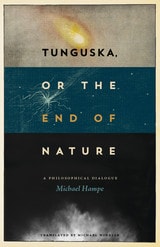
cover of Tunguska, or the End of Nature: A Philosophical Dialogue

Tunguska, or the End of Nature

A Philosophical Dialogue

Michael Hampe

University of Chicago Press, 2015

On June 30, 1908, a mysterious explosion erupted in the skies over a vast woodland area of Siberia. Known as the Tunguska Event, it has been a source of wild conjecture over the past century, attributed to causes ranging from meteors to a small black hole to antimatter. In this imaginative book, Michael Hampe sets four fictional men based on real-life scholars—a physicist (Günter Hasinger and Steven Weinberg), a philosopher (Paul Feyerabend), a biologist (Adolf Portmann), and a mathematician (Alfred North Whitehead)—adrift on the open ocean, in a dense fog, to discuss what they think happened. The result is a playful and highly illuminating exploration of the definition of nature, mankind’s role within it, and what its end might be.
           
Tunguska, Or the End of Nature uses its four-man setup to tackle some of today’s burning issues—such as climate change, environmental destruction, and resource management—from a diverse range of perspectives. With a kind of foreboding, it asks what the world was like, and will be like, without us, whether we are negligible and the universe random, whether nature can truly be explained, whether it is good or evil, or whether nature is simply a thought we think. This is a profoundly unique work, a thrillingly interdisciplinary piece of scholarly literature that probes the mysteries of nature and humans alike. 
[more]
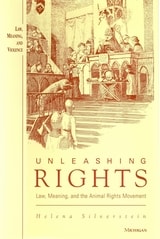
cover of Unleashing Rights: Law, Meaning, and the Animal Rights Movement

Unleashing Rights

Law, Meaning, and the Animal Rights Movement

Helena Silverstein

University of Michigan Press, 1996

Unleashing Rights is a study of the animal rights movement's efforts to advance social reform through the deployment of legal language and practices. The study looks at how prevailing understandings of rights language have shaped the attempt to put forth the idea that animals have rights, and how this attempt, in turn, offers the opportunity to reconstruct the meaning of rights. The book also examines the way litigation has influenced the movement's activities and opportunities for success.
Presented here is an investigation of the legal system through a decentered, cultural approach. Legal languages and practices are viewed as a part of everyday life--constructed, used, and interpreted not only by those who run official legal institutions but also by everyday people with a legal consciousness. Using this approach, the book questions whether the deployment of rights and litigation by animal rights advocates has challenged prevailing legal meaning.
Looking to both the constitutive and instrumental aspects of law, and to how each informs the other, Unleashing Rights finds that the resort to rights and litigation has advanced movement goals and contributed to alternative constructions of legal meaning. The study concludes that despite their many constraints, both rights talk and litigation are powerful resources for those who seek change, especially when used by strategically minded activists.
Unleashing Rights is a book that illustrates the relationship between law, social movement activism, and social change. The book joins the ongoing debate within public law scholarship that is concerned with the effectiveness of legal strategies and languages. The book also speaks to those interested in the general study of social movements and in the particular study of the animal rights movement. With its cultural approach focused on rights language and the construction of meaning, the work will be of interest to the disciplines of law and political science, as well as those who study sociology, anthropology, and philosophy.
Helena Silverstein is F. M. Kirby Assistant Professor of Government and Law, Lafayette College.
[more]
cover of Walk in the Good Way: Classical Natural Law and Civic Friendship

Walk in the Good Way

Classical Natural Law and Civic Friendship

Michael Pakaluk

Catholic University of America Press, 2027
What holds a free society together? Not law alone, and not self-interest — but something older and deeper that the classical tradition called civic friendship: the bonds of genuine goodwill and common purpose that bind citizens to one another and make a republic possible. This book recovers that idea, and argues that without it, neither natural law theory nor political life can be adequately understood. Michael Pakaluk brings together more than two decades of scholarship on Aristotle, Aquinas, and the American Founding to show that the classical conception of natural law is fundamentally different in kind from the modern theories that have displaced it. Where contemporary natural law and liberal political theory — in their best-known versions — begin from abstract principles of practical reason, the classical tradition begins from human nature itself: from our constitution as social beings, equipped by nature and Providence to live together, and oriented toward civic friendship as the proper realization of that nature. The argument moves across three great traditions. In Aristotle, civic friendship is the telos of political life — not an ornament added to justice, but its consummation, the common good understood as a shared form of life. In Aquinas, natural law is the rational creature's participation in divine providence, its precepts providing not a checklist of obligations but starting-points for the cultivation of virtue and the perfection of character. In the American Founders — above all in John Adams, whose Aristotelian convictions Pakaluk examines with care — the ideals of natural sociability were neither decorative nor derivative, but the animating principles of the republican experiment itself. The result is a vision at once ancient and urgently contemporary. At a moment of deepening civic fracture, Walk in the Good Way makes the case that the path to a stable and vigorous free society runs through the recovery of something we have nearly forgotten: that we are, by nature, made for life together — and that nature itself shows us how
[more]
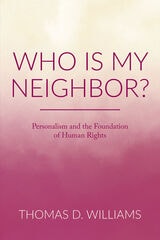
cover of Who is my neighbor?: personalism and the foundations of human rights

Who is my neighbor?

personalism and the foundations of human rights

Thomas D. Williams

Catholic University of America Press, 2005

Who Is My Neighbor? makes an original, compelling case for human rights as moral entitlements grounded in the dignity of the human person.
[more]