Results by title
13 books match the query 'Naturalism'
Articulating the World
Conceptual Understanding and the Scientific ImageJoseph Rouse
University of Chicago Press, 2015
In Articulating the World, Joseph Rouse argues that the most pressing challenge for advocates of naturalism today is precisely this: to understand how to make sense of a scientific conception of nature as itself part of nature, scientifically understood. Drawing upon recent developments in evolutionary biology and the philosophy of science, Rouse defends naturalism in response to this challenge by revising both how we understand our scientific conception of the world and how we situate ourselves within it.
Documents of American Realism and Naturalism
Donald Pizer
Southern Illinois University Press, 1998
Donald Pizer presents the major critical discussions of American realism and naturalism from the beginnings of the movement in the 1870s to the present. He includes the most often cited discussions ranging from William Dean Howells, Henry James, and Frank Norris in the late nineteenth century to those by V. L. Parrington, Malcolm Cowley, and Lionel Trilling in the early twentieth century. To provide the full context for the effort to interpret the nature and significance of realism and naturalism during the periods when the movements were live issues on the critical scene, however, he also includes many uncollected essays. His selections since World War II reflect the major recent tendencies in academic criticism of the movements.
Through introductions to each of the three sections, Pizer provides background, delineating the underlying issues motivating attempts to attack, defend, or describe American realism and naturalism. In particular, Pizer attempts to reveal the close ties between criticism of the two movements and significant cultural concerns of the period in which the criticism appeared. Before each selection, Pizer provides a brief biographical note and establishes the cultural milieu in which the essay was originally published. He closes his anthology with a bibliography of twentieth-century academic criticism of American realism and naturalism.
How Scientific Practices Matter
Reclaiming Philosophical NaturalismJoseph Rouse
University of Chicago Press, 2002
Rouse begins with a detailed critique of modern thought on naturalism, from Neurath and Heidegger to Charles Taylor, Thomas Kuhn, and W. V. O. Quine. He identifies two constraints central to a philosophically robust naturalism: it must impose no arbitrarily philosophical restrictions on science, and it must shun even the most subtle appeals to mysterious or supernatural forces. Thus a naturalistic approach requires philosophers to show that their preferred conception of nature is what scientific inquiry discloses, and that their conception of scientific understanding is itself intelligible as part of the natural world. Finally, Rouse draws on feminist science studies and other recent work on causality and discourse to demonstrate the crucial role that closer attention to scientific practice can play in reclaiming naturalism.
A bold and ambitious book, How Scientific Practices Matter seeks to provide a viable—yet nontraditional—defense of a naturalistic conception of philosophy and science. Its daring proposals will spark much discussion and debate among philosophers, historians, and sociologists of science.
Huxley's Church and Maxwell's Demon
From Theistic Science to Naturalistic ScienceMatthew Stanley
University of Chicago Press, 2014
Matthew Stanley explores the overlap and shift between theistic and naturalistic science through a parallel study of two major scientific figures: James Clerk Maxwell, a devout Christian physicist, and Thomas Henry Huxley, the iconoclast biologist who coined the word agnostic. Both were deeply engaged in the methodological, institutional, and political issues that were crucial to the theistic-naturalistic transformation. What Stanley’s analysis of these figures reveals is that the scientific naturalists executed a number of strategies over a generation to gain control of the institutions of scientific education and to reimagine the history of their discipline. Rather than a sudden revolution, the similarity between theistic and naturalistic science allowed for a relatively smooth transition in practice from the old guard to the new.
Mind, Matter, and Nature
James D. Madden
Catholic University of America Press, 2013
Pragmatic Naturalism
An IntroductionS. Morris Eames
Southern Illinois University Press, 1977
It is said that America came of age intellectually with the appearance of the pragmatic movement in philosophy. Pragmatic Naturalism presents a selective and interpretative overview of this philosophy as developed in the writings of its intellectual founders and chief exponents—Charles Sanders Peirce, William James, George Herbert Mead, and John Dewey. Mr. Eames groups the leading ideas of these pragmatic naturalists around the general fields of “Nature and Human Life,” “Knowledge,” “Value,” and “Education,” treating the primary concerns and special emphasis of each philosopher to these issues.
Philosophy students, teachers of philosophy, and general readers will find this book a comprehensive overview of American philosophy.

Realism and Naturalism in Nineteenth-Century American Literature, Revised Edition
Donald Pizer
Southern Illinois University Press, 1984
The 1966 edition of this book has become a standard work. In this new, revised edition, Pizer has dropped three chapters and has refined and extended the work by adding six: “American Literary Naturalism: An Approach Through Form,” “American Literary Naturalism: The Example of Dreiser,” “The Problem of Philosophy in the Naturalistic Novel,” “Hamlin Garland’s 1891 Main-Travelled Roads: Local Color as Art,” “Jack London: The Problem of Form,” and “Dreiser’s ‘Nigger Jeff’: The Development of an Aesthetic.”
The book contains definitions of realism and naturalism based on representative novels of the period ranging from Howells’ Rise of Silas Lapham to Crane’s Red Badge of Courage; analyses of the literary criticism of the age, stressing that of Howells, Garland, and Norris; and close readings of specific works by major figures of the period.
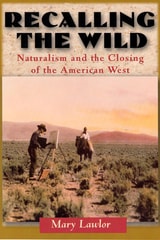
Recalling the Wild
Naturalism and the Closing of the American WestLawlor, Mary
Rutgers University Press, 2000
Ever since the first interactions between Europeans and Native Americans, the “West” has served as a site of complex geographical, social and cultural transformation. American literature is defined, in part, by the central symbols derived from these points of contact. By the end of the nineteenth century, the Western frontier was declared “closed,” a demise solidified by Frederick Jackson Turner’s influential essay “The Significance of the Frontier in American History (1893). At the same time, “naturalism” was popularized by the writings of Frank Norris, Stephen Crane, Jack London, Willa Cather, and the photographs of Edward Curtis. Though very different artists, they were united by their common attraction to the mythic American West.
As she investigates the interactions of representations of the West, Lawlor effortlessly melds literary studies, American studies, and history. She traces the cultural conception of the American West through its incarnations in the “westernism” of Daniel Boone and James Fenimore Cooper and the romanticism of the expansive frontier they helped formulate. Simultaneously, however, the influence of evolutionism and the styles of French naturalism began to challenge this romantic idiom. This naturalistic discourse constructed the West as a strictly material place, picturing a limited and often limiting geography that portrayed regional identity as the product of material “forces” rather than of individualistic enterprise.
With subtle, probing language, Lawlor explains how literary and artistic devices helped shape the idea of the American West and the changing landscape of the continent at the turn of the last century.

Resisting Regionalism
Gender And Naturalism In American Fiction, 1885-1915Donna Campbell
Ohio University Press, 1997
When James Lane Allen defined the “Feminine Principle” and the “Masculine Principle” in American fiction for the Atlantic Monthly in 1897, he in effect described local color fiction and naturalism, two branches of realism often regarded as bearing little relationship to each other. In this award-winning study of both movements, Resisting Regionalism explores the effect the cultural dominance of women’s local color fiction in the 1890’s had on young male naturalist writers, who rebelled against the local colorists and their “teacup tragedies.”
An immensely popular genre, local color fiction reached its peak in the 1880s in such literary journals as Harper’s Monthly, Scribner’s, the Atlantic Monthly, and the Century. These short stories exhibited local “characters,” depicted marginal groups and vanishing folkways, and addressed issues of absence, loss, limitation, and the past. Despite such prickly themes, according to Donna Campbell, local color fiction “fulfilled some specific needs of the public – for nostalgia, for a retreat into mildly exotic locales, for a semblance of order preserved in ritual.”
By the turn of the century, however, local color fiction was fading from the scene, supplanted by writers of adventure fiction and historical romances, with whom local colorists increasingly merged, and opposed by the naturalists. In examining this historic shift, Resisting Regionalism shows that far from being distanced from local color fiction, nationalism emerged in part as a dissenting response to its popularity and to the era’s concerns about the dominance of feminine influence in American literature. The new generation of authors, including Crane, Norris, London, Frederic, Wharton, resisted the cultural myths and narrative strategies common to local colorists Sarah Orne Jewett, Rose Terry Cooke, Mary E. Wilkins Freeman, and Constance Fenimore Woolson. Yet, as Campbell underscores in her analysis of Stephan Crane’s The Monster, the naturalists could, and did, integrate local color conventions with the grotesque and horrifying to powerful effect.
In clear, accessible prose, Resisting Regionalism provides fresh readings of naturalistic works in the context of the dispute between local color and naturalism. In the process, this book shows the debt naturalism owes to local color fiction and illuminates a neglected but significant literary era.
The Philosophy Scare
The Politics of Reason in the Early Cold WarJohn McCumber
University of Chicago Press, 2016
McCumber begins with the story of Max Otto, whose appointment to the UCLA Philosophy Department in 1947 was met with widespread protest charging him as an atheist. Drawing on Otto’s case, McCumber details the hugely successful conservative efforts that, by 1960, had all but banished the existentialist and pragmatist paradigms—not to mention Marxism—from philosophy departments all across the country, replacing them with an approach that valorized scientific objectivity and free markets and which downplayed the anti-theistic implications of modern thought. As he shows, while there have since been many instances of definitive and even explosive rejection of this conservative trend, its effects can still be seen at American universities today.
Thorstein Veblen and the Enrichment of Evolutionary Naturalism
Rick Tilman
University of Missouri Press, 2007
One of America’s most influential social critics, Thorstein Veblen authored works deeply rooted in evolutionary biology and American philosophical naturalism—both of which help explain his institutional economics and radical sociology. Now, one of today’s preeminent Veblen scholars ranges widely over the man’s writings to show how evolutionary naturalism underlies his social theory and criticism, shapes his satire, and binds his work together.
Rick Tilman’s study focuses on the intersections of social theory and social psychology, political economy and political theory, and modern philosophy and intellectual history in Veblen’s thinking. It links evolutionary naturalism for the first time to Veblen’s aesthetics, secular humanism, sociology of control, sociobiology, and sociology of knowledge, and it makes groundbreaking observations regarding the relationship of Veblen’s own life to his thinking; his place as a cultural lag theorist; and his analysis of sports, gambling, and religion.
Drawing on textual exegesis of Veblen’s work, unpublished correspondence, and selected archives, Tilman argues that only evolutionary naturalism could provide the philosophical foundations of Veblen’s thought. He also emphasizes Veblen’s role in the enhancement and embellishment of the social sciences and cultural studies, as well as his insights into the processes of change in the sociopolitical order.
Veblen’s evolutionary naturalism, with its unflattering evaluation of America’s self-selected special place in the international arena, casts doubt on today’s foreign interventions, and it also provides a much-needed antidote to the resurgence of creationist thought in American culture. Tilman shows that Veblen’s ideas are still valuable to contemporary social scientists—indeed, that his method of analysis and values are sorely needed to help us avoid wasteful consumption, predation, and the persistence of religious superstition. This work offers readers a new appreciation of Veblen and the many issues he addressed, and of Tilman’s own masterful facility in bringing them to light.
Unguessed Kinships
Naturalism and the Geography of Hope in Cormac McCarthySteven Frye
University of Alabama Press, 2023
Literary naturalism at play in one of America’s most visionary novelists: Cormac McCarthy
It took six novels and nearly thirty years for Cormac McCarthy to find commercial success with the National Book Award–winning All the Pretty Horses, followed by major prizes, more best sellers, and Hollywood adaptations of his work. Those successes, though, have obscured McCarthy’s commitment to an older form of literary expression: naturalism.
It is hardly a secret that McCarthy’s work tends to darker themes: violence, brutality, the cruel indifference of nature, themes which would not be out of place in the writing of Jack London or Stephen Crane. But literary naturalism is more than the oversimplified Darwinism that many think of. Nature may be red in tooth and claw, and humans are part of nature, but the humanity depicted in naturalist literature is capable of love, selflessness, and spirituality, as well.
In Unguessed Kinships, Steven Frye illuminates all these dimensions of McCarthy’s work. In his novels and plays, McCarthy engages both explicitly and obliquely with the project of manifest destiny, in the western drama Blood Meridian, the Tennessee Valley Authority-era Tennessee novels, and the atomic frontier of Alamogordo in Cities of the Plain. McCarthy’s concerns are deeply religious and philosophical, drawing on ancient Greek philosophy, Gnosticism, and Nietzsche, among other sources. Frye argues for McCarthy not merely as a naturalist writer but as a naturalist in the most expansive sense. Unguessed Kinships includes biographical and historical context in each chapter, widening the appeal of the text to not just naturalists or McCarthy scholars but anyone studying the literature of the South or the West.
Victorian Scientific Naturalism
Community, Identity, ContinuityEdited by Gowan Dawson and Bernard Lightman
University of Chicago Press, 2014