Results by title

3 books match the query 'Naturalization'
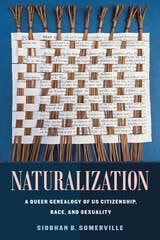
cover of Naturalization: A Queer Genealogy of US Citizenship, Race, and Sexuality

Naturalization

A Queer Genealogy of US Citizenship, Race, and Sexuality

Siobhan B. Somerville

Duke University Press, 2026
Amid contentious debates about citizenship, borders, and belonging, naturalization tends to stand apart, widely celebrated as the culmination of immigrant narratives and American ideals of liberalism. In Naturalization, Siobhan B. Somerville unsettles this story, showing how the process of citizen-making has historically been embedded in normative assumptions about race, indigeneity, and sexuality that have sustained the US settler colonial project. Tracing an alternative genealogy of naturalization from the eighteenth century through the mid-twentieth, Somerville investigates overlooked stories not only of immigrants but also of Indigenous people, formerly enslaved people of African descent, and inhabitants of US territories, many of whom became US citizens through collective naturalization, often without their consent. Somerville’s interdisciplinary approach to a wide-ranging archive—including federal law, photographs, letters, and memoirs—shows how naturalization has long functioned as both a powerful metaphor and a contradictory material practice at the core of the US settler colonial state.
[more]
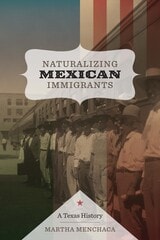
cover of Naturalizing Mexican Immigrants: A Texas History

Naturalizing Mexican Immigrants

A Texas History

By Martha Menchaca

University of Texas Press, 2011

2013 — NACCS Book Award – National Association for Chicana and Chicano Studies

During the nineteenth and early twentieth centuries, a majority of the Mexican immigrant population in the United States resided in Texas, making the state a flashpoint in debates over whether to deny naturalization rights. As Texas federal courts grappled with the issue, policies pertaining to Mexican immigrants came to reflect evolving political ideologies on both sides of the border.

Drawing on unprecedented historical analysis of state archives, U.S. Congressional records, and other sources of overlooked data, Naturalizing Mexican Immigrants provides a rich understanding of the realities and rhetoric that have led to present-day immigration controversies. Martha Menchaca's groundbreaking research examines such facets as U.S.-Mexico relations following the U.S. Civil War and the schisms created by Mexican abolitionists; the anti-immigration stance that marked many suffragist appeals; the effects of the Spanish American War; distinctions made for mestizo, Afromexicano, and Native American populations; the erosion of means for U.S. citizens to legalize their relatives; and the ways in which U.S. corporations have caused the political conditions that stimulated emigration from Mexico.

The first historical study of its kind, Naturalizing Mexican Immigrants delivers a clear-eyed view of provocative issues.
[more]
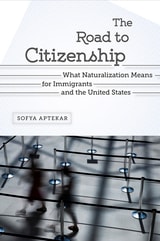
cover of The Road to Citizenship: What Naturalization Means for Immigrants and the United States

The Road to Citizenship

What Naturalization Means for Immigrants and the United States

Aptekar, Sofya

Rutgers University Press, 2015

Between 2000 and 2011, eight million immigrants became American citizens. In naturalization ceremonies large and small these new Americans pledged an oath of allegiance to the United States, gaining the right to vote, serve on juries, and hold political office; access to certain jobs; and the legal rights of full citizens. 

In The Road to Citizenship, Sofya Aptekar analyzes what the process of becoming a citizen means for these newly minted Americans and what it means for the United States as a whole. Examining the evolution of the discursive role of immigrants in American society from potential traitors to morally superior “supercitizens,” Aptekar’s in-depth research uncovers considerable contradictions with the way naturalization works today. Census data reveal that citizenship is distributed in ways that increasingly exacerbate existing class and racial inequalities, at the same time that immigrants’ own understandings of naturalization defy accepted stories we tell about assimilation, citizenship, and becoming American. Aptekar contends that debates about immigration must be broadened beyond the current focus on borders and documentation to include larger questions about the definition of citizenship. 

Aptekar’s work brings into sharp relief key questions about the overall system: does the current naturalization process accurately reflect our priorities as a nation and reflect the values we wish to instill in new residents and citizens? Should barriers to full membership in the American polity be lowered? What are the implications of keeping the process the same or changing it? Using archival research, interviews, analysis of census and survey data, and participant observation of citizenship ceremonies, The Road to Citizenship demonstrates the ways in which naturalization itself reflects the larger operations of social cohesion and democracy in America.
[more]