Results by title
10 books match the query 'Nature (Aesthetics)'
Aesthetics of the Natural Environment
Emily Brady
University of Alabama Press, 2003
Aesthetic experience is one of the fundamental ways that we develop a relationship to our natural surroundings. Emily Brady provides a comprehensive study of this type of experience and the central philosophical issues related to it, developing her own original theory of aesthetic appreciation of nature. She provides useful background to the current debate and an up-to-date critical appraisal of contemporary theories.
The context of the contemporary debate is laid out through a discussion of aesthetic experience and aesthetic qualities; early theories of aesthetic appreciation of nature, including the beautiful, the sublime, and the picturesque; and differences between artistic and environmental appreciation and interpretation. Brady situates her own approach in relation to a set of noncognitive accounts of appreciation. Her "integrated aesthetic" brings together various features of appreciation, including the senses, emotion, and imagination, with a reappraisal of the concept of disinterestedness. These ideas are further developed within the more practical domains of aesthetic judgment and education of the environment and through an examination of the role of aesthetic value in environmental conservation.
Arnold Berleant of Long Island University, a pioneer in this area of research, has declared Brady’s work, “admirably comprehensive coverage of the subject.” Julie C. Van Camp of California State University, Long Beach, has said, “The bibliography is priceless. . . . The discussions of such philosophers as Kant and Dewey seem plausible and understandable to an audience of students and the educated public.” This book will be valuable to readers interested in such wide-ranging subjects as philosophy, aesthetics, ethics, ecology, conservation, environmental policy-making, geography, and landscape architecture.
Animal, Vegetable, Digital
Experiments in New Media Aesthetics and Environmental PoeticsElizabeth Swanstrom
University of Alabama Press, 2016
An audacious, interdisciplinary study that combines the burgeoning fields of digital aesthetics and eco-criticism
In Animal, Vegetable, Digital, Elizabeth Swanstrom makes a confident and spirited argument for the use of digital art in support of ameliorating human engagement with the environment and suggests a four-part framework for analyzing and discussing such applications.
Through close readings of a panoply of texts, artworks, and cultural artifacts, Swanstrom demonstrates that the division popular culture has for decades observed between nature and technology is artificial. Not only is digital technology not necessarily a brick in the road to a dystopian future of environmental disaster, but digital art forms can be a revivifying bridge that returns people to a more immediate relationship to nature as well as their own embodied selves.
To analyze and understand the intersection of digital art and nature, Animal, Vegetable, Digital explores four aesthetic techniques: coding, collapsing, corresponding, and conserving. “Coding” denotes the way artists use operational computer code to blur distinctions between the reader and text, and, hence, the world. Inviting a fluid conception of the boundary between human and technology, “collapsing” voids simplistic assumptions about the human body’s innate perimeter. The process of translation between natural and human-readable signs that enables communication is described as “corresponding.” “Conserving” is the application of digital art by artists to democratize large- and small-scale preservation efforts.
A fascinating synthesis of literary criticism, communications and journalism, science and technology, and rhetoric that draws on such disparate phenomena as simulated environments, video games, and popular culture, Animal, Vegetable, Digital posits that partnerships between digital aesthetics and environmental criticism are possible that reconnect humankind to nature and reaffirm its kinship with other living and nonliving things.
Ecological Aesthetics
artful tactics for humans, nature, and politicsNathaniel Stern
Dartmouth College Press, 2018
Finding Thoreau
The Meaning of Nature in the Making of an Environmental IconRichard W. Judd
University of Massachusetts Press, 2018
In his 1862 eulogy for Henry David Thoreau, Ralph Waldo Emerson reflected that his friend “dedicated his genius with such entire love to the fields, hills, and waters of his native town, that he made them known and interesting to all reading Americans, and to people over the sea.” Finding Thoreau traces the reception of Thoreau's work from the time of his death to his ascendancy as an environmental icon in the 1970s, revealing insights into American culture's conception of the environment.
Moving decade by decade through this period, Richard W. Judd unveils a cache of commentary from intellectuals, critics, and journalists to demonstrate the dynamism in the idea of nature, as Americans defined and redefined the organic world around them amidst shifting intellectual, creative, and political forces. This book tells the captivating story of one writer's rise from obscurity to fame through a cultural reappraisal of the work he left behind.
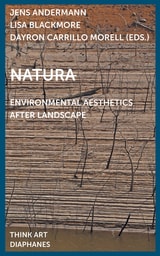
Natura
Environmental Aesthetics After LandscapeEdited by Jens Andermann, Lisa Blackmore, and Dayron Carrillo Morell
Diaphanes, 2018
Natura takes up this challenge, exploring how recent activist practices and eco-artistic turns in Latin America can help us to reconfigure the categories of nature and the human. Moving from botanical explorations of early modernity, through the legacies of mid-twentieth-century landscape design, up to present struggles for the rights of nature and speculative post-human creations, the critical essays and visual contributions in this anthology use interdisciplinary encounters to reimagine the landscape and how we inhabit it.
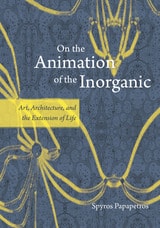
On the Animation of the Inorganic
Art, Architecture, and the Extension of LifeSpyros Papapetros
University of Chicago Press, 2012
Throughout human history, people have imagined inanimate objects to have intelligence, language, and even souls. In our secular societies today, we still willingly believe that nonliving objects have lives of their own as we find ourselves interacting with computers and other equipment. In On the Animation of the Inorganic, Spyros Papapetros examines ideas about simulated movement and inorganic life during and after the turn of the twentieth century—a period of great technical innovation whose effects continue to reverberate today.
Exploring key works of art historians such as Aby Warburg, Wilhelm Worringer, and Alois Riegl, as well as architects and artists like Fernand Léger, Mies van der Rohe, and Salvador Dalí, Papapetros tracks the evolution of the problem of animation from the fin de siècle through the twentieth century. He argues that empathy—the ability to identify with objects of the external world—was repressed by twentieth-century modernist culture, but it returned, projected onto inorganic objects such as machines, automobiles, and crystalline skyscrapers. These modern artifacts, he demonstrates, vibrated with energy, life, and desire of their own and had profound effects on people. Subtle and insightful, this book will change how we view modernist art, architecture, and their histories.
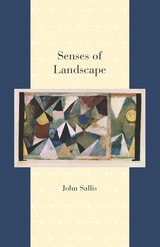
Senses of Landscape
John Sallis
Northwestern University Press, 2015
Beginning with the assertion that earth is the elemental place that grants an abode to humans and to other living things, in Senses of Landscape the philosopher John Sallis turns to landscapes, and in particular to their representation in painting, to present a powerful synthetic work.
Senses of Landscape proffers three kinds of analyses, which, though distinct, continually intersect in the course of the book. The first consists of extended analyses of distinctive landscapes from four exemplary painters, Paul Cezanne, Caspar David Friedrich, Paul Klee, and Guo Xi. Sallis then turns to these artists’ own writings—treatises, essays, and letters—about art in general and landscape painting in particular, and he sets them into a philosophical context. The third kind of analysis draws both on Sallis’s theoretical writings and on the canonical texts in the philosophy of art (Kant, Schelling, Hegel, and Heidegger). These analyses present for a wide audience a profound sense of landscape and of the earthly abode of the human.
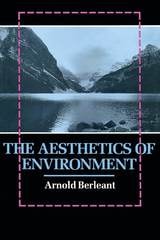
The Aesthetics of Environment
Arnold Berleant
Temple University Press, 1995
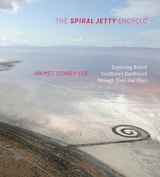
The Spiral Jetty Encyclo
Exploring Robert Smithson's Earthwork through Time and PlaceHikmet Sidney Loe
University of Utah Press, 2017
Copublished with the Tanner Trust Fund, J. Willard Marriott Library.
Robert Smithson’s earthwork, Spiral Jetty (1970), an icon of the Land Art movement of the 1960s and 1970s, is located on the northern shores of Utah’s Great Salt Lake. Smithson built a masterpiece from local materials, one that spirals counterclockwise into the lake and appears or is submerged with fluctuations in the lake’s locally red, saline water.
The Spiral Jetty Encyclo draws on Smithson’s writings for encyclopedic entries that bring to light the context of the earthwork and Smithson’s many points of reference in creating it. Visitors and armchair travelers, too, will discover how much significance Smithson placed on regional considerations, his immersion in natural history, his passion for travel, and his ability to use diverse mediums to create a cohesive and lasting work of art. Containing some 220 images, most of them in color, with some historical black and whites, The Spiral Jetty Encyclo lets readers explore the construction, connections, and significance of Smithson’s 1,500-foot-long curl into Great Salt Lake, created, in Smithson’s words, of “mud, salt crystals, rocks, water.”
Winner of 15 Bytes Book Award for Art Book.
Finalist for the Utah State Historical Society Best Book Award.
Where the Sky Touched the Earth
The Cosmological Landscapes of the SouthwestDon Lago
University of Nevada Press, 2017
Nowhere else in the world is the link between earth and sky so powerful. Lago witnesses a solar eclipse over the Grand Canyon, climbs primeval volcanos, and sees the universe in tree rings. Through ageless Native American ceremonies, modern telescopes, and even dreams of flying saucers, Lago, who is not only a poet but a true philosopher of science, strives to find order and meaning in the world and brings out the Southwest’s beauty and mystery.