Results by title
14 books match the query 'Nature study'
A Field Guide to the Familiar
Learning to Observe the Natural WorldGale Lawrence
Brandeis University Press, 1998
A Guide to Green New Jersey
Nature Walks in the Garden StateRosenfeld, Lucy D
Rutgers University Press, 2003
New Jersey is a state of surprises. Did you know there was a castle in Passaic County? Or that Essex County’s Branch Brook Park, rather than Washington, D.C., has the largest concentration of flowering cherry trees outside of Japan? Did you know you could walk through a bamboo forest on the Rutgers University campus, dig for fossils in Middletown’s Poricy Brook, visit an owl haven on the site of the Battle of Monmouth, or see wild river otters in Salem County?
Despite its proximity to major urban areas and its high population density, the state has dozens of absolutely marvelous natural areas and preserved spaces. It boasts something for everyone, from Atlantic seashore to rugged mountains, rolling farmland to winding canals, historic trails to formal gardens, bird-filled marshes to hardwood forests, pine barrens to fragrant vineyards and orchards. There are outings for hikers, bikers, beachcombers, gardeners, power-walkers, and strollers of all kinds, and A Guide to Green NewJersey is your key to finding it all.
The book is conveniently organized into forty geographic areas, spotlighting more than 200 nature walks. Each entry includes a description, visitor hours, fees, driving accessibility, and other pertinent information for walkers. At the end of the book, the authors provide an index with the names of each site, and their guide to choosing an outing according to individual tastes and interests. They identify sites that are wheelchair accessible, especially fun for kids, best for bicyclists, and those that are particularly physically challenging.
Newcomers to the state will find the book indispensable, and long-time New Jerseyans will find it a pleasantly eye-opening guide to wonderful walks right in their own backyards.
Creating Outdoor Classrooms
Schoolyard Habitats and Gardens for the SouthwestBy Lauri Macmillan Johnson, with Kim Duffek
University of Texas Press, 2008
Schoolyards have come a long way from the barren playgrounds that many people remember. Today's school campuses often feature gardens in which students can learn about native plants and wildlife, grow vegetables and fruit, explore cultural traditions, practice reading and math skills, and use their imaginations to create fun play spaces. And for a growing number of urban students, these schoolyard gardens offer the best, if not the only, opportunity to experience the natural world firsthand and enjoy its many benefits.
This book is a practical, hands-on guide for creating a variety of learning environments in the arid Southwest. Filled with clear, easy-to-use information and illustrated with photographs, drawings, and plans, the book covers everything necessary to create schoolyard gardens:
- An introduction to schoolyards as outdoor classrooms and several types of habitats, including art gardens, cultural history gardens, ecological gardens, literacy gardens, and vegetable gardens
- Design theory, including a history of garden styles, and design principles and design elements
- Beginning the design process, including identifying participants and writing a design program that sets out goals and requirements
- Conducting site research and synthesizing design elements to arrive at a final design
- Design essentials, including project funding and design features, maintenance, accessibility, safety, and project evaluation and revision
- Wildlife ecology, including elements needed for survival such as food and shelter
- Creating gardens for pollinators and other wildlife, including hummingbirds, butterflies, bees, moths, bats, and flies, as well as pest control
- Lists of native plants for various kinds of habitats and nurseries that sell native plants, as well as books, web sites, and other resources for learning more about native plants and wildlife
This guide will be essential for landscape architects, school personnel, parents, and students. Indeed, its principles can be used in designing schoolyard habitats across the country, while its information on gardening with native plants and wildlife will be useful to homeowners across the Southwest.
Ellie's Log
Exploring the Forest Where the Great Tree FellJudith L. Li
Oregon State University Press, 2013
After a huge tree crashes to the ground during a winter storm, ten-year-old Ellie and her new friend, Ricky, explore the forest where Ellie lives. Together, they learn how trees provide habitat for plants and animals high in the forest canopy, down among mossy old logs, and deep in the pools of a stream. The plants, insects, birds, and mammals they discover come to life in colored pen-and-ink drawings.
An engaging blend of science and storytelling, Ellie’s Log also features:
• Pages from Ellie’s own field notebook, which provide a model for recording observations in nature
• Ellie’s advice to readers for keeping a field notebook
• Ellie’s book recommendations Online resources for readers and teachers—including a Teacher’s Guide—are available at ellieslog.org.
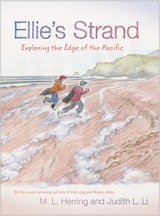
Ellie's Strand
Exploring the Edge of the PacificM. L. Herring
Oregon State University Press, 2018
Green Earth Book Award, Honor Book
There are days in late winter when the Pacific coast enjoys a brief spell of clear, warm weather. Most of the winter storms have passed and the summer fog has not yet settled in. This is when some coastal communities plan their annual beach clean-ups.
In this sequel to Ellie’s Log and Ricky’s Atlas, Ellie and Ricky travel to the Oregon coast from their home in the Cascade Mountains to help with a one-day beach clean-up. Hoping to find a prized Japanese glass float, they instead find more important natural treasures, and evidence of an ocean that needs its own global-scale clean-up.
Ellie and Ricky are amazed by their discoveries at the edge of the world’s largest ocean. Together, they realize the power of volunteering and grapple with the challenges of ocean conservation. In her journal Ellie records her observations of their adventures in her own words and pictures.
With charming pen-and-ink drawings and a compelling story, Ellie's Strand makes coastal science exciting for upper elementary school students. It will be a treasured companion for young beach explorers everywhere.
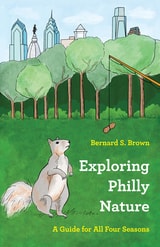
Exploring Philly Nature
A Guide for All Four SeasonsBernard S. Brown
Temple University Press, 2022
Do snakes and salamanders fascinate you or make you squeamish? Have you ever listened closely to the birds chirping in your neighborhood? Can you identify the flowers growing in Philadelphia’s urban parks? (Moreover, are the mushrooms safe to eat?) Exploring Philly Nature is amateur naturalist, urban herper,* and Grid contributor Bernard Brown’s handy guide to experiencing the flora and fauna in Philly.
This compact illustrated volume contains 52 activities from birding, (squirrel) fishing, and basement bug-hunting to joining a frog call survey and visiting a mussel hatchery. Brown encourages kids (as well as their parents) to connect with the natural world close to home. Each entry contains information on where and when to participate, what you will need (even if it is only patience), and tips on clubs and organizations to contact for access.
The city and its environs contain a multitude of species from the lichen that grows on gravestones or trees to nocturnal animals like opossums, bats, and raccoons. Exploring Philly Nature is designed to get readers eager to discover, observe, and learn more about the concrete jungle that is Philadelphia.

Father Nature
Fathers as Guides to the Natural WorldPaul S. & Stan Piper & Tag
University of Iowa Press, 2003
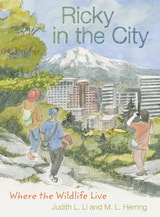
Ricky in the City
Where the Wildlife LiveJudith L. Li
Oregon State University Press, 2019
The kids find insects and reptiles moving about garden patches and bioswales, song birds and squirrels in neighborhood tree canopies, falcons and eagles crossing spacious river floodplains. As they record and map how wildlife and people are connected in these city spaces, they become community scientists, contributing to actual regional databases. After they see the young trees Marcus planted in his neighborhood, the feeders Jenny tends for hummingbirds, and the fascinating wildlife underpasses built in the wetlands, Ricky and Ellie realize there are many ways people actively care for the city’s wildlife.
In this fourth and final story of their award-winning children’s series, M. L. Herring’s vivid pen and watercolor illustrations complement the engaging storytelling of Judith Li. Readers will delight in the journal pages and maps “hand drawn” by Ricky and Ellie at the end of each chapter, while the “Dear Reader” section offers further tips for budding citizen scientists.
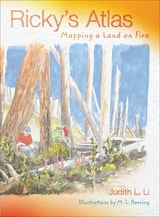
Ricky's Atlas
Mapping a Land on FireLi
Oregon State University Press, 2016
In this sequel to Ellie’s Log: Exploring the Forest Where the Great Tree Fell, Ricky Zamora brings his love of map-making and his boundless curiosity to the arid landscapes east of the Cascades Mountains. He arrives during a wild thunderstorm, and watches his family and their neighbors scramble to deal with a wildfire sparked by lightning. Joined by his friend Ellie, he sees how plants, animals, and people adjust to life with wildfires.
While hiking across a natural prairie, climbing up a fire tower, and studying historical photos and maps, Ricky and Ellie learn about the role of fire in shaping the landscape of the semi-arid plateau east of the mountains. They experience the scary days of wildfire in progress, explore a gritty site after a wildfire, and discover how some plants and animals depend on fire to survive.
Color pen-and-ink drawings accompany the text and vividly illustrate plants, animals, and events encountered in this exciting summer adventure. With his friend Ellie, Ricky creates a brightly colored diary of the fire, with maps, timelines, and sketches of what they see in this fire-prone land. Ricky’s notebook about his summer visit to his uncle’s ranch becomes an atlas of fire ecology, weather patterns, and life in the rain shadow.
Upper elementary kids will enjoy the mixture of amazing adventures with actual historical, physical, and ecological data about the region. Woven into the story are the small pleasures of ranch life, intriguing histories of Native Americans and early settlers, and almost unbelievable views of ancient fossils. Ricky and Ellie’s explorations, accompanied by their hand-written notes, introduce readers to a very special landscape and history east of the mountains.
Salleyland
Wildlife Adventures in Swamps, Sandhills, and ForestsWhit Gibbons
University of Alabama Press, 2023
WINNER OF THE SOUTH CAROLINA OUTDOOR PRESS ASSOCIATION'S EXCELLENCE IN CRAFT FOR THE BEST OUTDOOR BOOK AWARD
Adventures and misadventures exploring nature on a patch of “worthless” abandoned farmland
Following his retirement from academic life, renowned naturalist and writer Whit Gibbons and his family purchased a tract of abandoned farmland where the South Carolina piedmont meets the coastal plain. Described as backcountry scrubland, it was originally envisioned as a family retreat, but soon the property became Gibbons’s outdoor learning laboratory where he was often aided by his four grandchildren, along with a host of enthusiastic visitors.
Inspired by nature’s power to excite, educate, and provide a sense of place in the world, Gibbons invites readers to learn about their surrounding environments by describing his latest adventures and sharing expert advice for exploring the world in which we live. Peppered throughout with colorful personal anecdotes and told with Gibbons’s affable style and wit, Salleyland: Wildlife Adventures in Swamps, Sandhills, and Forests is more than a personal memoir or a record of place. Rather, it is an exercise in learning about a patch of nature, thereby reminding us to open our eyes to the complexity and wonder of the natural world.
Starting with the simple advice of following your own curiosity, Gibbons discusses different opportunities and methods for exploring one’s surroundings, introduces key ecological concepts, offers advice for cultivating habitat, explains the value of and different approaches to keeping lists and field journals, and celebrates the advances that cell phone photography and wildlife cameras offer naturalists of all levels. With Gibbons’s guidance and encouragement, readers will learn to embrace their inner scientists, equipped with the knowledge and encouragement to venture beyond their own front doors, ready to discover the secrets of their habitat, regardless of where they live.
Teaching Children Science
Hands-On Nature Study in North America, 1890-1930Sally Gregory Kohlstedt
University of Chicago Press, 2010
In the early twentieth century, a curriculum known as nature study flourished in major city school systems, streetcar suburbs, small towns, and even rural one-room schools. This object-based approach to learning about the natural world marked the first systematic attempt to introduce science into elementary education, and it came at a time when institutions such as zoos, botanical gardens, natural history museums, and national parks were promoting the idea that direct knowledge of nature would benefit an increasingly urban and industrial nation.
The definitive history of this once pervasive nature study movement, TeachingChildren Science emphasizes the scientific, pedagogical, and social incentives that encouraged primarily women teachers to explore nature in and beyond their classrooms. Sally Gregory Kohlstedt brings to vivid life the instructors and reformers who advanced nature study through on-campus schools, summer programs, textbooks, and public speaking. Within a generation, this highly successful hands-on approach migrated beyond public schools into summer camps, afterschool activities, and the scouting movement. Although the rich diversity of nature study classes eventually lost ground to increasingly standardized curricula, Kohlstedt locates its legacy in the living plants and animals in classrooms and environmental field trips that remain central parts of science education today.
The Iowa Lakeside Laboratory
A Century of Discovering the Nature of NatureMichael J. Lannoo
University of Iowa Press, 2012
Today’s huge array of environmental problems can best be solved by people who have learned about nature within nature at a place with a long history of research and observation, people who thoroughly understand and appreciate nature’s cogs and wheels. Lakeside Lab and biological research stations like it have never been more relevant to science and to society at large than they are today. Michael Lannoo convinces us that while Lakeside’s past is commendable, its future, grounded in ecological principles, will help shape a more sustainable society.
The Knowledge of Nature and the Nature of Knowledge in Early Modern Japan
Federico Marcon
University of Chicago Press, 2015
The first book-length English-language study devoted to the important field of honzogaku, The Knowledge of Nature and the Nature of Knowledge in Early Modern Japan will be an essential text for historians of Japanese and East Asian science, and a fascinating read for anyone interested in the development of science in the early modern era.
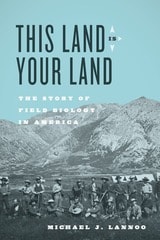
This Land Is Your Land
The Story of Field Biology in AmericaMichael J. Lannoo
University of Chicago Press, 2018
Lannoo illuminates characters such as John Wesley Powell, William Temple Hornaday, and Olaus and Adolph Murie—homegrown midwestern field biologists who either headed east to populate major research centers or went west to conduct their fieldwork along the frontier. From the pioneering work of Victor Shelford, Henry Chandler Cowles, and Aldo Leopold to contemporary insights from biologists such as Jim Furnish and historians such as William Cronon, Lannoo’s unearthing of American—and particularly midwestern—field biologists reveals how these scientists influenced American ecology, conservation biology, and restoration ecology, and in turn drove global conservation efforts through environmental legislation and land set-asides. This Land Is Your Land reveals the little-known legacy of midwestern field biologists, whose ethos and discoveries have enabled us to preserve and understand not just their land, but all lands.