Results by title
4 books match the query 'Nature writers'

Apostate Englishman
Grey Owl the Writer and the MythsAlbert Braz
University of Manitoba Press, 2015
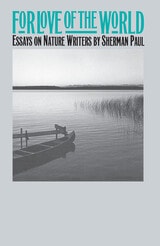
For Love of the World
Essays on Nature WritersSherman Paul
University of Iowa Press, 1992

Her Place in the Woods
The Life of Helen HooverDavid Hakensen
University of Minnesota Press, 2025
The biography of one of Minnesota’s most beloved nature writers, from her career in the city to her rustic cabin on Gunflint Lake
During the late 1950s through the early 1970s, Helen Hoover’s stories and essays of life in the wilderness on northern Minnesota’s Gunflint Lake, published in popular magazines and several bestselling books (including The Gift of the Deer in 1966 and A Place in the Woods in 1969), found millions of fans and earned her accolades alongside nature writers like Sigurd Olson, Rachel Carson, Sally Carrighar, and Calvin Rutstrum. Hoover’s own unlikely history of leaving a corporate career in Chicago for a small cabin without electricity or running water—with no interest in hunting or fishing—is just one chapter of the remarkable life that David Hakensen describes in Her Place in the Woods. This first complete biography illuminates how Helen Hoover (1910–1984) made a place for herself and for countless readers in, as she put it, the world of her time.
Hoover defied convention. Self-trained and without an academic degree, she worked in the male-dominated metallurgical field as a researcher at International Harvester, where she solved a long-standing problem with the manufacture of discs for farm implements and earned a patent. She and her husband, Adrian, a commercial artist, had long dreamed of moving to a remote cabin in the woods. As they started the long return drive to Chicago after a summer spent on Gunflint Lake, they finally made the leap, quitting their jobs with a long-distance phone call from Grand Marais and figuring out the rest as they went.
The Hoovers were woefully unprepared for life off the grid and slowly learned how to convert sheds into chicken coops and fend off bears. Social encounters presented their own challenges, with Helen’s fiery personality leading to clashes with hunters and other Gunflint neighbors. Gradually, the Hoovers settled into the rhythms of their remote homestead, and Helen would craft a prolific literary livelihood from her keen observations of nature and encounters with animals in the surrounding woods.
Her Place in the Woods captures both an awakening to the power and fragility of the natural world and the efforts and talents of an extraordinary woman defining herself as a writer. Though Helen Hoover would move on from the secluded North Woods, as she wrote in her final book, The Years of the Forest, “From this time on it would be both here and with me wherever I might be, as long as I should live.”
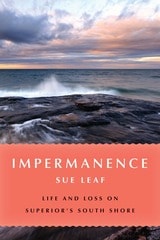
Impermanence
Life and Loss on Superior's South Shoreleaf
University of Minnesota Press, 2024
A personal journey through the ever-changing natural and cultural history of Lake Superior’s South Shore
Lake Superior’s South Shore is as malleable as it is enduring, its red sandstone cliffs, clay bluffs, and golden sand beaches reshaped by winds and water from season to season—and sometimes from one hour to the next. Generations of people have inhabited the South Shore, harvesting the forests and fish, mining copper, altering the land for pleasure and profit, for better or worse. In Impermanence, author Sue Leaf explores the natural and human histories that make the South Shore what it is, from the gritty port city of Superior, Wisconsin, to the shipping locks at Sault Ste. Marie, Michigan.
For Leaf, what began as a bicycling adventure on the coast of Lake Superior in 1977 turned into a lifelong connection with the area, and her experience, not least as owner of a rustic cabin on a rapidly eroding lakeside cliff, imbues these essays with a passionate sense of place and an abiding curiosity about its past and precarious future. As waves slowly consume the shoreline where her family has spent countless summers, Leaf is forced to confront the complexity of loving a place that all too quickly is being reclaimed by the great lake.
Impermanence is a journey through the South Shore’s story, from the early days of the Anishinaabe and fur traders through the heyday of commercial fishing, lumber camps, and copper mining on the Keweenaw Peninsula to the awakening of the Northland to the perils and consequences of plundering its natural splendor. Noting the geological, ecological, and cultural features of each stop on her tour along the South Shore, Leaf writes about the restoration of the heavily touristed Apostle Islands National Lakeshore to its pristine conditions, even as Lake Superior maintains its allure for ice fishers, kayakers, and long-distance swimmers. She describes efforts to protect the endangered piping plover and to preserve the diverse sand dunes on the Michigan coast, and she observes the slough that supports rare intact wild rice beds central to Anishinaabe culture.
Part memoir, part travelogue, part natural and cultural history, Leaf’s love letter to Lake Superior’s South Shore is an invitation to see this liminal world in all its seasons and guises, to appreciate its ageless, ever-changing wonders and intimate charms.