Results by title
7 books match the query 'Need'

All the News I Need
a novelJoan Frank
University of Massachusetts Press, 2017
Because of course she feels what he feels. . . . People their age natter along not copping to it but the awareness is billboarded all over their faces—a wavering, a hesitation, even those who used to crow and jab the air. The tablecloth of certainty, with all its sparkly settings, has been yanked, and not artfully. It's why people drink.
All The News I Need probes the modern American response to inevitable, ancient riddles—of love and sex and mortality.
Frances Ferguson is a lonely, sharp-tongued widow who lives in the wine country. Oliver Gaffney is a painfully shy gay man who guards a secret and lives out equally lonely days in San Francisco. Friends by default, Fran and Ollie nurse the deep anomie of loss and the creeping, animal betrayal of aging. Each loves routine but is anxious that life might be passing by. To crack open this stalemate, Fran insists the two travel together to Paris. The aftermath of their funny, bittersweet journey suggests those small changes, within our reach, that may help us save ourselves—somewhere toward the end.
In Plenty and in Time of Need
Popular Culture and the Remapping of Barbadian IdentityLia T. Bascomb
Rutgers University Press, 2020

Places in Need
The Changing Geography of PovertyScott W. Allard
Russell Sage Foundation, 2017
Using census data, administrative data from safety net programs, and interviews with nonprofit leaders in the Chicago, Los Angeles, and Washington, D.C. metropolitan areas, Allard shows that poor suburban households resemble their urban counterparts in terms of labor force participation, family structure, and educational attainment. In the last few decades, suburbs have seen increases in single-parent households, decreases in the number of college graduates, and higher unemployment rates. As a result, suburban demand for safety net assistance has increased. Concerning is evidence suburban social service providers—which serve clients spread out over large geographical areas, and often lack the political and philanthropic support that urban nonprofit organizations can command—do not have sufficient resources to meet the demand.
To strengthen local safety nets, Allard argues for expanding funding and eligibility to federal programs such as SNAP and the Earned Income Tax Credit, which have proven effective in urban and suburban communities alike. He also proposes to increase the capabilities of community-based service providers through a mix of new funding and capacity-building efforts.
Places in Need demonstrates why researchers, policymakers, and nonprofit leaders should focus more on the shared fate of poor urban and suburban communities. This account of suburban vulnerability amidst persistent urban poverty provides a valuable foundation for developing more effective antipoverty strategies.
Standing in the Need
Culture, Comfort, and Coming Home After KatrinaBy Katherine E. Browne
University of Texas Press, 2015
Standing in the Need presents an intimate account of an African American family’s ordeal after Hurricane Katrina. Before the storm struck, this family of one hundred fifty members lived in the bayou communities of St. Bernard Parish just outside New Orleans. Rooted there like the wild red iris of the coastal wetlands, the family had gathered for generations to cook and share homemade seafood meals, savor conversation, and refresh their interconnected lives.
In this lively narrative, Katherine Browne weaves together voices and experiences from eight years of post-Katrina research. Her story documents the heartbreaking struggles to remake life after everyone in the family faced ruin. Cast against a recovery landscape managed by outsiders, the efforts of family members to help themselves could get no traction; outsiders undermined any sense of their control over the process. In the end, the insights of the story offer hope. Written for a broad audience and supported by an array of photographs and graphics, Standing in the Need offers readers an inside view of life at its most vulnerable.
The Need to Help
The Domestic Arts of International HumanitarianismLiisa H. Malkki
Duke University Press, 2015
The Voices of Need
From Petition to Patient in Early Massachusetts, 1730–1820Angela M. Keysor
University of Massachusetts Press, 2027
Revealing how people in need advocated for and negotiated their own care until the development of standardized medicine
The Voices of Need uncovers how men and women in Charlestown, Massachusetts, who turned to municipal authorities for aid, actively shaped how their need was understood and addressed. Through a close examination of Charlestown’s care networks, Angela Keysor shows how town selectmen relied on sufferers themselves to articulate what would relieve their distress, while local women—paid by town authorities—provided hands-on care in homes and neighborhoods. These networks flourished in the early and mid-eighteenth century, but their flexibility and responsiveness were increasingly strained by crisis and change. A devastating smallpox epidemic in 1763, followed by racialized debates over belonging after the legal end of enslavement in Massachusetts in 1783, exposed the limits of community-based care.
After the American Revolution, rising numbers of aid requests prompted town officials to reorganize care through a contract system in which paid caregivers attended to multiple dependents at once. As care became centralized and standardized, the space for individuals to define their own needs—and to influence how those needs were met—steadily narrowed. By 1819, with the founding of Massachusetts General Hospital, sufferers were fully redefined as patients, expected to submit to professional authority rather than participate in decisions about their own care.
Tracing this transition from negotiated assistance to institutional medicine, The Voices of Need illuminates a largely forgotten history of agency among the poor and infirm. In doing so, Keysor challenges conventional narratives of early American health care and shows how the rise of standardized medicine fundamentally reshaped the meaning of need, care, and authority.
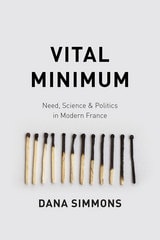
Vital Minimum
Need, Science, and Politics in Modern FranceDana Simmons
University of Chicago Press, 2015
The result was the concept of the "vital minimum"--the living wage, a measure of physical and social needs. In this book, Dana Simmons traces the history of this concept, revealing the intersections between technologies of measurement, such as calorimeters and social surveys, and technologies of wages and welfare, such as minimum wages, poor aid, and welfare programs. In looking at how we define and measure need, Vital Minimum raises profound questions about the authority of nature and the nature of inequality.