Results by title

4 books match the query 'Negritude (Literary movement)'
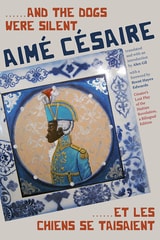
cover of ......And the Dogs Were Silent/......Et les chiens se taisaient

......And the Dogs Were Silent/......Et les chiens se taisaient

Aimé Césaire. Translated and with an introduction by Alex Gil. With a foreword by Brent Hayes Edwards.

Duke University Press, 2024
Available to readers for the first time, Aimé Césaire’s three-act drama . . . . . . And the Dogs Were Silent—written during the Vichy regime in Martinique in 1943 and lost until 2008—dramatizes the Haitian Revolution and the rise and fall of Toussaint Louverture as its heroic leader. This bilingual English and French edition stands apart from Césaire’s more widely known 1946 closet drama. Following the slave revolts that sparked the revolution, Louverture arrives as both prophet and poet, general and visionary. With striking dramatic technique, Césaire retells the revolution in poignant encounters between rebels and colonial forces, guided by a prophetic chorus and Louverture’s steady ethical and political vision. In the last act, we reach the hero’s betrayal, his imprisonment, and his last stand against the lures of compromise. Césaire’s masterwork is a strikingly beautiful and brutal indictment of colonial cruelty and an unabashed celebration of Black rebellion and victory.
[more]
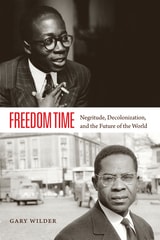
cover of Freedom Time: Negritude, Decolonization, and the Future of the World

Freedom Time

Negritude, Decolonization, and the Future of the World

Gary Wilder

Duke University Press, 2015
Freedom Time reconsiders decolonization from the perspectives of Aimé Césaire (Martinique) and Léopold Sédar Senghor (Senegal) who, beginning in 1945, promoted self-determination without state sovereignty. As politicians, public intellectuals, and poets they struggled to transform imperial France into a democratic federation, with former colonies as autonomous members of a transcontinental polity. In so doing, they revitalized past but unrealized political projects and anticipated impossible futures by acting as if they had already arrived. Refusing to reduce colonial emancipation to national independence, they regarded decolonization as an opportunity to remake the world, reconcile peoples, and realize humanity’s potential. Emphasizing the link between politics and aesthetics, Gary Wilder reads Césaire and Senghor as pragmatic utopians, situated humanists, and concrete cosmopolitans whose postwar insights can illuminate current debates about self-management, postnational politics, and planetary solidarity. Freedom Time invites scholars to decolonize intellectual history and globalize critical theory, to analyze the temporal dimensions of political life, and to question the territorialist assumptions of contemporary historiography.
[more]
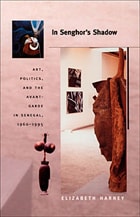
cover of In Senghor's Shadow: Art, Politics, and the Avant-Garde in Senegal, 1960–1995

In Senghor's Shadow

Art, Politics, and the Avant-Garde in Senegal, 1960–1995

Elizabeth Harney

Duke University Press, 2004

In Senghor’s Shadow is a unique study of modern art in postindependence Senegal. Elizabeth Harney examines the art that flourished during the administration of Léopold Sédar Senghor, Senegal’s first president, and in the decades since he stepped down in 1980. As a major philosopher and poet of Negritude, Senghor envisioned an active and revolutionary role for modern artists, and he created a well-funded system for nurturing their work. In questioning the canon of art produced under his aegis—known as the Ecole de Dakar—Harney reconsiders Senghor’s Negritude philosophy, his desire to express Senegal’s postcolonial national identity through art, and the system of art schools and exhibits he developed. She expands scholarship on global modernisms by highlighting the distinctive cultural history that shaped Senegalese modernism and the complex and often contradictory choices made by its early artists.

Heavily illustrated with nearly one hundred images, including some in color, In Senghor’s Shadow surveys the work of a range of Senegalese artists, including painters, muralists, sculptors, and performance-based groups—from those who worked at the height of Senghor’s patronage system to those who graduated from art school in the early 1990s. Harney reveals how, in the 1970s, avant-gardists contested Negritude beliefs by breaking out of established artistic forms. During the 1980s and 1990s, artists such as Moustapha Dimé, Germaine Anta Gaye, and Kan-Si engaged with avant-garde methods and local artistic forms to challenge both Senghor’s legacy and the broader art world’s understandings of cultural syncretism. Ultimately, Harney’s work illuminates the production and reception of modern Senegalese art within the global arena.
[more]
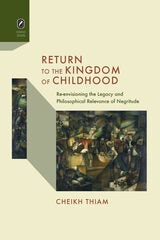
cover of Return to the Kingdom of Childhood: Re-envisioning the Legacy and Philosophical Relevance of Negritude

Return to the Kingdom of Childhood

Re-envisioning the Legacy and Philosophical Relevance of Negritude

Cheikh Thiam

The Ohio State University Press, 2014

Return to the Kingdom of Childhood: Re-envisioning the Legacy and Philosophical Relevance of Negritude examines the philosophy of Negritude through an innovative analysis of Léopold Sédar Senghor’s oeuvre. In the first book-length study of Senghorian philosophy, Cheikh Thiam argues that Senghor’s work expresses an Afri-centered conception of the human while simultaneously offering a critique of the Western universalization of “man.” Senghor’s corrective, descriptive, and prescriptive theory of humanness is developed through a conception of race as a cultural manifestation of being.
 
Thiam contends that Senghor’s conception of race entails an innovative Afri-centered epistemology and ontology. For Senghor, races are the effects of particular groups’ relations to the world. The so-called “Negroes,” for example, are determined by their epistemology based on their fluid understanding of the ontological manifestations of being. The examination of this ontology and its ensuing epistemology, which is constitutive of the foundation of Senghor’s entire oeuvre, indicates that Negritude is a postcolonial philosophy that stands on its own.
 
The hermeneutics of Senghor’s race theory show that the Senegalese thinker’s pioneering postcolonial philosophy remains relevant in the postcolonial era. In fact, it questions and expands the works of major contemporary African-descended scholars such as Paul Gilroy, Edouard Glissant, and Molefi Asante. Thiam’s approach is thoroughly interdisciplinary, combining perspectives from philosophy, literary analysis, anthropology, and postcolonial, African, and cultural studies.
[more]