Results by title
5 books match the query 'Nelson, Margaret K.'
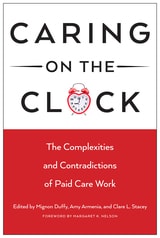
Caring on the Clock
The Complexities and Contradictions of Paid Care WorkDuffy, Mignon
Rutgers University Press, 2015
A nurse inserts an I.V. A personal care attendant helps a quadriplegic bathe and get dressed. A nanny reads a bedtime story to soothe a child to sleep. Every day, workers like these provide critical support to some of the most vulnerable members of our society. Caring on the Clock provides a wealth of insight into these workers, who take care of our most fundamental needs, often at risk to their own economic and physical well-being.
Caring on the Clock is the first book to bring together cutting-edge research on a wide range of paid care occupations, and to place the various fields within a comprehensive and comparative framework across occupational boundaries. The book includes twenty-two original essays by leading researchers across a range of disciplines—including sociology, psychology, social work, and public health. They examine the history of the paid care sector in America, reveal why paid-care work can be both personally fulfilling but also make workers vulnerable to burnout, emotional fatigue, physical injuries, and wage exploitation. Finally, the editors outline many innovative ideas for reform, including top-down and grassroots efforts to improve recognition, remuneration, and mobility for care workers.
As America faces a series of challenges to providing care for its citizens, including the many aging baby boomers, this volume offers a wealth of information and insight for policymakers, scholars, advocates, and the general public.
[more]
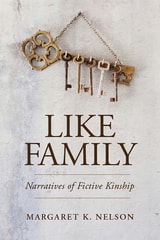
Like Family
Narratives of Fictive KinshipMargaret K. Nelson
Rutgers University Press, 2020
For decades, social scientists have assumed that “fictive kinship” is a phenomenon associated only with marginal peoples and people of color in the United States. In this innovative book, Nelson reveals the frequency, texture and dynamics of relationships which are felt to be “like family” among the white middle-class. Drawing on extensive, in-depth interviews, Nelson describes the quandaries and contradictions, delight and anxiety, benefits and costs, choice and obligation in these relationships. She shows the ways these fictive kinships are similar to one another as well as the ways they vary—whether around age or generation, co-residence, or the possibility of becoming “real” families. Moreover she shows that different parties to the same relationship understand them in some similar – and some very different – ways. Theoretically rich and beautifully written, the book is accessible to the general public while breaking new ground for scholars in the field of family studies.
[more]
Open to Disruption
Time and Craft in the Practice of Slow SociologyAnita Ilta Garey
Vanderbilt University Press, 2014
At a time when an emphasis on productivity in higher education threatens to undermine well-crafted research, these highly reflexive essays capture the sometimes profound intellectual effects that may accompany disrupted scholarship. They reveal that over long periods of time relationships with people studied invariably change, sometimes in dramatic ways. They illustrate how world events such as 9/11 and economic cycles impact individual biographies.
Some researchers describe how disruptions prompted them to expand the boundaries of their discipline and invent concepts that could more accurately describe phenomena that previously had no name and no scholarly history. Sometimes scholars themselves caused the disruption as they circled back to work they had considered "done" and allowed the possibility of rethinking earlier findings.
[more]
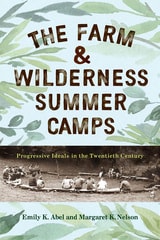
The Farm & Wilderness Summer Camps
Progressive Ideals in the Twentieth CenturyEmily K. Abel
Rutgers University Press, 2024
Although summer camps profoundly impact children, they have received little attention from scholars. The well-known Farm & Wilderness (F&W) camps, founded in 1939 by Ken and Susan Webb, resembled most other private camps of the same period in many ways, but F&W also had some distinctive features. Campers and staff took pride in the special ruggedness of the surrounding environment, and delighted in the exceptional rigor of the camping trips and the work projects. Importantly, the Farm & Wilderness camps were some of the first private camps to become racially integrated.The Farm & Wilderness Summer Camps: Progressive Ideals in the Twentieth Century traces these camps, both unique and emblematic of American youth culture of the twentieth century, from their establishment in the late 1930s to the end of the twentieth century. Emily K. Abel and Margaret K. Nelson explore how ideals considered progressive in the 1940s and 1950s had to be reconfigured by the camps to respond to shifts in culture and society as well as to new understandings of race and ethnicity, social class, gender, and sexual identity. To illustrate this change, the authors draw on over forty interviews with former campers, archival materials, and their own memories. This book tells a story of progressive ideals, crises of leadership, childhood challenges, and social adaptation in the quintessential American summer camp.
[more]
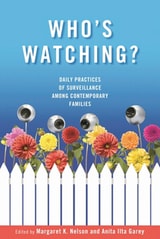
Who's Watching?
Daily Practices of Surveillance among Contemporary FamiliesMargaret K. Nelson
Vanderbilt University Press, 2009
Although family members sometime engage in monitoring as an extension of governmental surveillance, they also monitor each other, other families, and their own borders to preserve norms about what a family should be and what family members should do. Whether it is the seemingly benign surveillance of using baby monitors, the more obviously intrusive use of home drug tests on teenagers, or the way people in public feel free to judge and comment on the family composition of others, monitoring goes on all the time -- and even (or maybe especially) when there seems to be no monitoring going on at all.
[more]