Results by title
6 books match the query 'Neoliberal Era'
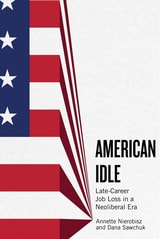
American Idle
Late-Career Job Loss in a Neoliberal EraAnnette Nierobisz
Rutgers University Press, 2025
In American Idle, sociologists Annette Nierobisz and Dana Sawchuk report their findings from interviews with sixty-two mostly white-collar workers who experienced late-career job loss in the wake of the Great Recession. Without the benefits of planned retirement or time horizons favorable to recouping their losses, these employees experience an array of outcomes, from hard falls to soft landings. Notably, the authors find that when reflecting on the effects of job loss, fruitless job searches, and the overall experience of unemployment, participants regularly called on the frameworks instilled by neoliberalism. Invoking neoliberal rhetoric, these older Americans deferred to businesses’ need to prioritize bottom lines, accepted the shift toward precarious employment, or highlighted the importance of taking initiative and maintaining a positive mindset in the face of structural obstacles. Even so, participants also recognized the incompatibility between neoliberalism’s “one-size-fits-all” solutions and their own situations; this disconnect led them to consider their experiences through competing frameworks and to voice resistance to aspects of neoliberal capitalism. Employing a life course sociology perspective to explore older workers’ precarity in an age of rising economic insecurity, Nierobisz and Sawchuk shed light on a new wrinkle in American aging.
[more]
Composing Capital
Classical Music in the Neoliberal EraMarianna Ritchey
University of Chicago Press, 2019
The familiar old world of classical music, with its wealthy donors and ornate concert halls, is changing. The patronage of a wealthy few is being replaced by that of corporations, leading to new unions of classical music and contemporary capitalism. In Composing Capital, Marianna Ritchey lays bare the appropriation of classical music by the current neoliberal regime, arguing that artists, critics, and institutions have aligned themselves—and, by extension, classical music itself—with free-market ideology. More specifically, she demonstrates how classical music has lent its cachet to marketing schemes, tech firm-sponsored performances, and global corporate partnerships. As Ritchey shows, the neoliberalization of classical music has put music at the service of contemporary capitalism, blurring the line between creativity and entrepreneurship, and challenging us to imagine how a noncommodified musical practice might be possible in today’s world.
[more]
Composing Capital
Classical Music in the Neoliberal EraMarianna Ritchey
University of Chicago Press, 2019
This is an auto-narrated audiobook edition of this book.
The familiar old world of classical music, with its wealthy donors and ornate concert halls, is changing. The patronage of a wealthy few is being replaced by that of corporations, leading to new unions of classical music and contemporary capitalism. In Composing Capital, Marianna Ritchey lays bare the appropriation of classical music by the current neoliberal regime, arguing that artists, critics, and institutions have aligned themselves—and, by extension, classical music itself—with free-market ideology. More specifically, she demonstrates how classical music has lent its cachet to marketing schemes, tech firm-sponsored performances, and global corporate partnerships. As Ritchey shows, the neoliberalization of classical music has put music at the service of contemporary capitalism, blurring the line between creativity and entrepreneurship, and challenging us to imagine how a noncommodified musical practice might be possible in today’s world.
[more]
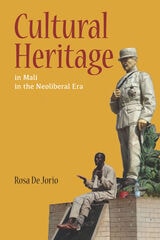
Cultural Heritage in Mali in the Neoliberal Era
Rosa De Jorio
University of Illinois Press, 2016
Up to 2012, Mali was a poster child of African democracy, despite multiple signs of growing dissatisfaction with the democratic experiment. Then disaster struck, bringing many of the nation's unresolved contradictions to international attention. A military coup carved off the country's south. A revolt by a coalition of Tuareg and extremist Islamist forces shook the north. The events, so violent and unexpected, forced experts to reassess Mali's democratic institutions and the neoliberal economic reforms enacted in conjunction with the move toward democracy. Rosa De Jorio's detailed study of cultural heritage and its transformations provides a key to understanding the impasse that confronts Malian democracy. As she shows, postcolonial Mali privileged its cultural heritage to display itself on the regional and international scene. The neoliberal reforms both intensified and altered this trend. Profiling heritage sites ranging from statues of colonial leaders to women's museums to historic Timbuktu, De Jorio portrays how various actors have deployed and contested notions of heritage. These actors include not just Malian administrators and politicians but UNESCO, and non-state NGOs. She also delves into the intricacies of heritage politics from the perspective of Malian actors and groups, as producers and receivers--but always highly informed and critically engaged--of international, national and local cultural initiatives.
[more]
Mexico's Middle Class in the Neoliberal Era
Dennis Gilbert
University of Arizona Press, 2007
Mexico’s modern middle class emerged in the decades after World War II, a period of spectacular economic growth and social change. Though little studied, the middle class now accounts for one in five Mexican households. This path-breaking book explores the changing fortunes and political transformation of the middle class, especially during the last two decades, as Mexico has adopted new, market-oriented economic policies and has abandoned one-party rule.
Blending the personal narratives of middle-class Mexicans with analyses of national surveys of households and voters, Dennis Gilbert traces the development of the middle class since the 1940s. He describes how middle-class Mexicans were affected by the economic upheavals of the 1980s and 1990s and examines their shifting relations with the ruling Partido Revolucionario Institucional (PRI).
Long faithful to the PRI, the middle class gradually grew disenchanted. Gilbert examines middle-class reactions to the 1968 Tlatelolco massacre, the 1982 debt crisis, the government’s feeble response to the 1985 Mexico City earthquake, and its brazen manipulation of the vote count in the 1988 presidential election. Drawing on detailed interviews with Mexican families, he describes the effects of the 1994–95 peso crisis on middle-class households and their economic and political responses to it. His analysis of exit poll data from the 2000 elections shows that the lopsided middle-class vote in favor of opposition candidate Vicente Fox played a critical role in the election that drove the PRI from power after seven decades.
The book closes with an epilogue on the middle class and the July 2006 presidential elections.
[more]
The Profit Doctrine
Economists of the Neoliberal EraRobert Chernomas and Ian Hudson
Pluto Press, 2016
The profession of economics has a lot to answer for. Since the late 1970s, the ideas of influential economists have justified policies that have made the world more prone to economic crisis, remarkably less equal, more polluted, and less secure than it might be. How did ideas and policies that have proved to be such an abject failure come to dominate the economic landscape?
By critically examining the work of the most famous economists of the neoliberal period including Alan Greenspan, Milton Friedman, and Robert Lucas, Robert Chernomas and Ian Hudson demonstrate that many of those who rose to prominence did so primarily because of their defense of, and contribution to, rising corporate profits, rather thantheir ability to predict or explain economic events.
An important and controversial book, The Profit Doctrine exposes the uses and abuses of mainstream economic canons, identifies those responsible, and reaffirms the primacy of political economy.
[more]