Results by title

3 books match the query 'Neoliberalism and literature'
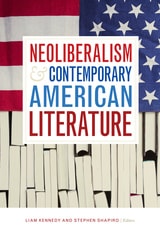
cover of Neoliberalism and Contemporary American Literature

Neoliberalism and Contemporary American Literature

Edited by Liam Kennedy and Stephen Shapiro

Dartmouth College Press, 2019
Neoliberalism is the rare buzzword that has fully crossed over from academic theorizing into mainstream discussion. Neoliberalism and Contemporary American Literature is the first book to examine the ways that US literature has responded to the dominance of our neoliberal regime. The essays collected here reveal how contemporary American writers have both propped up and interrogated the foundations of neoliberalism. The contributors look at a host of literary genres and styles, from the utopian sci-fi of Kim Stanley Robinson and the dark fantasy of Karen Russell to the poetic memoir-fiction hybrids of Ben Lerner, exploring how the relationships between politics, economics, and literary form have become both distorted and revitalized in the age of neoliberalism. Most pressingly, they ask if contemporary literature can still imagine either the end of capitalism or any realistic alternative to it.
 
[more]
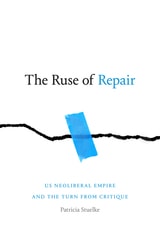
cover of The Ruse of Repair: US Neoliberal Empire and the Turn from Critique

The Ruse of Repair

US Neoliberal Empire and the Turn from Critique

Patricia Stuelke

Duke University Press, 2021

Since the 1990s, literary and queer studies scholars have eschewed Marxist and Foucauldian critique and hailed the reparative mode of criticism as a more humane and humble way of approaching literature and culture. The reparative turn has traveled far beyond the academy, influencing how people imagine justice, solidarity, and social change. In The Ruse of Repair, Patricia Stuelke locates the reparative turn's hidden history in the failed struggle against US empire and neoliberal capitalism in the 1970s and 1980s. She shows how feminist, antiracist, and anti-imperialist liberation movements' visions of connection across difference, practices of self care, and other reparative modes of artistic and cultural production have unintentionally reinforced forms of neoliberal governance. At the same time, the US government and military, universities, and other institutions have appropriated and depoliticized these same techniques to sidestep addressing structural racism and imperialism in more substantive ways. In tracing the reparative turn's complicated and fraught genealogy, Stuelke questions reparative criticism's efficacy in ways that will prompt critics to reevaluate their own reading practices.
[more]
cover of Visible Borders, Invisible Economies: Living Death in Latinx Narratives

Visible Borders, Invisible Economies

Living Death in Latinx Narratives

Kristy L. Ulibarri

University of Texas Press, 2022

2023 Outstanding Book Award, National Association for Ethnic Studies

A thorough examination of the political and economic exploitation of Latinx subjects, migrants, and workers through the lens of Latinx literature, photography, and film.


Globalization in the United States can seem paradoxical: free trade coincides with fortification of the southern border, while immigration is reimagined as a national-security threat. US politics turn aggressively against Latinx migrants and subjects even as post-NAFTA markets become thoroughly reliant on migrant and racialized workers. But in fact, there is no incongruity here. Rather, anti-immigrant politics reflect a strategy whereby capital uses specialized forms of violence to create a reserve army of the living, laboring dead.

Visible Borders, Invisible Economies turns to Latinx literature, photography, and films that render this unseen scheme shockingly vivid. Works such as Valeria Luiselli’s Tell Me How It Ends and Alex Rivera’s Sleep Dealer crystallize the experience of Latinx subjects and migrants subjugated to social death, their political existence erased by disenfranchisement and racist violence while their bodies still toil in behalf of corporate profits. In Kristy L. Ulibarri’s telling, art clarifies what power obscures: the national-security state performs anti-immigrant and xenophobic politics that substitute cathartic nationalism for protections from the free market while ensuring maximal corporate profits through the manufacture of disposable migrant labor.

[more]