Results by title
16 books match the query 'Nepal'
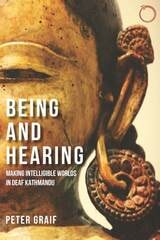
Being and Hearing
Making Intelligible Worlds in Deaf KathmanduPeter Graif
HAU, 2018
From pranks and protests, to diverse acts of love and resistance, to renewed distinctions between material and immaterial, deaf communities in Nepal have crafted ways to foreground the habits of perception that shape both their own experiences and how they are experienced by the hearing people around them. By exploring these often overlooked strategies, Being and Hearing makes a unique contribution to ethnography and comparative philosophy.
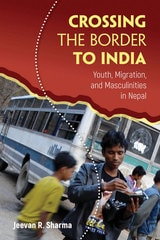
Crossing the Border to India
Youth, Migration, and Masculinities in NepalJeevan R. Sharma
Temple University Press, 2018
Given the limited economic opportunities in rural Nepal, the desire of young men of all income and education levels, castes and ethnicities to migrate has never been higher. Crossing the Border to India provides an ethnography of male labor migration from the western hills of Nepal to Indian cities. Jeevan Sharma shows how a migrant’s livelihood and gender, as well as structural violence impacts his perceptions, experiences, and aspirations.
Based on long-term fieldwork, Sharma captures the actual experiences of crossing the border. He shows that Nepali migration to India does not just allow young men from poorer backgrounds to “save there and eat here,” but also offers a strategy to escape the more regimented social order of the village. Additionally, migrants may benefit from the opportunities offered by the “open-border” between India and Nepal to attain independence and experience a distant world. However, Nepali migrants are subjected to high levels of ill treatment. Thus, while the idea of freedom remains extremely important in Nepali men’s migration decisions, their actual experience is often met with unfreedom and suffering.
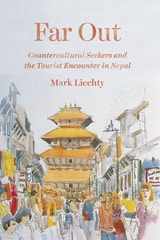
Far Out
Countercultural Seekers and the Tourist Encounter in NepalMark Liechty
University of Chicago Press, 2017
Emerging from centuries of political isolation but eager to engage the world, Nepalis struggled to make sense of the hordes of exotic, enthusiastic foreigners. They quickly embraced the phenomenon, however, and harnessed it to their own ends by building tourists’ fantasies into their national image and crafting Nepal as a premier tourist destination. Liechty describes three distinct phases: the postwar era, when the country provided a Raj-like throwback experience for rich Americans; Nepal’s emergence as an exotic outpost of hippie counterculture in the 1960s; and its rebranding into a hip adventure destination, which began in the 1970s and continues today. He shows how Western projections of Nepal as an isolated place inspired creative enterprises and, paradoxically, allowed locals to participate in the global economy. Based on twenty-five years of research, Far Out blends ethnographic analysis, a lifelong passion for Nepal, and a touch of humor to produce the first comprehensive history of what tourists looked for—and found—on the road to Kathmandu.
Himalayan Dialogue
Tibetan Lamas & Gurung Shamans In NepalStan Royal Mumford
University of Wisconsin Press, 1989
Here for the first time is a thorough anthropological study of Tibetan lamaism combining textual analysis with richly contextualized ethnographic data. The rites studied are of the Nyingma Tibetan Buddhist tradition. In contrast to the textual analyses that have viewed the culture as a finished entity, here we see an unbounded ritual process with unfinished interpretations.
Mumford’s focus is on the “dialogue” taking place between the lamaist and the shamanic regimes, as a historic development occurring between different cultural layers. The study powerfully demonstrates that interrelationships between subsystems within a given cultural matrix over time are critical to an understanding of religion as a cultural process.
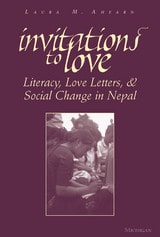
Invitations to Love
Literacy, Love Letters, and Social Change in NepalLaura M. Ahearn
University of Michigan Press, 2001
The love-letter correspondences examined by Ahearn also provide a deeper understanding of the social effects of literacy. While the acquisition of literary skills may open up new opportunities for some individuals, such skills can also impose new constraints, expectations, and disappointments. The increase in female literacy rates in Junigau in the 1990s made possible the emergence of new courtship practices and facilitated self-initiated marriages, but it also reinforced certain gender ideologies and undercut some avenues to social power, especially for women.
Scholars, and students in such fields as anthropology, women's studies, linguistics, development studies, and South Asian studies will find this book ethnographically rich and theoretically insightful.

Karnali Under Stress
Livelihood Strategies and Seasonal Rhythms in a Changing Nepal HimalayaBarry C. Bishop
University of Chicago Press, 1990
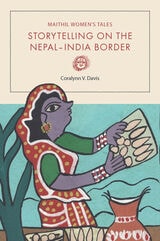
Maithil Women's Tales
Storytelling on the Nepal-India BorderCoralynn V. Davis
University of Illinois Press, 2014
In Maithil Women’s Tales, Coralynn V. Davis examines how these storytellers weave together their own life experiences--the hardships and the pleasures--with age-old themes. In so doing, Davis demonstrates, they harness folk traditions to grapple personally as well as collectively with social values, behavioral mores, relationships, and cosmological questions.
Each chapter includes stories and excerpts that reveal Maithil women’s gift for rich language, layered plots, and stunning allegory. In addition, Davis provides ethnographic and personal information that reveal the complexity of women’s own lives, and includes works painted by Maithil storytellers to illustrate their tales. The result is a fascinating study of being and becoming that will resonate for readers in women’s and Hindu studies, folklore, and anthropology.

On the Edge of the Auspicious
GENDER AND CASTE IN NEPALMary M. Cameron
University of Illinois Press, 1998
been noticeably absent from ethnographic accounts of the Himalayan region.
Starting from the perspective of lower-caste Hindu women, Mary M. Cameron
offers a long-overdue study of artisans and farmers in western Nepal.
On the Edge of the Auspicious skillfully shows the connections
between caste hierarchy and gender relations leading to domestic, economic,
and religious power of lower-caste women. Situating her study in the history
of land ownership and contemporary family and work relations, Cameron
explains how and why patriarchal ideology associated with high-caste families
in Nepal does not apply to women of lower caste. Drawing on data from
work, family, and religious domains, this ethnography goes further than
other current studies of caste hierarchy in South Asia to show the everyday
material and ideological dimensions of domination and lower-caste people's
resistance to them..
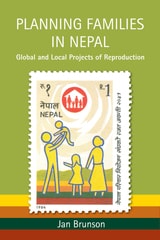
Planning Families in Nepal
Global and Local Projects of ReproductionBrunson, Jan
Rutgers University Press, 2016
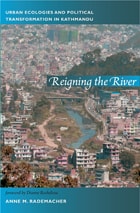
Reigning the River
Urban Ecologies and Political Transformation in KathmanduAnne M. Rademacher
Duke University Press, 2011
Rademacher conducted research during a volatile period in Nepal’s political history. As clashes between Maoist revolutionaries and the government intensified, the riverscape became a site of competing claims to a capital city that increasingly functioned as a last refuge from war-related violence. In this time of intense flux, efforts to ensure, create, or imagine ecological stability intersected with aspirations for political stability. Throughout her analysis, Rademacher emphasizes ecology as an important site of dislocation, entitlement, and cultural meaning.
Rulings Of The Night
An Ethnography Of Nepalese Shaman Oral TextsGregory G. Maskarinec
University of Wisconsin Press, 1995
It is impossible to discuss what shamans are and what they do, contends Gregory G. Maskarinec, without knowing what shamans say. When Maskarinec took an interest in shaman rituals on his first visit to Nepal, he was told by many Nepalis and Westerners that the shamans he had encountered in the Himalayan foothills of western Nepal engaged in "meaningless mumblings." But in the course of several years of fieldwork he learned from the shamans that both their long, publicly chanted rituals and their whispered, secretive incantations are oral texts meticulously memorized through years of training. In The Rulings of the Night, he shows how the shamans, during their dramatic night-long performances, create the worlds of words in which shamans exist.
Maskarinec analyzes several complete repertoires of the texts that the shamans use to diagnose and treat afflictions that trouble their clients. Through these texts, they intervene to manipulate and change the world, replacing its unbalanced, inexpressible chaos with orderly, balanced, grammatical, and eloquently expressible states. They negotiate the relations between language, action, and social realities, providing a well-constructed and thoroughly consistent intentional universe—and only in that universe can all shaman actions and beliefs be fully comprehended.
Signing and Belonging in Nepal
Erika Hoffmann-Dilloway
Gallaudet University Press, 2016
In this book, Erika Hoffmann-Dilloway presents an accessible examination of deafness in Nepal. As a linguistic anthropologist, she describes the emergence of Nepali Sign Language and deaf sociality in the social and historical context of Nepal during the last decades before the Hindu Kingdom became a secular republic. She then shows how the adoption of an ethno-linguistic model interacted with the ritual pollution model, or the prior notion that deafness results from bad karma. Her focus is on the impact of these competing and co-existing understandings of deafness on three groups: signers who adopted deafness as an ethnic identity, homesigners whose ability to adopt that identity is hindered by their difficulties in acquiring Nepali Sign Language, and hearing Nepalis who interact with Deaf signers. Comparing these contexts demonstrates that both the ethno-linguistic model and the ritual pollution model, its seeming foil, draw on the same basic premise: that both persons and larger social formations are mutually constituted through interaction. Signing and Belonging in Nepal is an ethnography that studies a rich and unique Deaf culture while also contributing to larger discussions about social reproduction and social change.

Subject to Death
Life and Loss in a Buddhist WorldRobert Desjarlais
University of Chicago Press, 2016

The Gap Years
Climbing, Skiing, and the Journey BackTom French
Brandeis University Press, 2026
At the end of 2019, Tom French retired from a four-decade career in business, determined to return to interests that had defined his youth and see what meaning they still held. One of these interests was mountaineering. Another was adventure travel, with a particular focus on Nepal. A third was cross-country ski racing. Having taken “gap years” between school and university, and again before he started work, he decided to take a gap year before settling into the expectations of retirement. One year turned into three as he rebuilt his athletic strength, competed in cross-country ski marathons, and climbed some of the world’s highest mountains, including two expeditions to Mount Everest. On the first Everest climb, a cyclone forced him to turn around high on the mountain and descend the treacherous Lhotse Face in a blizzard. On the second, he approached the mountain through the remote Makalu Barun region, the first climber ever to do so, and climbed to the summit on a moonlit night.
But this is a book about much more than Everest. It is about beauty and joy found in wild places, about cross-country ski racing and mountaineering more broadly, and—most of all—about a journey to find meaning in life and reconnect with the passions of youth.
The Work of Disaster
Crisis and Care Along a Himalayan Fault LineAidan Seale-Feldman
University of Chicago Press, 2025
In a world marked by escalating disasters, the forms that care takes are increasingly fraught. In this powerful book, anthropologist Aidan Seale-Feldman focuses on Nepal, where in 2015 a 7.8-magnitude earthquake and equally powerful aftershock struck the country’s central region. The disaster claimed more than nine thousand lives and inspired a surge of humanitarian concern for the mental health of Nepali people. Based on extensive ethnographic fieldwork, The Work of Disaster examines the possibilities generated by disaster, as well as the vexed relationship between crisis and care.
Moving between NGO offices, mountain trails, therapeutic interventions, and affected villages, Seale-Feldman tells the story of an emergent “mental health crisis” and the forms of care that followed in the disaster’s wake. She also analyzes the changes emergency services bring about in the places they seek to assist, the challenges of psychiatric support provided by international organizations, and the place of mental health counseling in a modern biopolitical reality. The Work of Disaster reveals the simultaneous violence and gentleness of humanitarian encounters, engaging along the way with broader debates about world making and the ethics of care.

Tiger Moon
Tracking the Great Cats in NepalFiona Sunquist and Mel Sunquist
University of Chicago Press, 2003