Results by title
6 books match the query 'Network'
A Network of Converso Families in Early Modern Toledo
Assimilating a MinorityLinda Martz
University of Michigan Press, 2003
Linda M. Martz focuses on families that were immersed in the worlds of business and finance. They formed the backbone of the trade industry and, during the economic expansion of the sixteenth century, enjoyed a high degree of affluence. The seventeenth century, however, brought harder times. How these families rose to positions of commercial eminence and then adapted to this economic downturn is one of the questions addressed in this insightful book.
A Network of Converso Families in Early Modern Toledo relies heavily on archival evidence--notarial, parish, and city records--that offers new insights into the families' histories. Business endeavors, marriage alliances, involvement in local politics, and the pursuit of improved social status are all subjected to Martz's keen analysis.
These families appear to have been well integrated into their contemporary society; aside from their business and financial activities, many were members of the city's governing council. But how well did they integrate with the lower classes? Assimilating minorities in the majority culture is a task that confronts most modern societies, so the experience of Spain and this particular minority may serve as an example of how earlier societies viewed and confronted this challenge.
This book will appeal to historians of medieval and Renaissance Spain and those interested in the Inquisition's effect on Renaissance Spain. It will also prove to be indispensable for those interested in the history of the Jewish race, as well as for those pursuing the question of marginalization.
Linda M. Martz is an independent historian as well as a freelance editor and writer.
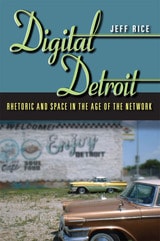
Digital Detroit
Rhetoric and Space in the Age of the NetworkJeff Rice
Southern Illinois University Press, 2012
Since the 1967 riots that ripped apart the city, Detroit has traditionally been viewed either as a place in ruins or a metropolis on the verge of rejuvenation. In Digital Detroit: Rhetoric and Space in the Age of the Network, author Jeff Rice goes beyond the notion of Detroit as simply a city of two ideas. Instead he explores the city as a web of multiple meanings which, in the digital age, come together in the city’s spaces to form a network that shapes the writing, the activity, and the very thinking of those around it.
Rice focuses his study on four of Detroit’s most iconic places—Woodward Avenue, the Maccabees Building, Michigan Central Station, and 8 Mile—covering each in a separate chapter. Each of these chapters explains one of the four features of network rhetoric: folksono(me), the affective interface, response, and decision making. As these rhetorical features connect, they form the overall network called Digital Detroit. Rice demonstrates how new media, such as podcasts, wikis, blogs, interactive maps, and the Internet in general, knit together Detroit into a digital network whose identity is fluid and ever-changing. In telling Detroit’s spatial story, Rice deftly illustrates how this new media, as a rhetorical practice, ultimately shapes understandings of space in ways that computer applications and city planning often cannot. The result is a model for a new way of thinking and interacting with space and the imagination, and for a better understanding of the challenges network rhetorics pose for writing.
Nation as Network
Diaspora, Cyberspace, and CitizenshipVictoria Bernal
University of Chicago Press, 2014
Bernal argues that Benedict Anderson’s famous concept of nations as “imagined communities” must now be rethought because diasporas and information technologies have transformed the ways nations are sustained and challenged. She traces the development of Eritrean diaspora websites over two turbulent decades that saw the Eritrean state grow ever more tyrannical. Through Eritreans’ own words in posts and debates, she reveals how new subjectivities are formed and political action is galvanized online. She suggests that “infopolitics”—struggles over the management of information—make politics in the 21st century distinct, and she analyzes the innovative ways Eritreans deploy the internet to support and subvert state power. Nation as Network is a unique and compelling work that advances our understanding of the political significance of digital media.
Network as a Service for Next Generation Internet
Qiang Duan
The Institution of Engineering and Technology, 2017

Off the Network
Disrupting the Digital WorldUlises Ali Mejias
University of Minnesota Press, 2013
The digital world profoundly shapes how we work and consume and also how we play, socialize, create identities, and engage in politics and civic life. Indeed, we are so enmeshed in digital networks—from social media to cell phones—that it is hard to conceive of them from the outside or to imagine an alternative, let alone defy their seemingly inescapable power and logic. Yes, it is (sort of) possible to quit Facebook. But is it possible to disconnect from the digital network—and why might we want to?
Off the Network is a fresh and authoritative examination of how the hidden logic of the Internet, social media, and the digital network is changing users’ understanding of the world—and why that should worry us. Ulises Ali Mejias also suggests how we might begin to rethink the logic of the network and question its ascendancy. Touted as consensual, inclusive, and pleasurable, the digital network is also, Mejias says, monopolizing and threatening in its capacity to determine, commodify, and commercialize so many aspects of our lives. He shows how the network broadens participation yet also exacerbates disparity—and how it excludes more of society than it includes.
Uniquely, Mejias makes the case that it is not only necessary to challenge the privatized and commercialized modes of social and civic life offered by corporate-controlled spaces such as Facebook and Twitter, but that such confrontations can be mounted from both within and outside the network. The result is an uncompromising, sophisticated, and accessible critique of the digital world that increasingly dominates our lives.
The Art of the Network
Strategic Interaction and Patronage in Renaissance FlorencePaul D. McLean
Duke University Press, 2007
McLean scrutinized thousands of letters to and from Renaissance Florentines. He describes the social protocols the letters reveal, paying particular attention to the means by which Florentines crafted credible presentations of themselves. The letters, McLean contends, testify to the development not only of new forms of self-presentation but also of a new kind of self to be presented: an emergent, “modern” conception of self as an autonomous agent. They also bring to the fore the importance that their writers attached to concepts of honor, and the ways that they perceived themselves in relation to the Florentine state.