Results by title
5 books match the query 'Never'

Caste War Now and Never
Unreading Gender, Race, and Land in YucatánS. B. West
University of Arizona Press, 2026
In Caste War Now and Never scholar S. B. West considers Yucatán’s nineteenth-century Caste War, the longest and most violent Indigenous uprising of the Western Hemisphere, to argue that it actually never occurred.
Instead, West writes that the violent events grouped under the “Caste War” label must be understood through alternative frameworks that resist the emergent logics of race war and include related regulatory matrices like gender and land. Through this lens, the Caste War emerges as a discursive construct rooted in an anti-Indigenous archive that served the political interests of a frustrated regional elite during the rise of liberalism and nationhood. West argues that Caste War discourse unfolds as a technology that mobilized and legitimized genocidal actions against racialized rebels and inspired assimilation into hegemonic political and social structures.
In the second half of the book, West looks at the Caste War to engage its contemporary polysemic nature through close readings of Yucatec Maya texts, stories, and other forms of knowledge production. These sources reframe the Caste War as an important part of a framework of resistance that defies colonial time and reclaims narrative control of its events.
Caste War Now and Never captures how Maya communities understand the conflict as ongoing and demonstrates that although the Caste War never occurred as such, it continues to endure presently.
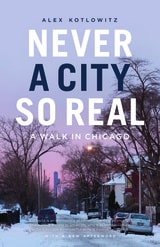
Never a City So Real
A Walk in ChicagoAlex Kotlowitz
University of Chicago Press, 2019
The book is a tour of the people of Chicago, those who have been Kotlowitz’s guide into this city’s – and by inference, this country’s – heart. Chicago, after all, is America’s city. Kotlowitz introduces us to the owner of a West Side soul food restaurant who believes in second chances, a steelworker turned history teacher, the “Diego Rivera of the projects,” and the lawyers and defendants who populate Chicago’s Criminal Courts Building. These empathic, intimate stories chronicle the city’s soul, its lifeblood.
This new edition features a new afterword from the author, which examines the state of the city today as seen from the double-paned windows of a pawnshop. Ultimately, Never a City So Real is a love letter to Chicago, a place that Kotlowitz describes as “a place that can tie me up in knots but a place that has been my muse, my friend, my joy.”
Never on Time, Always in Time
Narrative Form and the Queer SensoriumKate McCullough
The Ohio State University Press, 2024
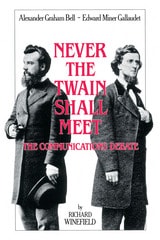
Never the Twain Shall Meet
Bell, Gallaudet, and the Communications DebateRichard Winefield
Gallaudet University Press, 1987

Never the Whole Story
Anita Skeen
Michigan State University Press, 2011
Epiphanic and rich with striking imagery, Anita Skeen’s new collection of poetry documents the fragmentary nature of life and celebrates the desire to make a meaningful narrative from momentary experience. In Never the Whole Story, the past is never past, and the present comes filled with the miracle of small gestures—singular moments that have the power to transport the mind from one geographic place to the next, one emotional world to another. Memory is incomplete, events unfold from multiple perspectives, and secrets unspool from the ordinary. Following in the tradition of James Wright, Maxine Kumin, Mary Oliver, Jane Kenyon, Robert Hass, and other writers whose work is grounded in the detail of ordinary life, Never the Whole Story will be a welcome addition to the libraries of those who turn to literature to find deeper connections between their own lives and the natural world.