Results by title
8 books match the query 'New Century'

Culture and Contestation in the New Century
Edited by Marc James Léger
Intellect Books, 2011
A series of essays by internationally known artists, scholars, and critics in the growing field of cultural theory, Culture and Contestation in the New Century examines the conditions of cultural production in the first decade of the twenty-first century. With an emphasis on how current neoliberal policies have affected institutions of cultural production and dissemination, it emphasizes the ensuing changes to critical theory. The contributors here are among the most respected scholars in art, art criticism, and cultural studies, and this powerful analysis poses important questions about cultural democracy and social change.
Diversity and Disparities
America Enters a New CenturyJohn Logan is professor of sociology and director of the Research Initiative on Spatial Structures in the Social Sciences at Brown University and editor of Diversity and Disparities: America Enters a New Century.
Russell Sage Foundation, 2014
Immigration Research for a New Century
Multidisciplinary PerspectivesNancy Foner
Russell Sage Foundation, 2000
In a New Century
Essays on Queer History, Politics, and Community LifeJohn D’Emilio
University of Wisconsin Press, 2014
A pioneering scholar of gay history, John D’Emilio reflects in this wide-ranging collection of essays upon the social, cultural, and political changes provoked by LGBT activism. He offers provocative questions and historical analyses: What can we learn from a life-long activist like Bayard Rustin, who questioned the wisdom of “identity politics”? Was Richard Nixon a “gay liberationist”? How can knowing local stories—like those of Chicago in the 1950s, 1960s, and 1970s—help build stronger communities and enrich traditions of activism? Might the focus on achieving actually be evidence of growing conservatism in LGBT communities?
In a New Century provides a dynamic, thoughtful, and important resource for identifying changes that have occurred in the United States since 1960, taking stock of the work that still needs to be done, and issuing an urgent call to action for getting there.
Best Books for General Audiences, selected by the American Association of School Librarians
Best Special Interest Books, selected by the Public Library Reviewers
Rhetoric and Writing Studies in the New Century
Historiography, Pedagogy, and PoliticsEdited by Cheryl Glenn and Roxanne Mountford
Southern Illinois University Press, 2017

The New Century
Bergsonism, Phenomenology, and Responses to Modern ScienceEdited by Keith Ansell-Pearson and Alan D. Schrift
University of Chicago Press, 2010
From Kant to Kierkegaard, from Hegel to Heidegger, continental philosophers have indelibly shaped the trajectory of Western thought since the eighteenth century. Although much has been written about these monumental thinkers, students and scholars lack a definitive guide to the entire scope of the continental tradition. The most comprehensive reference work to date, this eight-volume History of Continental Philosophy will both encapsulate the subject and reorient our understanding of it. Beginning with an overview of Kant’s philosophy and its initial reception, the History traces the evolution of continental philosophy through major figures as well as movements such as existentialism, phenomenology, hermeneutics, and poststructuralism. The final volume outlines the current state of the field, bringing the work of both historical and modern thinkers to bear on such contemporary topics as feminism, globalization, and the environment. Throughout, the volumes examine important philosophical figures and developments in their historical, political, and cultural contexts.
The first reference of its kind, A History of Continental Philosophy has been written and edited by internationally recognized experts with a commitment to explaining complex thinkers, texts, and movements in rigorous yet jargon-free essays suitable for both undergraduates and seasoned specialists. These volumes also elucidate ongoing debates about the nature of continental and analytic philosophy, surveying the distinctive, sometimes overlapping characteristics and approaches of each tradition. Featuring helpful overviews of major topics and plotting road maps to their underlying contexts, A History of Continental Philosophy is destined to be the resource of first and last resort for students and scholars alike.
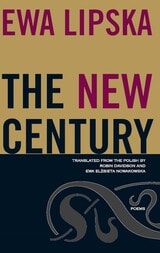
The New Century
PoemsEwa Lipska, translated from the Polisyh by Robin Davidson and Ewa Nowakowska
Northwestern University Press, 2009
Since the publication of her first book in 1967, Ewa Lipska has been among the most acclaimed of contemporary Polish poets. Yet, to date she has not enjoyed the same popularity in the United States as her fellow Poles Wislawa Szymborska, Czeslaw Milosz, and her contemporary Adam Zagajewski. The New Century: Poems, a selection of her recent work, introduces to an American audience the work of an underappreciated master.
Although Lipska’s work displays an acute awareness of history and politics, she’s nonetheless most concerned with individual experience and the most difficult philosophical questions of evil. Lipska is capable of being awed by beauty despite the deep pessimism that flows through her poems, including the failure of language itself to have any ameliorative effect on human experience.
Surreal, skeptical, and laced with wit, Lipska’s poetry, like that of Milosz and Szymborska, seems to effortlessly achieve a kind of hard-won and gracefully wielded authority that tells us something essential about the legacies of the twentieth century’s horrors.
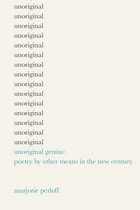
Unoriginal Genius
Poetry by Other Means in the New CenturyMarjorie Perloff
University of Chicago Press, 2010
What is the place of individual genius in a global world of hyper-information— a world in which, as Walter Benjamin predicted more than seventy years ago, everyone is potentially an author? For poets in such a climate, "originality" begins to take a back seat to what can be done with other people’s words—framing, citing, recycling, and otherwise mediating available words and sentences, and sometimes entire texts. Marjorie Perloff here explores this intriguing development in contemporary poetry: the embrace of "unoriginal" writing. Paradoxically, she argues, such citational and often constraint-based poetry is more accessible and, in a sense, "personal" than was the hermetic poetry of the 1980s and 90s.
Perloff traces this poetics of "unoriginal genius" from its paradigmatic work, Benjamin’s encyclopedic Arcades Project, a book largely made up of citations. She discusses the processes of choice, framing, and reconfiguration in the work of Brazilian Concretism and Oulipo, both movements now understood as precursors of such hybrid citational texts as Charles Bernstein’s opera libretto Shadowtime and Susan Howe’s documentary lyric sequence The Midnight. Perloff also finds that the new syncretism extends to language: for example, to the French-Norwegian Caroline Bergvall writing in English and the Japanese Yoko Tawada, in German. Unoriginal Genius concludes with a discussion of Kenneth Goldsmith’s conceptualist book Traffic—a seemingly "pure’" radio transcript of one holiday weekend’s worth of traffic reports. In these instances and many others, Perloff shows us "poetry by other means" of great ingenuity, wit, and complexity.