Results by title
3 books match the query 'New France'
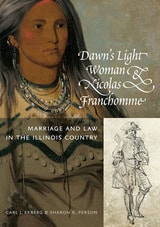
Dawn's Light Woman & Nicolas Franchomme
Marriage and Law in the Illinois CountryCarl J. Ekberg and Sharon K. Person
Southern Illinois University Press, 2022
Native women’s marital rights and roles in colonial Illinois society
Kaskaskia, Illinois, once the state’s capital, torn from the state by flood waters, and now largely forgotten, was once the home to a couple who helped transform the region in the 1720s from a frontier village to a civil society. In the heart of France’s North American empire, the village was a community of French-Canadian fur traders and Kaskaskia Indians who not only lived together but often intermarried. These Indigenous and French intermarriages were central to colonial Illinois society, and the coupling of Marguerite 8assecam8c8e (Dawn’s Light Woman) and Nicolas Franchomme, in particular, was critical to expanding the jurisdiction of French law.
While the story of Marguerite and Nicolas is unknown today, it is the story of how French customary law (Coutume de Paris) governed colonial marriage, how mixed Indian-French marriages stood at the very core of early colonial Illinois society, and how Illinois Indian women benefited, socially and legally, from being married to French men. All of this came about due to a lawsuit in which Nicolas successfully argued that his wife had legal claim to her first husband’s estate—a legal decision that created a precedent for society in the Illinois Country.
Within this narrative of a married couple and their legal fight—based on original French manuscripts and supported by the comprehensively annotated 1726 Illinois census—is also the story of the village of Kaskaskia during the 1720s, of the war between Fox Indians and French settlers, with their Indian allies, in Illinois, and of how the spread of plow agriculture dramatically transformed the Illinois Country’s economy from largely fur trade–based to expansively agricultural.
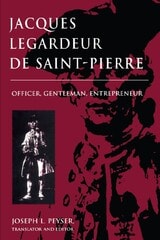
Jacques Legardeur De Saint-Pierre
Officer, Gentleman, EntrepeneurJoseph L. Peyser
Michigan State University Press, 1996
The documentary biography of Jacques Legardeur de Saint-Pierre, an officer in the Troupes de la Marine, who served throughout New France, sheds new light on the business activity of French colonial officers stationed in the West. Many of the eighty previously untranslated documents in Jacques Legardeur de Saint-Pierre demonstrate the extent and profitability of Saint-Pierre's pursuit of business activities while performing official duties in eighteenth-century French North America. The quest for profit permeated Saint- Pierre's career, particularly his command of the Western Sea Post after he succeeded the fabled Pierre Gaultier de Varennes et de la Vérendrye. Saint-Pierre and his secret partner General Jacques-Pierre de Taffanel de La Jonquière, Intendant François Bigot, and Meret, secretary to La Jonquière, used their positions to engage in extensive trade, especially brandy, with the Cree and Assiniboine northwest of Lake Superior. Saint-Pierre's activities provide fresh insights into the North American fur trade.

On the Eve of Conquest
The Chevalier de Raymond's Critique of New France in 1754Joseph L. Peyser
Michigan State University Press, 1997
In 1754, Charles de Raymond, chevalier of the Royal and Military Order of Saint Louis and a captain in the Troupes de la Marine wrote a bold, candid, and revealing expose; on the French colonial posts and settlements of New France. On the Eve of the Conquest, more than an annotated translation, includes a discussion on the historical background of the start of the French and Indian War, as well as a concise biography of Raymond and Michel Le Courtois de Surlaville, the army colonel at the French court to whom the report was sent. The events surrounding Raymond's controversial year as commandant of the post (now Fort Wayne, Indiana) in 1749-50, his disputed recall by Governor General Jacques-Pierre de Taffanel de La Jonquier, and the subsequent friction between La Jonquiere's successor, Ange de Menneville Duqesne, and Raymond are presented in detail and illustrated by translations of their correspondence.