Results by title
2 books match the query 'New Ideas'

Dialogical Imaginations
Aisthesis as Social Perception and New Ideas of HumanismEdited by Michael F. Zimmermann with Gernot Müller, Christian Sauer, Kerstin Schmidt, Robert Schmidt, and Fosca Mariani Zini
Diaphanes, 0
Whereas language is situated in the communicative zones between subjects, the imagination, according to a widespread prejudice concerning its freedom, is often treated as obscurely originating from the inner self. Instead of focusing on individual or “private” imaginations by means of introspection, the contributors to the volume inquire into the dialogical formations the imagination shares with language, and into social ways of world making.
“Aisthesis” means perception, but, in this volume, as the cover illustration the artist Giulio Paolini made for us demonstrates, it is treated as inscribed into dialogue. Furthermore, the range of its meaning is extended to include societies’ capacities to perceive their own conditions and dispositions—those concerning their inner structures and their external, cultural, and natural contexts. The essays present a wide variety of cultural manifestations of social perception—from the documentary to the fictional. Philosophers and sociologists, literary and art historians, media and film analysts deal with figurations, topoi, and stereotypes as created in various communal spheres and as resulting from media and epistemological practices.
Many of the debates turn around dialogical humanism, but this is certainly not aimed at returning to normative models more regulating than describing the human. Our period has been marked by debates around the post-human, biopolitics, and an increasing awareness of crisis and of global interdependence. Previously, the concept of humanism had been criticized, for good reasons, by Foucault and by philosophers such as Judith Butler. If the editors propose to discuss humanism again, a reevaluation of the dialogical character of humanism—and a reconstruction of its history as marked by dialogical strategies—is the starting point. In dialogical humanism, man, instead of being defined by a system of norms, is and remains an argument—even if, in the final instance, inscrutable, inexhaustible.
[more]
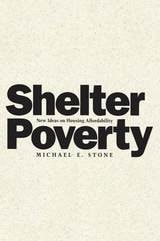
Shelter Poverty
New Ideas on Housing AffordabilityMichael E. Stone
Temple University Press, 1993
"...the most original--and profoundly disturbing--work on the critical issue of housing affordability...."
--Chester Hartman, President, Poverty and Race Research Action Council
In Shelter Poverty, Michael E. Stone presents the definitive discussion of housing and social justice in the United States. Challenging the conventional definition of housing affordability, Stone offers original and powerful insights about the nature, causes, and consequences of the affordability problem and presents creative and detailed proposals for solving a problem that afflicts one-third of this nation. Setting the housing crisis into broad political, economic, and historical contexts, Stone asks: What is shelter poverty? Why does it exist and persist? and How can it be overcome?
Describing shelter poverty as the denial of a universal human need, Stone offers a quantitative scale by which to measure it and reflects on the social and economic implications of housing affordability in this country. He argues for "the right to housing" and presents a program for transforming a large proportion of the housing in this country from an expensive commodity into an affordable social entitlement. Employing new concepts of housing ownership, tenure, and finance, he favors social ownership in which market concepts have a useful but subordinate role in the identification of housing preferences and allocation. Stone concludes that political action around shelter poverty will further the goal of achieving a truly just and democratic society that is also equitably and responsibly productive and prosperous.
[more]