Results by title
226 books match the query 'New Jersey' and 20 start with a
A Citizen's Guide to Grassroots Campaigns
Barry, Jan
Rutgers University Press, 2000
Civic movements are essential to Americans’ freedom and quality of life. Active citizens have led the way from the American Revolution to urban renewal. But fiery emotions and good intentions without skillful organization can lead to frustrated civic involvement. How can individual concerns be transformed into effective community action?
Jan Barry provides a pragmatic, common-sense handbook to civic action. Using case studies from his home state of New Jersey, Barry has crafted what he calls a “guidebook for creative improvement on the American dream.” He dissects civic actions such as environmental campaigns, mutual-help groups, neighborhood improvement projects, and a grassroots peace mission to Russia. Looking for patterns to explain successes and failures, Barry includes his own experiences as a Vietnam veteran peace activist to inspire and coach fledgling activists. The result is a wealth of practical, non-partisan information on membership recruitment, organizational skills, public speaking, lobbying, publicity, conflict resolution, and more. Rising above any particular political, social, or religious beliefs, Barry shows would-be activists how to confront one enduring truth —“Democracy is a lot harder to do than it is to talk about or fight over.”
A Cruising Guide to New Jersey Waters
Launer, Donald
Rutgers University Press, 2004
A Dutch Family in the Middle Colonies
1660-1880Firth Haring Fabend
Rutgers University Press, 1991
As she traces the lives of the Harings and their neighbors, Fabend focuses on their marriage and childbearing patterns, living conditions, agricultural methods, and relative economic position. She investigates inheritance patterns, concluding that the position of women deteriorated under English law. She is equally interested in the political and religious life of the family. The Harings formed a church fitting their Pietist beliefs, and this church became central to community life. Their theology encouraged them to question religious authority, which in turn fostered the questioning of political authority. Their community became a seedbed for revolutionary activity. Fabend examines the family's position in the Revolution--primarily patriot--and the losses they suffered in that conflict.
The Harings of colonial America were ideal yeoman farmers, a class that stood well in the social hierarchy of the day. They were industrious, they prospered, and they participated in the civic life of colonial America. But once the new republic formed, they were not very visible. Fabend argues that they maintained their "Dutchness" more consciously than ever after the Revolution, which hindered their full participation in public affairs. In some ways, the fifth and sixth generations were more Dutch than the early generations.
A Geography of New Jersey
The City in the GardenStansfield, Charles A.
Rutgers University Press, 1998
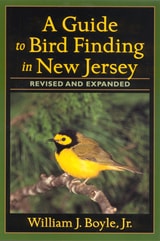
A Guide to Bird Finding in New Jersey
William J. Boyle, Jr.
Rutgers University Press, 2002
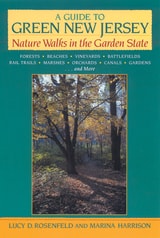
A Guide to Green New Jersey
Nature Walks in the Garden StateRosenfeld, Lucy D
Rutgers University Press, 2003
New Jersey is a state of surprises. Did you know there was a castle in Passaic County? Or that Essex County’s Branch Brook Park, rather than Washington, D.C., has the largest concentration of flowering cherry trees outside of Japan? Did you know you could walk through a bamboo forest on the Rutgers University campus, dig for fossils in Middletown’s Poricy Brook, visit an owl haven on the site of the Battle of Monmouth, or see wild river otters in Salem County?
Despite its proximity to major urban areas and its high population density, the state has dozens of absolutely marvelous natural areas and preserved spaces. It boasts something for everyone, from Atlantic seashore to rugged mountains, rolling farmland to winding canals, historic trails to formal gardens, bird-filled marshes to hardwood forests, pine barrens to fragrant vineyards and orchards. There are outings for hikers, bikers, beachcombers, gardeners, power-walkers, and strollers of all kinds, and A Guide to Green NewJersey is your key to finding it all.
The book is conveniently organized into forty geographic areas, spotlighting more than 200 nature walks. Each entry includes a description, visitor hours, fees, driving accessibility, and other pertinent information for walkers. At the end of the book, the authors provide an index with the names of each site, and their guide to choosing an outing according to individual tastes and interests. They identify sites that are wheelchair accessible, especially fun for kids, best for bicyclists, and those that are particularly physically challenging.
Newcomers to the state will find the book indispensable, and long-time New Jerseyans will find it a pleasantly eye-opening guide to wonderful walks right in their own backyards.
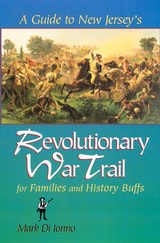
A Guide to New Jersey's Revolutionary War Trail
for Families and History BuffsDi Ionno, Mark
Rutgers University Press, 2000
New Jersey’s role in the Revolutionary War is widely overlooked. Every school kid learns about the Boston Tea Party but not the Greenwich tea burning; and about the miserable winter at Valley Forge but not Jockey Hollow. Schools fund class trips to Philadelphia’s Independence Hall but not Princeton’s Nassau Hall. To find history in New Jersey, all you need is DiIonno’s book as your guide. His easy-to-read volume helps readers explore the cities and the countryside from Bergen to Cape May County to find out exactly what happened there during the Revolutionary War.
While previously published books center on the highlights — Fort Lee and Washington’s retreat across the state, victories at Trenton and Princeton, the brutal winter encampment at Jockey Hollow and the Battle of Monmouth — DiIonno fills in the blanks. Battlefields, churches, homes of the famous and infamous, cemeteries, parks, taverns, liberty poles, bridges, creeks, hills, museums, encampment sites, lighthouses, historical societies, walking trails, monuments, plaques—if it played a part in or commemorates the Revolutionary War in New Jersey, DiIonno tells you what happened there, the personalities involved, and how to see it for yourself.
The sites are conveniently cataloged by county, with a helpful summary of the area’s war history beginning each chapter. Each entry lists the town and directions to each site, and where appropriate, a complete address, telephone numbers, and hours of operation. Both public and private sites are described, and DiIonno advises readers of which private sites tours can be arranged.
A History of the Rutgers University Glee Club
David F. Chapman
Rutgers University Press, 2022
Founded in 1872, the Glee Club is Rutgers University’s oldest continuously active student organization, as well as one of the first glee clubs in the United States. For the past 150 years, it has represented the university and presented an image of the Rutgers man on a national and international stage.
This volume offers a comprehensive history of the Rutgers Glee Club, from its origins adopting traditions from the German Männerchor and British singing clubs to its current manifestation as a world-recognized ensemble. Along the way, we meet the colorful and charismatic men who have directed the group over the years, from the popular composer and minstrel performer Loren Bragdon to the classically-trained conductor Patrick Gardner. And of course, we learn what the club has meant to the generations of talented and dedicated young men who have sung in it.
A History of the Rutgers University Glee Club recounts the origins of the group’s most beloved traditions, including the composition of the alma mater’s anthem “On the Banks of the Old Raritan” and the development of the annual Christmas in Carol and Song concerts. Meticulously researched, including a complete discography of the club’s recordings, this book is a must-have for all the Rutgers Glee Club’s many fans and alumni.
A Key to the Woody Plants of the New Jersey Pine Barrens
Geller, Michael D
Rutgers University Press, 2002
Within southern New Jersey lies the largest expanse of undeveloped land in the megalopolis between Boston and Washington, D.C. This is the Pine Barrens, our nation’s first National Reserve, where visitors are struck by how much the vegetation varies from surrounding areas. Because the sandy soil is only marginally suitable for most agriculture and because the location amounts to a peninsula, settlement has been limited and the current ecology is relatively untouched. However, as New Jersey’s population increases, people are looking to the Pine Barrens with a new interest.
A Key to the Woody Plants of the New Jersey Pine Barrens is a hand-illustrated, user-friendly guide for both the interested student and weekend naturalist. The key lists all of the woody plants of the Pine Barrens except for a few rare, non-native species. In several keys and more than fifty highly detailed drawings, Michael D. Geller describes the basic features of woody plants and explains how to identify plants both in summer and winter.
Along with his set of workable identification keys, the author provides an enjoyable introduction to the geology, ecology, and history of the region, and relates each to the unique flora of the Pine Barrens. The book provides readers with an effective means of identifying the plants that are hallmarks of one of the state’s last wild areas.
A Mayor for All the People
Kenneth Gibson's NewarkRobert C. Holmes
Rutgers University Press, 2020
In 1970, Kenneth Gibson was elected as Newark, New Jersey’s first African-American mayor, a position he held for an impressive sixteen years. Yet even as Gibson served as a trailblazer for black politicians, he presided over a troubled time in the city’s history, as Newark’s industries declined and its crime and unemployment rates soared.
This book offers a balanced assessment of Gibson’s leadership and his legacy, from the perspectives of the people most deeply immersed in 1970s and 1980s Newark politics: city employees, politicians, activists, journalists, educators, and even fellow big-city mayors like David Dinkins. The contributors include many of Gibson’s harshest critics, as well as some of his closest supporters, friends, and family members—culminating in an exclusive interview with Gibson himself, reflecting on his time in office.
Together, these accounts provide readers with a compelling inside look at a city in crisis, a city that had been rocked by riots three years before Gibson took office and one that Harper’s magazine named “America’s worst city” at the start of his second term. At its heart, it raises a question that is still relevant today: how should we evaluate a leader who faced major structural and economic challenges, but never delivered all the hope and change he promised voters?
A Naturalist Along the Jersey Shore
Burger, Joanna
Rutgers University Press, 1996
Come for a journey along the Jersey shore with naturalist and ecologist Joanna Burger! In these deeply felt, closely observed personal essays, Burger invokes the intertwined lives of naturalist and wild creatures at the ever-changing edge of ocean and land. Discover with her the delicate mating dances of fiddler crabs, the dangers to piping plovers, the swarming of fish communities into the bays and estuaries, the trilling notes of Fowler's toads, and the subtle green-grays of salt marshes.
Joanna Burger knows the shore through all its seasons--the first moment of spring when the herring gulls arrive on ice-gouged salt marshes, the end of spring when the great flocks of shorebirds come to feed on horseshoe crab eggs at Cape May, the summer when the peregrine hunts its prey, the fall when the migrations of hawks and monarch butterflies attract watchers from around the world, and the depths of winter when a lone snowy owl sweeps across snow-covered dunes and frozen bay.
This is a book that anyone who loves the Jersey shore will cherish! And because so many of these wonderful creatures live all along the Atlantic coast, it will be of equal interest to beach-lovers, naturalists, bird-watchers, fishermen, and coastal and marine scientists from North Carolina to Maine.
A New Jersey Anthology
Lurie, Maxine N
Rutgers University Press, 2010

A State of Health
New Jersey's Medical HeritageReeds, Karen
Rutgers University Press, 2002
Did you know that New Jersey spearheaded the discovery of antibiotics? Or that the Garden State had the first state hospital serving the mentally ill and the first community rescue squad? And did you know that close to a million people around the world can walk again, thanks to the New Jersey Knee?
New Jersey is a small state that has played a big role in the history of medicine. Adrenalin, streptomycin, pure milk, tranquilizers, malaria control, cortisone, vitamins, revelations of radium's dangers—New Jersey’s impressive contributions to American health have been on display in a major traveling exhibition, “A State of Health: New Jersey’s Medical Heritage.” By 2002, more than twelve sites throughout New Jersey and Philadelphia will have hosted this display.
This catalogue to the exhibition celebrates more than four centuries of New Jersey medicine through original essays and 150-plus striking illustrations of artifacts, manuscripts, books, photographs, works of art, and postcards. Taking subjects of perennial interest—epidemics, children’s health, public health, hospitals, and biomedical research—curator Karen Reeds explores the state’s rich medical heritage and its uniqueplace as the heart of the world’s pharmaceutical industry.
Engagingly written and handsomely produced, A State of Health: New Jersey’s
Medical Heritage is at once a lasting resource for students, teachers, and historians and the perfect gift to your favorite healthcare professional or local history buff.
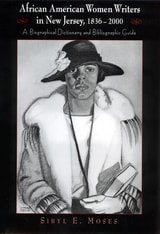
African American Women Writers in New Jersey, 1836-2000
A Biographical Dictionary and Bibliographic GuideMoses, Sibyl E
Rutgers University Press, 2006
Selected as a "New Jersey Notable Book for 1995-2005" by the New Jersey Center for the Book
Awarded the 2004 Certificate of Commendation by the American Association for State and Local History
African American Women Writers in New Jersey, 1836-2000 is the first and only reference book to identify and document the lives, intellectual contributions, and publications of over one hundred African American women writers in the Garden State from 1836 through 2000. Many, such as Jessie Redmon Fauset, Alice Perry Johnson, Sharon Bell Mathis, Ntozake Shange, Claudia C. Tate, Ruby Ora Williams, and Marion Thompson Wright, were born in the state. Others, like Amina Baraka, E. Alma Flagg, Helen Jackson Lee, Gertrude Williams Pitts, and Dorothy Porter Wesley, although not born there, were residents of New Jersey for more than fifteen years, and made significant contributions during that time.
This volume contains biographical and bibliographical information for each author. There are photographs of the writers as well as citations for their published pamphlets, books, reports, and articles. Sibyl E. Moses has enhanced the text with characteristic excerpts from the poetry and prose of selected writers. The two appendixes highlight the distribution of African American women writers in New Jersey both by city or town, and by genre.
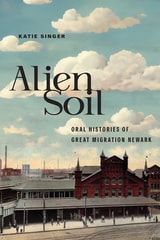
Alien Soil
Oral Histories of Great Migration NewarkKatie Singer
Rutgers University Press, 2024
The book begins with the Krueger-Scott Mansion’s deep history, followed by the sequence of events surrounding the proposed Cultural Center. Last owned by African-American millionaire and beauty-culture entrepreneur Louise Scott, the Victorian Krueger-Scott Mansion was built by beer baron Gottfried Krueger in 1888. Through the history of the Mansion, and the ultimately failed Cultural Center project, one learns about the Newark that African Americans migrated to, what they found when they got there, how living in the city changed them, and how they, individually and collectively, changed Newark.
After the Cultural Center project was officially halted in 2000, the cassette tapes of the oral history interviews were stored away at the Newark Public Library. Ten years later they were unearthed, and ultimately digitized. As of yet, no one has applied these sources directly to their research. Deeply committed to these rich, insightful stories, Singer calls for a more thoughtful consideration of all cities, reminding us that Newark is much more than its 1967 rebellion.

America's Working Man
Work, Home, and Politics Among Blue Collar Property OwnersDavid Halle
University of Chicago Press, 1984
America, the Dream of My Life
Selections from the Federal Writers' Project's New Jersey Ethnic SurveyCohen, David Steven
Rutgers University Press, 1990
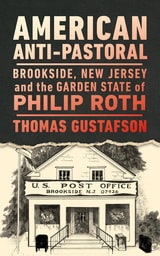
American Anti-Pastoral
Brookside, New Jersey and the Garden State of Philip RothThomas Gustafson
Rutgers University Press, 2024
American Anti-Pastoral reads the events in Roth’s novel in relation to the history of Brookside and its region. While Roth’s protagonist Seymour “Swede” Levov initially views Old Rimrock as an idyllic paradise within the Garden State, its real-world counterpart has a more complex past in its origins as a small industrial village, as well as a site for the politics of exclusionary zoning and a 1960s anti-war protest at its celebrated 4th of July parade. Literary historian and Brookside native Thomas Gustafson casts Roth’s canonical novel in a fresh light as he studies both Old Rimrock in comparison to Brookside and the novel in relationship to NJ literature, making a case for it as the Great New Jersey novel. For Roth fans and history buffs alike, American Anti-Pastoral peels back the myths about the bucolic Garden State countryside to reveal deep fissures along the fault-lines of race and religion in American democracy.
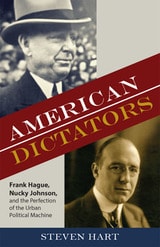
American Dictators
Frank Hague, Nucky Johnson, and the Perfection of the Urban Political MachineHart, Steven
Rutgers University Press, 2013
One man was tongue-tied and awkward around women, in many ways a mama's boy at heart, although his reputation for thuggery was well earned. The other was a playboy, full of easy charm and ready jokes, his appetite for high living a matter of public record. One man tolerated gangsters and bootleggers as long as they paid their dues to his organization. The other was effectively a gangster himself, so crooked that he hosted a national gathering of America's most ruthless killers. One man never drank alcohol. The other, from all evidence, seldom drank anything else.
American Dictators is the dual biography of two of America’s greatest political bosses: Frank Hagueand Enoch “Nucky” Johnson. Packed with compelling information and written in an informal, sometimes humorous style, the book shows Hague and Johnson at the peak of their power and the strength of their political machines during the years of Prohibition and the Great Depression. Steven Hart compares how both men used their influence to benefit and punish the local citizenry, amass huge personal fortunes, and sometimes collaborate to trounce their enemies.
Similar in their ruthlessness, both men were very different in appearance and temperament. Hague, the mayor of Jersey City, intimidated presidents and wielded unchallenged power for three decades. He never drank and was happily married to his wife for decades. He also allowed gangsters to run bootlegging and illegal gambling operations as long as they paid protection money. Johnson, the political boss of Atlantic City, and the inspiration for the hit HBO series Boardwalk Empire, presided over corruption as well, but for a shorter period of time. He was notorious for his decadent lifestyle. Essentially a gangster himself, Johnson hosted the infamous Atlantic City conference that fostered the growth of organized crime.
Both Hague and Johnson shrewdly integrated otherwise disenfranchised groups into their machines and gave them a stake in political power. Yet each failed to adapt to changing demographics and circumstances. In American Dictators, Hart paints a balanced portrait of their accomplishments and their failures.
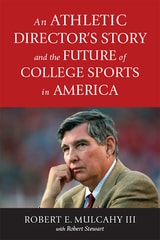
An Athletic Director’s Story and the Future of College Sports in America
Robert E. Mulcahy
Rutgers University Press, 2020
His words and actions were prominent during a nationally-reported incident involving student athletes. When the Rutgers Women’s Basketball team players were slandered by racist remarks from a popular radio talk show host, Mulcahy met it head on. With the coach and players, he set an inspiring example for defending character and values.
Though Mr. Mulcahy left Rutgers in 2009, his memoir reflects continued devotion to intercollegiate athletics and student athletes. His insights for addressing several leading issues confronting Division I sports today offer guidelines for present and future athletic directors to follow.