Results by title
2 books match the query 'New Literary History'
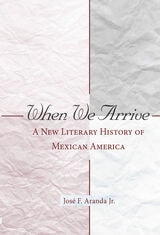
When We Arrive
A New Literary History of Mexican AmericaJosé F. Aranda Jr.
University of Arizona Press, 2003
In this bold new look at the American canon, Aranda weaves the threads of Mexican American literature into the broader tapestry of Anglo American writing, especially its Puritan origins, by pointing out common ties that bind the two traditions: narratives of persecution, of immigration, and of communal crises, alongside chronicles of the promise of America. Examining texts ranging from María Amparo Ruiz de Burton's 1872 critique of the Civil War, Who Would Have Thought It?, through the contemporary autobiographies of Richard Rodriguez and Cherríe Moraga, he surveys Mexican American history, politics, and literature, locating his analyses within the context of Chicano/a cultural criticism of the last four decades.
When We Arrive integrates Early American Studies and Chicano/a Studies into a comparative cultural framework by using the Puritan connection to shed new light on dominant images of Chicano/a narrative, such as Aztlán and the borderlands. Aranda explores the influence of a nationalized Puritan ethos on nineteenth- and twentieth-century writers of Mexican descent, particularly upon constructions of ethnic identity and aesthetic values. He then frames the rise of contemporary Chicano/a literature within a critical body of work produced from the 1930s through the 1950s, one that combines a Puritan myth of origins with a literary history in which American literature is heralded as the product and producer of social and political dissent.
Aranda's work is a virtual sourcebook of historical figures, texts, and ideas that revitalizes both Chicano/a studies and American literary history. By showing how a comparative study of two genres can produce a more integrated literary history for the United States, When We Arrive enables critics and readers alike to see Mexican American literature as part of a broader tradition and establishes for its writers a more deserving place in the American literary imagination.
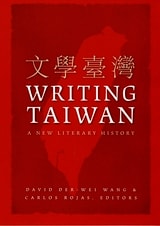
Writing Taiwan
A New Literary HistoryDavid Der-wei Wang and Carlos Rojas, eds.
Duke University Press, 2007
Because the island of Taiwan spent the first half of the century as a colony of Japan and the second half in an umbilical relationship to China, its literature challenges basic assumptions about what constitutes a “national literature.” Several contributors directly address the methodological and epistemological issues involved in writing about “Taiwan literature.” Other contributors investigate the cultural and political grounds from which specific genres and literary movements emerged. Still others explore themes of history and memory in Taiwan literature and tropes of space and geography, looking at representations of boundaries as well as the boundary-crossing global flows of commodities and capital. Like Taiwan’s history, modern Taiwan literature is rife with conflicting legacies and impulses. Writing Taiwan reveals a sense of its richness and diversity to English-language readers.
Contributors. Yomi Braester, Sung-sheng Yvonne Chang, Fangming Chen, Lingchei Letty Chen, Chaoyang Liao, Ping-hui Liao, Joyce C. H. Liu, Kim-chu Ng, Carlos Rojas, Xiaobing Tang, Ban Wang, David Der-wei Wang, Gang Gary Xu, Michelle Yeh, Fenghuang Ying