110 books match the query 'New Mexico' and 8 start with a
cover of A Dictionary of New Mexico and Southern Colorado Spanish: Revised and Expanded Edition

A Dictionary of New Mexico and Southern Colorado Spanish

Revised and Expanded Edition

Rubén Cobos

Museum of New Mexico Press, 2011

Continuously in print since 1983, Dictionary of New Mexico and Southern Colorado Spanish, has become a classic Spanish reference book, widely used in classrooms across the United States. As a teenager in Albuquerque, esteemed linguist and folkorist Rubén Cobos (1911-2010) was intrigued by and began documenting the regional variations of spoken Spanish. This was to become his work of a lifetime spanning seventy-five years. Dr. Cobos began recording Indo-Hispanic folklore material in the early 1940s. With the co-operation of the villagers, farmers, sheepherders, and other hard-working people in the small towns throughout New Mexico and Southern Colorado he recorded the nuances, slang and the regionally distinctive words of Spanish spoken in the communities of the upper Rio Grande and Southern Colorado.

Ruben Cobos spent a decade working on the revised and expanded edition of the dictionary, published in 2003. The Dictionary of New Mexico and Southern Colorado Spanish has assumed its place as the most authoritative reference on the archaic dialect of Spanish spoken in this region.
[more]
cover of A Jumble of Needs: Women’s Activism and Neoliberalism in the Colonias of the Southwest

A Jumble of Needs

Women’s Activism and Neoliberalism in the Colonias of the Southwest

Rebecca Dolhinow

University of Minnesota Press, 2010
Many immigrant communities along the U.S. border with Mexico are colonias, border settlements lacking infrastructure or safe housing. A Jumble of Needs examines the leadership of Mexican women immigrants in three colonias in New Mexico, documenting the role of NGOs in shaping women’s activism in these communities. Ethnographer Rebecca Dolhinow, who worked in the colonias, uncovers why such attempts to exercise political agency are so rarely successful.
 
Central to the relationship between NGOs and women activists in colonias, Dolhinow argues, is the looming presence of the neoliberal political project. In particular, the discourses of caretaking that NGOs use to recruit women into leadership positions simultaneously naturalize and depoliticize the activist work that these women do in their communities. Dolhinow discovers the connections between colonias as isolated communities and colonia leaders as political subjects who unintentionally reinforce neoliberal policy. In the long run, she finds, any politicization that might take place is limited to the women leaders and seldom involves the community as a whole.
 
Surprisingly, Dolhinow reveals, many NGOs promote neoliberal ideals, resulting in continued disenfranchisement, despite the women’s activism to better their lives, families, and communities.
[more]
cover of A Land Apart: The Southwest and the Nation in the Twentieth Century

A Land Apart

The Southwest and the Nation in the Twentieth Century

Flannery Burke

University of Arizona Press, 2017

Winner, Spur Award for Best Contemporary Nonfiction (Western Writers of America)

A Land Apart is not just a cultural history of the modern Southwest—it is a complete rethinking and recentering of the key players and primary events marking the Southwest in the twentieth century. Historian Flannery Burke emphasizes how indigenous, Hispanic, and other non-white people negotiated their rightful place in the Southwest. Readers visit the region’s top tourist attractions and find out how they got there, listen to the debates of Native people as they sought to establish independence for themselves in the modern United States, and ponder the significance of the U.S.-Mexico border in a place that used to be Mexico. Burke emphasizes policy over politicians, communities over individuals, and stories over simple narratives.

Burke argues that the Southwest’s reputation as a region on the margins of the nation has caused many of its problems in the twentieth century. She proposes that, as they consider the future, Americans should view New Mexico and Arizona as close neighbors rather than distant siblings, pay attention to the region’s history as Mexican and indigenous space, bear witness to the area’s inequalities, and listen to the Southwest’s stories. Burke explains that two core parts of southwestern history are the development of the nuclear bomb and subsequent uranium mining, and she maintains that these are not merely a critical facet in the history of World War II and the militarization of the American West but central to an understanding of the region’s energy future, its environmental health, and southwesterners’ conception of home.

Burke masterfully crafts an engaging and accessible history that will interest historians and lay readers alike. It is for anyone interested in using the past to understand the present and the future of not only the region but the nation as a whole.
[more]
cover of A Mad Mess: Community Mental Health in Crisis

A Mad Mess

Community Mental Health in Crisis

Owen Whooley

University of Chicago Press, 2026

A sobering assessment of the systematic failures of mental health work.

The United States is in the midst of a mental health crisis that cannot be ignored. Its effects are visible in overcrowded emergency rooms, homeless encampments, and frequent encounters between police and people with serious mental illness. And yet, our attempts to support people with mental illness—from medical care to housing support to basic hygiene—seem to never take meaningful hold despite the tireless work of professionals who attempt to help people bring together the pieces of a life. The problem is not in any individual effort though; it’s in the many ways these programs fail to work together. For those with serious mental illness, and those who work to ameliorate it, there is no system. There is only mess. 

In A Mad Mess, sociologist Owen Whooley uncovers the exasperating barriers, bureaucratic mismatches, and threadbare resources that have made a mess of what should be a supportive system. Set in Albuquerque, New Mexico—a city whose struggles echo those of communities nationwide—the book reveals the challenges mental health workers face daily, from tedious paperwork to occasional violence. Whooley follows workers across local outpatient service organizations, specialized police mental health units, and a psychiatric emergency department. Despite mostly good intentions and sometimes heroic efforts, he shows why this important work so often ends in failure. 

Written with deep sympathy and unflinching honesty, A Mad Mess reveals how the lack of a cohesive mental health system obstructs critical care and places roadblocks before front-line mental health workers at every turn. Most critically, for those who suffer from severe mental illness, these setbacks are a constant reminder that the institutions charged with helping them have left them on their own.
[more]
cover of A Prehistoric Sequence in the Middle Pecos Valley, New Mexico

A Prehistoric Sequence in the Middle Pecos Valley, New Mexico

Arthur J. Jelinek

University of Michigan Press, 1967
Arthur J. Jelinek describes the results of his archaeological surveys and excavations in east central New Mexico and provides a prehistoric cultural sequence of the Middle Pecos Valley, from the Paleoindian period to the Late McKenzie Phase. With a contribution on pollen analysis by Paul S. Martin.
[more]
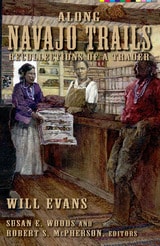
cover of Along Navajo Trails: Recollections of a Trader 1898-1948

Along Navajo Trails

Recollections of a Trader 1898-1948

Will Evans edited by Susan E. Woods and Robert McPherson

Utah State University Press, 2005
Will Evans's writings should find a special niche in the small but significant body of literature from and about traders to the Navajos. Evans was the proprietor of the Shiprock Trading Company. Probably more than most of his fellow traders, he had a strong interest in Navajo culture. The effort he made to record and share what he learned certainly was unusual. He published in the Farmington and New Mexico newspapers and other periodicals, compiling many of his pieces into a book manuscript. His subjects were Navajos he knew and traded with, their stories of historic events such as the Long Walk, and descriptions of their culture as he, an outsider without academic training, understood it. Evans's writings were colored by his fondness for, uncommon access to, and friendships with Navajos, and by who he was: a trader, folk artist, and Mormon. He accurately portrayed the operations of a trading post and knew both the material and artistic value of Navajo crafts. His art was mainly inspired by Navajo sandpainting. He appropriated and, no doubt, sometimes misappropriated that sacred art to paint surfaces and objects of all kinds. As a Mormon, he had particular views of who the Navajos were and what they believed and was representative of a large class of often-overlooked traders. Much of the Navajo trade in the Four Corners region and farther west was operated by Mormons. They had a significant historical role as intermediaries, or brokers, between Native and European American peoples in this part of the West. Well connected at the center of that world, Evans was a good spokesperson.
[more]
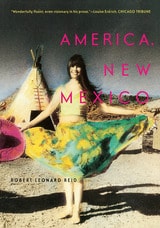
cover of America, New Mexico

America, New Mexico

Robert Leonard Reid

University of Arizona Press, 1998
New Mexico is a land with two faces. It is a land of enchantment, legendary for its natural beauty and rich cultural heritage. But it is also a land of paradox. In America, New Mexico, Robert Leonard Reid explores deep inside New Mexico's landscape to find the real New Mexico—with all of its gifts and challenges—within. Having traveled and hiked countless miles throughout the state, Reid knows New Mexico's breathtaking landscape intimately. But he knows the human landscape as well: its artists and poets, medicine men and businessmen, preachers and politicians, Hispanics and Anglos. He knows that amid the glittering mansions of Santa Fe there are homeless shelters, that the Indians of myth and legend combat alcoholism and poverty, and that toxic waste lurks beneath a land of almost surreal beauty. America, New Mexico is a book about land, sky, and hope by a writer whose passion and inspiring prose invite us to see the promise and possibilities of reconnecting with the natural world. It is unflinching in its depiction of the adversities facing New Mexicans and indeed all Americans. But above all, it searches behind and beyond these troubling issues to find, standing staunchly against them, a quiet and unshakable confidence rooted in New Mexico's natural world. For anyone who has ever been moved by the incomparable beauty of New Mexico, for anyone concerned with the landscape in which all Americans live, America, New Mexico is an unforgettable book.
[more]
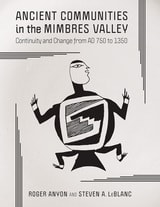
cover of Ancient Communities in the Mimbres Valley: Continuity and Change from AD 750 to 1350

Ancient Communities in the Mimbres Valley

Continuity and Change from AD 750 to 1350

Roger Anyon and Steven A. LeBlanc

University of Arizona Press, 2024

In the Mimbres Valley of southwestern New Mexico, archaeologists have been working for decades to meticulously excavate archaeological sites.

Expanding beyond studies that focus on a single pueblo, this volume represents the final report on the excavations of the Mimbres Foundation. It brings together data from a range of pithouse and pueblo sites of different sizes and histories in diverse locations—to refine the current understandings of Mimbres region archaeology in the context of the Greater Southwest.

From the end of the Late Pithouse period through the Black Mountain phase, the book provides excellent documentation of the artifacts and data recovered from the sites, addresses models of Mimbres community, and tracks change and continuity in the valley over centuries. In addition, the authors consider the nature of the relationship between the Classic Mimbres period population of the valley and the people of the succeeding Black Mountain phase, as well as relationships among the Black Mountain phase people and those of neighboring parts of the region, including the Casas Grandes world and the Jornada Mogollon area.

In Ancient Communities in the Mimbres Valley two leading archaeologists bring together a trove of unpublished investigations, expanding understandings and setting a course for the future.
 
[more]