Results by title
2 books match the query 'New School for Social Research'
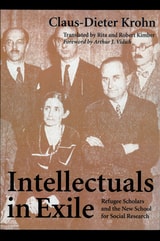
Intellectuals in Exile
Refugee Scholars and the New School for Social ResearchClaus-Dieter Krohn
University of Massachusetts Press, 1993
In the 1930s, with the rise of the Third Reich, thousands of European intellectuals sought refuge in the United States. Through the tireless efforts of Alvin Johnson, director of the New School for Social Research, nearly two hundred of these scholars came to be affiliated with the University in Exile, later known as the Graduate Faculty of Political and Social Science. This book presents an intellectual history of that remarkable group of social and political scientists, documenting their experiences and their influence on both European and American thought.
Johnson was one of the first to recognize the need for action to prevent Hitler’s destruction of the German intellectual tradition. He sought out many of the best European scholars of the day and brought them to the newly created University in Exile in New York. There, the refugees framed as intellectual problems the social and political experiences that had so disrupted their lives and careers. They examined the cultural roots of fascism, the bureaucratization of Western societies, and the prerequisites for a historically and morally informed social science. In the field of economics, the exiles developed theoretical concepts and models that came to be instrumental in the formation of New Deal policies and that remain relevant today.
The Golden Age of Phenomenology at the New School for Social Research, 1954–1973
Lester Embree
Ohio University Press, 2017
This collection focuses on the introduction of phenomenology to the United States by the community of scholars who taught and studied at the New School for Social Research from 1954 through 1973. During those years, Dorion Cairns, Alfred Schutz, and Aron Gurwitsch—all former students of Edmund Husserl—came together in the department of philosophy to establish the first locus of phenomenology scholarship in the country. This founding trio was soon joined by three other prominent scholars in the field: Werner Marx, Thomas M. Seebohm, and J. N. Mohanty. The Husserlian phenomenology that they brought to the New School has subsequently spread through the Anglophone world as the tradition of Continental philosophy.
The first part of this volume includes original works by each of these six influential teachers of phenomenology, introduced either by one of their students or, in the case of Seebohm and Mohanty, by the thinkers themselves. The second part comprises contributions from twelve leading scholars of phenomenology who trained at the New School during this period. The result is a powerful document tracing the lineage and development of phenomenology in the North American context, written by members of the first two generations of scholars who shaped the field.
Contributors: Michael Barber, Lester Embree, Jorge García-Gómez, Fred Kersten, Thomas M. T. Luckmann, William McKenna, J. N. Mohanty, Giuseppina C. Moneta, Thomas Nenon, George Psathas, Osborne P. Wiggins, Matthew M. Seebohm, and Richard M. Zaner.