Results by title
4 books match the query 'Newfield, Christopher'
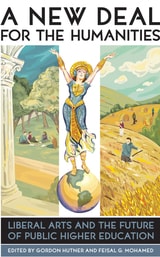
A New Deal for the Humanities
Liberal Arts and the Future of Public Higher EducationHutner, Gordon
Rutgers University Press, 2015
The contributors offer spirited and thought-provoking debates on a diverse range of topics. For instance, they deplore the push by administrations to narrow learning into quantifiable outcomes as well as the demands of state governments for more practical, usable training. Indeed, for those who suggest that a college education should be “practical”—that it should lean toward the sciences and engineering, where the high-paying jobs are—this book points out that while a few nations produce as many technicians as the United States does, America is still renowned worldwide for its innovation and creativity, skills taught most effectively in the humanities. Most importantly, the essays in this collection examine ways to make the humanities even more effective, such as offering a broader array of options than the traditional major/minor scheme, options that combine a student’s professional and intellectual interests, like the new medical humanities programs.
A democracy can only be as energetic as the minds of its citizens, and the questions fundamental to the humanities are also fundamental to a thoughtful life. A New Deal for the Humanities takes an intrepid step in making the humanities—and our citizens—even stronger in the future.
Ivy and Industry
Business and the Making of the American University, 1880-1980Christopher Newfield
Duke University Press, 2003
Newfield views management as neither inherently good nor bad, but rather as a challenge to and tool for negotiating modern life. In Ivy and Industry he integrates business and managerial philosophies from Taylorism through Tom Peters’s “culture of excellence” with the speeches and writings of leading university administrators and federal and state education and science policies. He discusses the financial dependence on industry and government that was established in the university’s early years and the equal influence of liberal arts traditions on faculty and administrators. He describes the arrival of a managerial ethos on campus well before World War II, showing how managerial strategies shaped even fields seemingly isolated from commerce, like literary studies. Demonstrating that business and the humanities have each had a far stronger impact on higher education in the United States than is commonly thought, Ivy and Industry is the dramatic story of how universities have approached their dual mission of expanding the mind of the individual while stimulating economic growth.

Limits of the Numerical
The Abuses and Uses of QuantificationEdited by Christopher Newfield, Anna Alexandrova, and Stephen John
University of Chicago Press, 2022
Numbers are both controlling and fragile. They drive public policy, figuring into everything from college rankings to vaccine efficacy rates. At the same time, they are frequent objects of obfuscation, manipulation, or outright denial. This timely collection by a diverse group of humanists and social scientists challenges undue reverence or skepticism toward quantification and offers new ideas about how to harmonize quantitative with qualitative forms of knowledge.
Limits of the Numerical focuses on quantification in several contexts: climate change; university teaching and research; and health, medicine, and well-being more broadly. This volume shows the many ways that qualitative and quantitative approaches can productively interact—how the limits of the numerical can be overcome through equitable partnerships with historical, institutional, and philosophical analysis. The authors show that we can use numbers to hold the powerful to account, but only when those numbers are themselves democratically accountable.
The Emerson Effect
Individualism and Submission in AmericaChristopher Newfield
University of Chicago Press, 1995
Christopher Newfield analyzes the interplay of liberal and authoritarian impulses in Emerson's work in various domains: domestic life, the changing New England economy, theories of poetic language, homoerotic friendship, and racial hierarchy. Focusing on neglected later writings, Newfield shows how Emerson explored the tensions between autonomy and community—and consistently resolved these tensions by "abandoning crucial elements of both" and redefining autonomy as a kind of liberating subjection. He argues that in Emersonian individualism, self-determination is accompanied by submission to authority, and examines the influence of this submissive individualism on the history of American liberalism. In a provocative reading of Emerson's early and neglected later works, Newfield analyzes Emerson's emphasis on collective, or "corporate", world-building, rather than private possession. Tracing the development of this corporate individualism, he illuminates contradictions in Emerson's political outlook, and the conjunctions of liberal and authoritarian ideology they produced.