Results by title

5 books match the query 'Newman'

cover of Fictions of Consciousness: Mill, Newman, and the Reading of Victorian Prose

Fictions of Consciousness

Mill, Newman, and the Reading of Victorian Prose

Jonathan Loesberg

Rutgers University Press, 1986
Mill, Newman, and the Reading of Victorian Prose
[more]
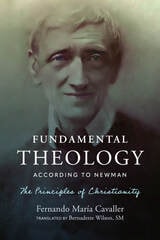
cover of Fundamental Theology According to Newman: The Principles of Christianity

Fundamental Theology According to Newman

The Principles of Christianity

Fernando Maria Cavaller

Catholic University of America Press, 2026
Although Newman certainly did not write the Essay on the Development of Christian Doctrine with the intention to do systematic theology, his ten principles serve as a framework for ordering the content of the essay with reference to Newman's other works. The result in this present book is a systematic analysis of the theological themes considered by Newman throughout his writing career. Newman’s writings were circumstantial in nature, written in response to controversies or needs of the moment. Nevertheless, he was able to shed light on those specific situations by appealing to timeless theological insights. The originality of this book consists in placing these insights in a systematic context. The arrangement is structured as a fundamental theology, following the usual discourse on God's revelation and faith as a response, with a brief intermediate exposition of fundamental Christology and ecclesiology. In order to give it Newman's own imprint, the author has provided only brief introductions or comments, as well as references to other authors, giving priority to Newman's own texts. In this way the work serves as an introduction to the thought and even to the life of John Henry Newman, whose literary style denotes the union of theological questions with a living faith.
[more]
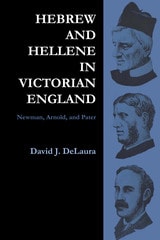
cover of Hebrew and Hellene in Victorian England: Newman, Arnold, and Pater

Hebrew and Hellene in Victorian England

Newman, Arnold, and Pater

By David DeLaura

University of Texas Press, 1969

Hebrew and Hellene explores the intellectual and personal relations among John Henry Newman, Matthew Arnold, and Walter Pater, three figures important in the development of nineteenth-century English thought and culture. Fundamentally concerned with the humanistic vision of Arnold and Pater, especially as they adapted the traditional religious culture to the needs of their generation, David DeLaura also recognizes Newman's central role. To a far greater degree than has been realized, Newman assumed a commanding position in the thought of the two younger men.

DeLaura seeks to define the mechanics of the process by which the conservative religious humanism of Newman could be exploited in the fluid, relativistic, and "aesthetic" humanism of Pater. The careers of Arnold and Pater are viewed as a continuing effort to reconcile the opposing forces of one of the central modern myths, the great cultural struggle between religious and secular values—Arnold's Hebraism and Hellenism.

DeLaura traces this important movement in nineteenth-century culture by studying the development of key phrases and ideas in the writings of the three men: the secularization of Newman's ideal of "inwardness" in Arnold's "criticism" and "culture" and in Pater's "impassioned contemplation"; the shared emphasis on an elite culture; the growing tendency to identify culture with the functions of traditional religion.

Newman, as the supreme apologist of both religious orthodoxy and the older Oxonian tradition, offered a rich arsenal to the defenders of a literary culture increasingly threatened by the utilitarian spirit (!nd by a rising scientific naturalism. Moreover, with the appearance of his Apologia in 1864, the "mystery" and the "miracle" of Newman's personality intrigued a new literary generation.

In Hebrew and Hellene DeLaura looks beyond the debates of the Late Victorians, the immediate inheritors of this legacy, to the continuing twentieth-century discussion of the nature of literature, its place in the humanizing process, and its role in a science-dominated civilization. He finds the problems faced by Pater, Arnold, and Newman—and some of their solutions—surprisingly relevant to unfinished contemporary debate.

[more]
cover of Incarnate Meaning: Lonergan on Newman

Incarnate Meaning

Lonergan on Newman

Richard M. Liddy

Catholic University of America Press, 2027
How is our fundamental vision of the world rooted in our own self-knowledge? Excellent answers to this question can be found in these two great writers – John Henry Newman (1801-1890) and Bernard Lonergan (1904-1984). To a great extent Lonergan found the answer to his question in Newman’s 1870 Grammar of Assent – the most philosophical and psychologically oriented of Newman’s writings. He went on from Newman to subsequently study Plato, Augustine and especially Aquinas, and then the modern sciences in preparation for his 1957 Insight: A Study of Human Understanding. He subsequently went on to study modern historical consciousness in preparation his 1971 Method in Theology. Through it all, he called Newman “my fundamental mentor and guide.” Incarnate Meaning traces Newman’s influence throughout Lonergan’s life and suggests how that influence can be discerned in the general orientation of Lonergan’s thought as well as in specific areas. Lonergan’s concern for the basic structure of our knowing as well as its historical unfolding mirrored Newman’s interests in his Grammar of Assent and in his other writings. Lonergan’s concern for concrete history as distinct from abstract classsicist tendencies mirrored Newman’s interest in the concrete history of early Christianity. Eventually Lonergan would root the various concerns of the Second Vatican Council in Newman’s thought: a concern for preaching the Good News to the poor, a willingness to dialogue with all peoples and religions and even with atheism. In all of this he repeatedly calls attention to Newman’s brilliance in communication. He called him “a terrific rhetorician” and would often repeat Newman’s motto when made a Cardinal, cor ad cor loquitur – “heart speaks to heart.” All this provided much of the background for Lonergan’s own methodological and theological achievements in the twentieth century. Both writers together constitute a wonderful background for Christian and Catholic thought facing the future. In a world in which humanity is tempted to seek answers in AI, Newman and Lonergan represent humanity’s openness to the divine and what Lonergan called “the spark in our clod, our native orientation to the divine.”
[more]
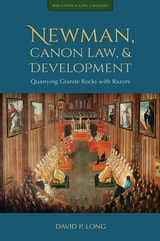
cover of Newman, Canon Law and Development: Quarrying Granite Rocks with Razors

Newman, Canon Law and Development

Quarrying Granite Rocks with Razors

David P. Long

Catholic University of America Press, 2024

John Henry Newman is well-known as a theologian, philosopher, historian, writer, University rector, and poet, but can he also be associated with the field of canon law? When Newman first proposed the possibility of doctrinal development as proof that the Catholic faith was free from corruption and error, he claimed “the Church is declared to be the great and special support of the Truth, her various functionaries are said to be means towards the settlement of diversities and of uncertainty of doctrine, and securing unity of faith.” For Newman, these various functionaries included not only apostles, prophets, evangelists, and pastors, but also theologians and, as is argued in this work, canon lawyers. While Newman and doctrinal development have become well-explored topics in the field of theology, there has been little scholarship on how Newman’s thoughts on doctrinal development can influence current canon law and Church governance. David Long addresses that lacuna by offering a systematic analysis of Newman’s concept of development within current canonical practice. It starts by tracing Newman’s notions of personal judgment, public discussion, and episcopal moderation, followed by a presentation of the current canonical understanding of the theologian, and finally an application of the connection between Newman’s theory on development and present canonical legislation as it involves the role of the theologian. By undertaking such an application, and by creating a model for discussion that preserves both development and Tradition, this work humbly proposes a valuable model for understanding the theologian’s contribution within the life of the contemporary Church in ways not previously explored.
[more]