Results by title
6 books match the query 'Newman, William R.'
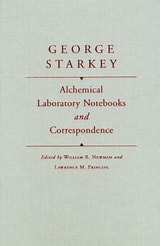
Alchemical Laboratory Notebooks and Correspondence
George Starkey
University of Chicago Press, 2004
George Starkey—chymistry tutor to Robert Boyle, author of immensely popular alchemical treatises, and probably early America's most important scientist—reveals in these pages the daily laboratory experimentation of a seventeenth-century alchemist.
The editors present in this volume transcriptions of Starkey's texts, their translations, and valuable commentary for the modern reader. Dispelling the myth that alchemy was an irrational enterprise, this remarkable collection of laboratory notebooks and correspondence reveals the otherwise hidden methodologies of one of the seventeenth century's most influential alchemists.
The editors present in this volume transcriptions of Starkey's texts, their translations, and valuable commentary for the modern reader. Dispelling the myth that alchemy was an irrational enterprise, this remarkable collection of laboratory notebooks and correspondence reveals the otherwise hidden methodologies of one of the seventeenth century's most influential alchemists.
[more]
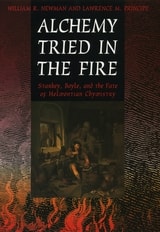
Alchemy Tried in the Fire
Starkey, Boyle, and the Fate of Helmontian ChymistryWilliam R. Newman and Lawrence M. Principe
University of Chicago Press, 2002
Winner of the 2005 Pfizer Prize from the History of Science Society.
What actually took place in the private laboratory of a mid-seventeenth century alchemist? How did he direct his quest after the secrets of Nature? What instruments and theoretical principles did he employ?
Using, as their guide, the previously misunderstood interactions between Robert Boyle, widely known as "the father of chemistry," and George Starkey, an alchemist and the most prominent American scientific writer before Benjamin Franklin as their guide, Newman and Principe reveal the hitherto hidden laboratory operations of a famous alchemist and argue that many of the principles and practices characteristic of modern chemistry derive from alchemy. By analyzing Starkey's extraordinary laboratory notebooks, the authors show how this American "chymist" translated the wildly figurative writings of traditional alchemy into quantitative, carefully reasoned laboratory practice—and then encoded his own work in allegorical, secretive treatises under the name of Eirenaeus Philalethes. The intriguing "mystic" Joan Baptista Van Helmont—a favorite of Starkey, Boyle, and even of Lavoisier—emerges from this study as a surprisingly central figure in seventeenth-century "chymistry." A common emphasis on quantification, material production, and analysis/synthesis, the authors argue, illustrates a continuity of goals and practices from late medieval alchemy down to and beyond the Chemical Revolution.
For anyone who wants to understand how alchemy was actually practiced during the Scientific Revolution and what it contributed to the development of modern chemistry, Alchemy Tried in the Fire will be a veritable philosopher's stone.
[more]
Atoms and Alchemy
Chymistry and the Experimental Origins of the Scientific RevolutionWilliam R. Newman
University of Chicago Press, 2006
Since the Enlightenment, alchemy has been viewed as a sort of antiscience, disparaged by many historians as a form of lunacy that impeded the development of rational chemistry. But in Atoms and Alchemy, William R. Newman—a historian widely credited for reviving recent interest in alchemy—exposes the speciousness of these views and challenges widely held beliefs about the origins of the Scientific Revolution.
Tracing the alchemical roots of Robert Boyle’s famous mechanical philosophy, Newman shows that alchemy contributed to the mechanization of nature, a movement that lay at the very heart of scientific discovery. Boyle and his predecessors—figures like the mysterious medieval Geber or the Lutheran professor Daniel Sennert—provided convincing experimental proof that matter is made up of enduring particles at the microlevel. At the same time, Newman argues that alchemists created the operational criterion of an “atomic” element as the last point of analysis, thereby contributing a key feature to the development of later chemistry. Atomsand Alchemy thus provokes a refreshing debate about the origins of modern science and will be welcomed—and deliberated—by all who are interested in the development of scientific theory and practice.
Tracing the alchemical roots of Robert Boyle’s famous mechanical philosophy, Newman shows that alchemy contributed to the mechanization of nature, a movement that lay at the very heart of scientific discovery. Boyle and his predecessors—figures like the mysterious medieval Geber or the Lutheran professor Daniel Sennert—provided convincing experimental proof that matter is made up of enduring particles at the microlevel. At the same time, Newman argues that alchemists created the operational criterion of an “atomic” element as the last point of analysis, thereby contributing a key feature to the development of later chemistry. Atomsand Alchemy thus provokes a refreshing debate about the origins of modern science and will be welcomed—and deliberated—by all who are interested in the development of scientific theory and practice.
[more]
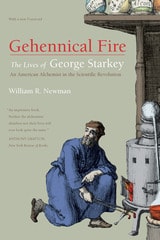
Gehennical Fire
The Lives of George Starkey, an American Alchemist in the Scientific RevolutionWilliam R. Newman
University of Chicago Press, 2002
Both the quest for natural knowledge and the aspiration to alchemical wisdom played crucial roles in the Scientific Revolution, as William R. Newman demonstrates in this fascinating book about George Starkey (1628-1665), America's first famous scientist. Beginning with Starkey's unusual education in colonial New England, Newman traces out his many interconnected careers—natural philosopher, alchemist, chemist, medical practitioner, economic projector, and creator of the fabulous adept, "Eirenaeus Philalethes." Newman reveals the profound impact Starkey had on the work of Isaac Newton, Robert Boyle, Samuel Hartlib, and other key thinkers in the realm of early modern science.
[more]
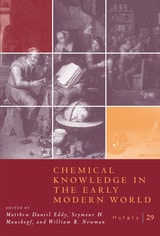
Osiris, Volume 29
Chemical Knowledge in the Early Modern WorldEdited by Matthew D. Eddy, Seymour H. Mauskopf, and William R. Newman
University of Chicago Press Journals, 2014
The last twenty-five years have witnessed some provocative transmutations in our understanding of early modern chemistry. The alchemist, once marginalized as a quack, now joins the apothecary, miner, humanist, and natural historian as a practitioner of “chymistry.” In a similar vein, the Chemical Revolution of the eighteenth century, with its focus on phlogiston and airs, has been expanded to include artisanal, medical, and industrial practices. This collection of essays builds on these reappraisals and excavates the affinities between alchemy, chymistry, and chemistry from the sixteenth to the eighteenth centuries. It reveals a rich world of theory and practice in which instruments, institutions, inscriptions and ideas were used to make material knowledge. More generally, the volume will catalyze wide-ranging discussions of material and visual cultures, the role of expertise, and the religious and practical contexts of scientific inquiry.
[more]
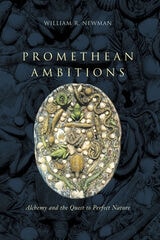
Promethean Ambitions
Alchemy and the Quest to Perfect NatureWilliam R. Newman
University of Chicago Press, 2004
In an age when the nature of reality is complicated daily by advances in bioengineering, cloning, and artificial intelligence, it is easy to forget that the ever-evolving boundary between nature and technology has long been a source of ethical and scientific concern: modern anxieties about the possibility of artificial life and the dangers of tinkering with nature more generally were shared by opponents of alchemy long before genetic science delivered us a cloned sheep named Dolly.
In Promethean Ambitions, William R. Newman ambitiously uses alchemy to investigate the thinning boundary between the natural and the artificial. Focusing primarily on the period between 1200 and 1700, Newman examines the labors of pioneering alchemists and the impassioned—and often negative—responses to their efforts. By the thirteenth century, Newman argues, alchemy had become a benchmark for determining the abilities of both men and demons, representing the epitome of creative power in the natural world. Newman frames the art-nature debate by contrasting the supposed transmutational power of alchemy with the merely representational abilities of the pictorial and plastic arts—a dispute which found artists such as Leonardo da Vinci and Bernard Palissy attacking alchemy as an irreligious fraud. The later assertion by the Paracelsian school that one could make an artificial human being—the homunculus—led to further disparagement of alchemy, but as Newman shows, the immense power over nature promised by the field contributed directly to the technological apologetics of Francis Bacon and his followers. By the mid-seventeenth century, the famous "father of modern chemistry," Robert Boyle, was employing the arguments of medieval alchemists to support the identity of naturally occurring substances with those manufactured by "chymical" means.
In using history to highlight the art-nature debate, Newman here shows that alchemy was not an unformed and capricious precursor to chemistry; it was an art founded on coherent philosophical and empirical principles, with vocal supporters and even louder critics, that attracted individuals of first-rate intellect. The historical relationship that Newman charts between human creation and nature has innumerable implications today, and he ably links contemporary issues to alchemical debates on the natural versus the artificial.
[more]