Results by title
5 books match the query 'Newport'

Lord, Please Don't Take Me in August
African-Americans in Newport and Saratoga Springs, 1870-1930Myra B. Young Armstead
University of Illinois Press, 1999
The lives built by Black Americans in a pair of summer resort towns
In the late nineteenth and early twentieth centuries, northern resort towns were in their heyday as celebrated retreats for America's wealthy. Lord, Please Don't Take Me in August documents the experiences of African Americans in Saratoga Springs, New York, and Newport, Rhode Island--towns that provided a recurring season of expanded employment opportunities, enhanced social life, cosmopolitan experience, and, in a good year, enough money to last through the winter.
Affirming that the decision to live in their tiny resort communities was conscious and deliberate, Myra B. Young Armstead shows how Afro-Saratogians and Afro-Newporters organized their rhythms, their routines, and their communities to create meaningful identities for themselves. Living on streets close to their churches, developing social organizations that promoted their standards of gentility and respectability, and lobbying for wider opportunities, these African Americans actively shaped their lives within the structures and limitations imposed on them.
Armstead situates the resort town between the poles of the rural South and the large industrial cities of the North. She shows how these small northern towns, with their seasonal economic rhythms and domestic wage work, permitted an important continuity between rural and urban lifestyles and a path from rural South to urban North besides the jarring, disruptive journey that often ended in the ghetto.
"Lord, Please Don't Take Me in August" tells a story that is at once American and uniquely African American: a story of economic imperatives and enlarged social aspirations culminating in a season--June, July, and August--that brought Blacks as close as they could get to the American Dream.

Newport In Rockies
Life & Good Times OfMarshall Sprague
Ohio University Press, 1988
In the town's early years, rich easterners and Englishmen came seeking adventure, romance, and gentility. But when gold was discovered at nearby Cripple Creek in 1900, Colorado Springs became an instant boom town. A second major boom came several decades later, when local boosters persuaded the Army to choose Colorado Springs as the site for Fort Carson, a training center for 30,000 troops. Other military projects followed, including Peterson Field, Ent Air Force Base, the underground North American Air Defense Command Combat Operations Center, and in 1954, the U.S. Air Force Academy. More recent projects, discussed in a new final chapter, include the Olympic Training Center and the Olympic Hall of Fame, as well as high-tech industries and advances in culture, education, and recreation.
As the city sprawls eastward onto the prairie, it bears little resemblance to General Palmer's 1871 village. Yet the general's dream of a quality town in a quality environment has continued to inspire generations of administrators and boosters who have made Colorado Springs a model of urban prosperity.
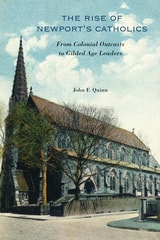
The Rise of Newport’s Catholics
From Colonial Outcasts to Gilded Age LeadersJohn F. Quinn
University of Massachusetts Press, 2024
Honorable Mention, 2025 Catholic Media Association Book Awards
Nineteenth-century New England was a hostile place for Catholics. In Massachusetts a mob torched a convent; in Maine a priest was tarred and feathered; and Rhode Island elected an anti-Catholic Know Nothing governor. “No Irish Need Apply” signs were common.
Newport was different. It was a religiously diverse and tolerant city that welcomed Catholic French troops during the American Revolution. Later, as it became the favored summer retreat for America’s Protestant social elite, Irish Catholics arrived to work in construction jobs, the tourist economy, and the grand Gilded Age cottages. By the end of the century, Newport’s Catholic community was flourishing. Moneyed Catholics acquired their own mansions, an Irish Catholic was mayor, and prominent Protestants were helping Catholic neighbors establish new schools and churches. In this deeply researched study, John F. Quinn delves into this rich Catholic history to discover why nineteenth-century Newport was particularly religiously tolerant and accepting.

The Victoria History of Essex
NewportEdited by Anthony Tuck
University of London Press, 2015
This book explores the varying character of Newport over eleven centuries. It examines the changing patterns of landownership, social structure and economy of the village and its institutions, not least its 16th-century grammar school. It also discusses the part played, especially in the 18th, 19th and 20th centuries, by the owners of Shortgrove Hall, within the parish, and Quendon Hall, a few miles to the south.

We Wanna Boogie
The Rockabilly Roots of Sonny Burgess and the PacersMarvin Schwartz
Butler Center for Arkansas Studies, 2014