Results by title
2 books match the query 'Ng, Eve'
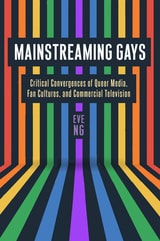
Mainstreaming Gays
Critical Convergences of Queer Media, Fan Cultures, and Commercial TelevisionEve Ng
Rutgers University Press, 2023
Mainstreaming Gays discusses a key transitional period linking the eras of legacy and streaming, analyzing how queer production and interaction that had earlier occurred outside the mainstream was transformed by multiple converging trends: the emergence of digital media, the rising influence of fan cultures, and increasing interest in LGBTQ content within commercial media. The U.S. networks Bravo and Logo broke new ground in the early 2000s and 2010s with their channel programming, as well as bringing in a new cohort of LGBTQ digital content creators, providing unprecedented opportunities for independent queer producers, and hosting distinctive spaces for queer interaction online centered on pop culture and politics rather than dating. These developments constituted the ground from which recent developments for LGBTQ content and queer sociality online have emerged. Mainstreaming Gays is critical reading for those interested in media production, fandom, subcultures, and LGBTQ digital media.
[more]
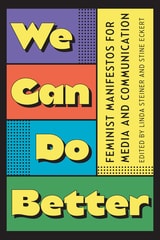
We Can Do Better
Feminist Manifestos for Media and CommunicationLinda Steiner
Rutgers University Press, 2025
Feminist Manifestos for Media and Communication brings together evidence-based manifestos for media and communication that take a feminist perspective and add up to a provocative vision of feminist media practices and of feminist communication. The book discusses critical problems and complaints in ways that identify and make the case for actionable, concrete solutions to media problems and deficiencies; it shows how feminist thinking can be usefully and effectively applied to a wide range of journalism, media, and communication practices. The manifestos are not “only” about women but rather offer specific, feasible blueprints for restructuring media in ways that make them fairer and more equitable along many vectors of identity, so that media can better serve democracy. These manifestos give concrete solutions to specific problems that can and should be implemented by journalists, media practitioners, students, faculty, and scholars. The manifestos are organized around three sets of demands: for better media practices, for more participatory online spaces, and for more precise and appropriate language.
[more]