Results by title
3 books match the query 'Nice, Richard'
Science of Science and Reflexivity
Pierre Bourdieu
University of Chicago Press, 2004
Over the last four decades, the French sociologist Pierre Bourdieu produced one of the most imaginative and subtle bodies of social theory of the postwar era. When he died two years ago, he was considered to be a thinker on a par with Foucault, Barthes, and Lacan—a public intellectual as influential to his generation as Sartre was to his.
Science of Science and Reflexivity will be welcomed as a companion volume to Bourdieu's now seminal An Invitation to Reflexive Sociology. In this posthumous work, Bourdieu declares that science is in danger of becoming a handmaiden to biotechnology, medicine, genetic engineering, and military research—that it risks falling under the control of industrial corporations that seek to exploit it for monopolies and profit.
Science thus endangered can become detrimental to mankind. The line between pure and applied science, therefore, must be subjected to intense theoretical scrutiny. Bourdieu's goals in Science of Science and Reflexivity are to identify the social conditions in which science develops in order to reclaim its objectivity and to rescue it from relativism and the forces that might exploit it. In the grand tradition of scientific reflections on science, Bourdieu provides a sociological analysis of the discipline as something capable of producing transhistorical truths; he presents an incisive critique of the main currents in the study of science throughout the past half century; and he offers a spirited defense of science against encroaching political and economic forces.
A masterful summation of the principles underlying Bourdieu's oeuvre and a memoir of his own scientific journey, Science of Science and Reflexivity is a capstone to one of the most important and prodigious careers in the field of sociology.
[more]
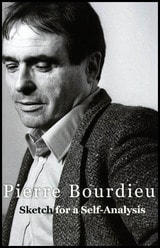
Sketch for a Self-Analysis
Pierre Bourdieu
University of Chicago Press, 2008
Over the past four decades, French sociologist Pierre Bourdieu produced one of the most imaginative and subtle bodies of social theory of the postwar era. When he died in 2002, he was considered to be the most influential sociologist in the world and a thinker on a par with Foucault and Lévi-Strauss—a public intellectual as important to his generation as Sartre was to his.
Sketch for a Self-Analysis is the ultimate outcome of Bourdieu’s lifelong preoccupation with reflexivity. Vehemently not an autobiography, this unique book is instead an application of Bourdieu’s theories to his own life and intellectual trajectory; along the way it offers compelling and intimate insights into the most important French intellectuals of the time—including Foucault, Sartre, Aron, Althusser, and de Beauvoir—as well as Bourdieu’s own formative experiences at boarding school and his moral outrage at the colonial war in Algeria.
[more]

The Bachelors' Ball
The Crisis of Peasant Society in BéarnPierre Bourdieu
University of Chicago Press, 2008
Over the past four decades, French sociologist Pierre Bourdieu produced one of the most imaginative and subtle bodies of social theory of the postwar era. When he died in 2002, he was considered to be the most influential sociologist in the world and a thinker on a par with Foucault and Lévi-Strauss—a public intellectual as important to his generation as Sartre was to his.
Bourdieu’s final book, The Bachelors’ Ball, sees him return to Béarn, the region where he grew up, to examine the gender dynamics of rural France. This personal connection adds poignancy to Bourdieu’s ethnographic account of the way the influence of urban values has precipitated a crisis for male peasants. Tied to the land through inheritance, these bachelors find themselves with little to offer the women of Béarn who, like the young Bourdieu himself, abandon the country for the city in droves.
[more]