Results by title

8 books match the query 'Nicholas, of Cusa, Cardinal'
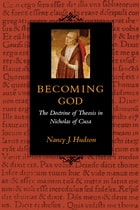
cover of Becoming God: The Doctrine of Theosis in Nicholas of Cusa

Becoming God

The Doctrine of Theosis in Nicholas of Cusa

Nancy J. Hudson

Catholic University of America Press, 2007
The doctrine of theosis means a salvation that is the deification of the saved. The saved actually become God. This unusual doctrine lies at the heart of Nicholas of Cusa's (1401-1464) mystical metaphysics. It is here examined for the first time as a theme in its own right, along with its implications for Cusanus's doctrine of God, his theological anthropology, and his epistemology.
[more]
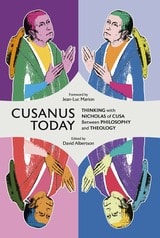
cover of Cusanus Today: Thinking with Nicholas of Cusa Between Philosophy and Theology

Cusanus Today

Thinking with Nicholas of Cusa Between Philosophy and Theology

David C. Albertson

Catholic University of America Press, 2024
At the end of the nineteenth century, German theologians and philosophers rediscovered the Renaissance cardinal Nicholas of Cusa (1401-1464). Immediately they hailed Cusanus as the first modern thinker, a brilliant German rival to the French Descartes. But since the founding of the Cusanus critical edition in 1927 up to its conclusion in 2005, historians have gradually learned that Nicholas was more of a medieval preacher and contemplative than a modern philosopher. Yet over the same century, modern German and French readers were already digging into Nicholas’s many works. There they encountered an exciting voice with fresh perspectives about God’s immanence in the cosmos and the awesome capacities of the human mind. Leading philosophers and theologians from Erich Przywara to Karl Jaspers to Hans-Georg Gadamer, and from Gilles Deleuze to Jacques Lacan to Michel de Certeau, found their own thinking stimulated by the cardinal’s innovative concepts and interdisciplinary style. Even as Nicholas shifted from modern to medieval among historians, he was emerging as a contemporary interlocutor for moderns and postmoderns. Who could have guessed that the first debate between Jean-Luc Marion and Emmanuel Falque would take place over the fifteenth-century mystical dialogue, De visione dei? If Meister Eckhart found his moment amidst Deconstruction in prior decades, Nicholas of Cusa is our thinker for today. His interests anticipate themes in continental philosophy of religion, whether alterity, invisibility, the fold, or the icon. His habit of interweaving philosophy and theology anticipates current debates on the thresholds of phenomenology. Our volume first maps the contours of modern receptions of Nicholas of Cusa in French and German spheres, and then beyond Europe to the Americas and Japan. It also hosts the next round of engagement by some of today’s most original Christian thinkers: Emmanuel Falque, John Milbank, and David Bentley Hart.
[more]
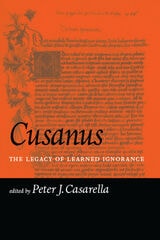
cover of Cusanus: A Legacy of Learned Ignorance

Cusanus

A Legacy of Learned Ignorance

Peter J. Casarella

Catholic University of America Press, 2006
This volume offers a detailed historical background to Cusanus's thinking while also assaying his significance for the present. It brings together major contributions from the English-speaking world as well as voices from Europe.
[more]
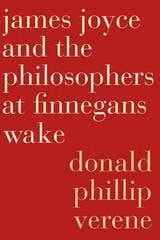
cover of James Joyce and the Philosophers at Finnegans Wake

James Joyce and the Philosophers at Finnegans Wake

Donald Phillip Verene

Northwestern University Press, 2016
James Joyce and the Philosophers at Finnegans Wake explores how Joyce used the philosophers Nicholas Cusanus, Giordano Bruno, and Giambattista Vico as the basis upon which to write Finnegans Wake. Very few Joyce critics know enough about these philosophers and therefore often miss their influence on Joyce's great work. Joyce embraces these philosophic companions to lead him through the underworld of history with all its repetitions and resurrections, oppositions and recombinations. We as philosophical readers of the Wake go along with them to meet everybody and in so doing are bound "to encounter for the millionth time the reality of experience and to forge in the smithy" of our souls the "uncreated conscience" of humankind. Verene builds his study on the basis of years of teaching Finnegans Wake side by side with Cusanus, Bruno, and Vico, and his book will serve as a guide to readers of Joyce's novel.
[more]
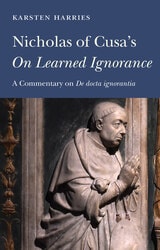
cover of Nicholas of Cusa's <i>On Learned Ignorance</i>: A Commentary on <i>De docta ignorantia</i>

Nicholas of Cusa's <i>On Learned Ignorance</i>

A Commentary on <i>De docta ignorantia</i>

Karsten Harries

Catholic University of America Press, 2024
This is the first commentary to have been written on Nicholas of Cusa's most famous work, On Learned Ignorance. This fact testifies to the difficulty of what has long been recognized to be the most significant philosophical text produced by the Renaissance. While there are many passages in the work that can be cited in support of Cassirer's celebration of Cusanus as the first modern philosopher, that judgment is challenged by the way his work is rooted in a faith and a tradition likely to strike us as thoroughly medieval. This commentary shows how closely the two are linked. Despite the many ways in which what the cardinal has to say belongs to a past that the progress of reason would seem to have left irrecoverably behind, it yet provides us with a continuing challenge. Key to On Learned Ignorance is the incommensurability of the infinite and the finite, of God and creation. Cusanus lets us recognize the essential transcendence of reality, so different from the ontology implied by Descartes' insistence on clear and distinct understanding, which has presided over the progress of science and has helped shape our world. What makes Cusanus’ thought important is not the way it anticipates modernity, but the way it challenges often taken-for-granted presuppositions of our worldview, most importantly a distinctly modern self-assertion or self-elevation that has made our human reason the measure of reality. If it is impossible to deny the countless ways in which our science and technology have given us ever deeper insights into the mysteries of nature and improved our lives, it is equally impossible to deny that this very progress today endangers this fragile earth and the quality of our lives. Cusanus can help us preserve our humanity.
[more]
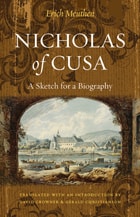
cover of Nicholas of Cusa: A Sketch for a Biography

Nicholas of Cusa

A Sketch for a Biography

Erich Meuthen

Catholic University of America Press, 2010
This translation of Erich Meuthen's well-known biography of Nicholas of Cusa presents the foremost summary of Cusanus's life and thought. F
[more]
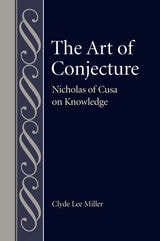
cover of The Art of Conjecture: Nicholas of Cusa on Knowledge

The Art of Conjecture

Nicholas of Cusa on Knowledge

Clyde Lee Miller

Catholic University of America Press, 2021
“Learned ignorance,” the recognition that God is beyond us and our knowing capacities is the theological concept for which Nicholas of Cusa is most famous. Despite God’s apparent absence Nicholas offers original ways to think about God that would unite his presence with his absence. He called these proposals “conjectures” (coniecturae). Conjecture and conjecturing are central to the methodology of Nicholas’s philosophical theology and to his thinking about human knowledge. By using concrete examples from the everyday life of his times as symbolic imagery Nicholas makes what we say about God imaginatively available and theoretically plausible. He called such conjectural symbols “aenigmata” (= “symbolic or ‘enigmatic’ conjectures”) because they partially clarify and likewise point to an exact truth that is beyond us. Novel and imaginative, Nicholas’s conjectural examples break with the traditional medieval Aristotelian examples and provide further evidence of his role as a figure bridging medieval and Renaissance thought. Following his earlier book, Reading Cusanus (The Catholic University of America Press, 2003), Clyde Lee Miller here examines and comments on the meaning of “conjecture” in Nicholas of Cusa. The Art of Conjecture: Nicholas of Cusa on Knowledge explores what Nicholas meant by conjecture and its import as demonstrated in his treatises and sermons. Beginning with Nicholas’ On Conjectures, Miller analyzes a series of conjectural symbols and proposals across Nicholas’s less frequently discussed texts and recently published sermons. This early Renaissance thinker offers an original and ground-breaking way of framing speculation in philosophical theology and more generally in philosophy itself.
[more]
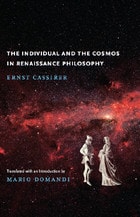
cover of The Individual and the Cosmos in Renaissance Philosophy

The Individual and the Cosmos in Renaissance Philosophy

Ernst Cassirer

University of Chicago Press, 2010

This provocative volume, one of the most important interpretive works on the philosophical thought of the Renaissance, has long been regarded as a classic in its field.  Ernst Cassirer here examines the changes brewing in the early stages of the Renaissance, tracing the interdependence of philosophy, language, art, and science; the newfound recognition of individual consciousness; and the great thinkers of the period—from da Vinci and Galileo to Pico della Mirandola and Giordano Bruno. The Individual and the Cosmos in Renaissance Philosophy discusses the importance of fifteenth-century philosopher Nicholas Cusanus, the concepts of freedom and necessity, and the subject-object problem in Renaissance thought.

“This fluent translation of a scholarly and penetrating original leaves little impression of an attempt to show that a ‘spirit of the age’ or ‘spiritual essence of the time’ unifies and expresses itself in all aspects of society or culture.”—Philosophy

[more]