Results by title
4 books match the query 'Niedecker, Lorine'

Between Your House and Mine
The Letters of Lorine Niedecker to Cid Corman, 1960-1970Lisa Pater Faranda, ed.
Duke University Press, 1986
The early letters were written before Niedecker's marriage and at a time when the poet had "more trees for friends than people." In these letters from Black Hawk Island, Niedecker sought a community of fellow poets. The following period, the Milwaukee years, form the bulk of the collection and saw the establishment of Niedecker's identity as a poet. From the city of "point-top towers," she wrote Corman frequently about poetry, other poets, current events, and daily life. After her return in 1969 to Black Hawk Island, relieved of earlier anxieties over publication, she was confidently at work on her sequences, her most serious poetic undertaking.
Lorine Niedecker
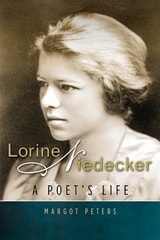
A Poet’s LifeMargot Peters
University of Wisconsin Press, 2011
Lorine Niedecker (1903–70) was a poet of extraordinary talent whose life and work were long enveloped in obscurity. After her death in 1970, poet Basil Bunting wrote that she was “the most interesting woman poet America has yet produced . . . only beginning to be appreciated when she died.” Her poverty and arduous family life, the isolated home in Wisconsin that provided rich imagery for her work, and her unusual acquaintances have all contributed to Niedecker’s enigmatic reputation.
Margot Peters brings Lorine Niedecker’s life out of the shadows in this first full biography of the poet. She depicts Niedecker’s watery world on Blackhawk Island (near Fort Atkinson, Wisconsin), where she was born and spent most of her life. A brief college career cut short by family obligations and an equally brief marriage were followed in 1931 by the start of a life-changing correspondence and complicated thirty-five-year friendship with modernist poet Louis Zukofsky, who connected Niedecker to a literary lifeline of distant poets and magazines. Supporting herself by turns as a hospital scrubwoman and proofreader for a dairy journal, Niedecker made a late marriage to an industrial painter, which gave her time to write and publish her work in the final decades of her life.
During her lifetime, Niedecker’s poetry was praised by a relatively small literary circle, including Zukofsky, William Carlos Williams, Robert Creeley, Denise Levetov, and Allen Ginsberg. Since her death much more of her surviving writings have been published, including a comprehensive edition of collected works and two volumes of correspondence. Through Margot Peters’s compelling biography, readers will discover Lorine Niedecker as a poet of spare and brilliant verse and a woman whose talent and grit carried her through periods of desperation and despair.
Best Special Interest Books, selected by the American Association of School Librarians
Radical Vernacular
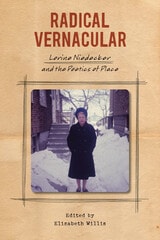
Lorine Niedecker and the Poetics of PlaceElizabeth Willis
University of Iowa Press, 2008
Aesthetically linked with the New York Objectivist poets, Niedecker remained committed to her community in rural Wisconsin despite the grinding poverty that dogged her throughout her life. Largely self-taught, Niedecker formed attachments through her voracious reading and correspondence, but she also delighted in the disruptive richness of vernacular usage and in the homegrown, improvisational aesthetics that thrived within her immediate world. Niedecker wrote from a highly attenuated concern with biological, cultural, and political sustainability and, in her stridently modernist poems, anticipated many of the most urgent concerns in twenty-first-century poetics. In Radical Vernacular, Elizabeth Willis collects essays by leading poets and scholars that make a major contribution to the study of an important but long overlooked American poet.
This pathbreaking volume contains essays by seventeen leading scholars: Rae Armantrout, Glenna Breslin, Michael Davidson, Rachel Blau DuPlessis, Ruth Jennison, Peter Middleton, Jenny Penberthy, Mary Pinard, Patrick Pritchett, Peter Quartermain, Lisa Robertson, Elizabeth Robinson, Eleni Sikelianos, Jonathan Skinner, Anne Waldman, Eliot Weinberger, and Elizabeth Willis.
The Granite Pail
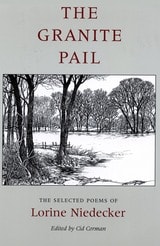
The Selected Poems of Lorine NiedeckerLorine Niedecker
Ohio University Press, 1996
This edition was published in 1996 by Gnomon Press.
The Granite Pail is a masterful collection that showcases the poetic brilliance of one of America’s most underappreciated modernist poets. Known for its minimalist style and deep connection to the natural world, Niedecker’s work combines precision with emotional depth in poems that resonate long after they are read.
This volume brings together some of Niedecker’s finest poetry, illustrating her gift for capturing profound truths in the simplest of forms. With themes ranging from the intimate and domestic to the universal and ecological, her poems reflect a life deeply rooted in the landscapes of rural Wisconsin. From meditations on the passage of time to lyrical explorations of nature, The Granite Pail reveals the interplay between solitude, creativity, and the human condition.
Edited and introduced by Cid Corman, a champion of Niedecker’s work, the collection highlights her unique voice within the Objectivist tradition and her ability to create moments of beauty and insight with remarkable economy. This edition also provides context for her life and influences, shedding light on her artistic evolution and the lasting significance of her poetry.
For both longtime admirers and those new to Niedecker’s work, The Granite Pail offers an essential glimpse into the mind of a poet whose quiet brilliance continues to inspire readers and writers alike.