Results by title
5 books match the query 'Nietzsche, Friedrich'
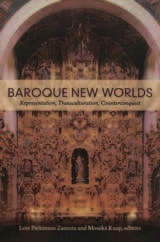
Baroque New Worlds
Representation, Transculturation, CounterconquestLois Parkinson Zamora and Monika Kaup, eds.
Duke University Press, 2010
Since Neobaroque reconstitutions necessarily reference the European Baroque, this volume begins with the reevaluation of the Baroque that evolved in Europe during the late nineteenth century and the early twentieth. Foundational essays by Friedrich Nietzsche, Heinrich Wölfflin, Walter Benjamin, Eugenio d’Ors, René Wellek, and Mario Praz recuperate and redefine the historical Baroque. Their essays lay the groundwork for the revisionist Latin American essays, many of which have not been translated into English until now. Authors including Alejo Carpentier, José Lezama Lima, Severo Sarduy, Édouard Glissant, Haroldo de Campos, and Carlos Fuentes understand the New World Baroque and Neobaroque as decolonizing strategies in Latin America and other postcolonial contexts. This collection moves between art history and literary criticism to provide a rich interdisciplinary discussion of the transcultural forms and functions of the Baroque.
Contributors. Dorothy Z. Baker, Walter Benjamin, Christine Buci-Glucksmann, José Pascual Buxó, Leo Cabranes-Grant, Haroldo de Campos, Alejo Carpentier, Irlemar Chiampi, William Childers, Gonzalo Celorio, Eugenio d’Ors, Jorge Ruedas de la Serna, Carlos Fuentes, Édouard Glissant, Roberto González Echevarría, Ángel Guido, Monika Kaup, José Lezama Lima, Friedrich Nietzsche, Mario Praz, Timothy J. Reiss, Alfonso Reyes, Severo Sarduy, Pedro Henríquez Ureña, Maarten van Delden, René Wellek, Christopher Winks, Heinrich Wölfflin, Lois Parkinson Zamora

On Future Of Educational Institutions
Friedrich Nietzsche
St. Augustine's Press, 2004
On the Future of Our Educational Institutions, the work that was to have been Nietzsche's second book until he canceled the contract and used portions in his Untimely Meditations, is a substantial call for radical educational reform presented in the form of a prolonged narrative dialogue. It is presented here in the first English translation ever from the standard critical edition (a little-known translation was made for the Complete Works of 1909, long out of print). Here Nietzsche, through the characters of this prolonged narrative dialogue, starts from a consideration of German educational institutions and rises to a consideration of what is needed for true, or classical, education. Though Nietzsche engages his contemporary world more in this work than in perhaps any other, this engagement is neither arbitrary nor limiting. Starting where one is and has grown up happens to be the necessary grounding of the organic unity that belongs to true culture: "Every so-called classical education has only one healthy and natural starting point, the artistic, serious, and rigorous habituation in the use of the mother tongue. . . . Here where gradually the distinguishing feeling for form and for barbarism awakes, the wing bestirs itself for the first time that carries to the right and sole home of education, to Greek antiquity. Of course we would not come very far with the help of that wing all alone in the attempt to bring ourselves close to that castle of the Hellenic, infinitely distant and enclosed within diamond ramparts: rather anew we need the same leaders, the same teachers, our German classics, in order ourselves to become swept away under the wingbeat of their ancient endeavors to the land of longing, to Greece."
In this dialogue, Nietzsche considers what it would mean to put education, culture, first in priority above all else, above religion, above economics, even above the state. The dialogue's call for educational reform goes so far as to require that the state be completely subordinated to the demands and needs of culture. The state must not be "a border guard, regulator, or overseer for his culture; rather the robust, muscular comrade, ready for battle, and companion on the way, who gives the admired, nobler, and, as it were, unearthly friend safe conduct through the harsh realities and for that earns his thankfulness."
Not only does the dialogue demand that the state subordinate itself to education, but it goes on to suggest that widespread educational institutions are for the sake of only a small number of beneficiaries. This radical and uncompromising devotion to the education of a very few sketches Nietzsche's thoughts on education perhaps more completely than any other work.
In addition, this dialogue offers numerous other objects of interest. The dialogue form shows off Nietzsche's literary art and offers an occasion to think carefully about the special tasks involved in reading philosophic texts well. The circumstances of this text's writing and its nearly being published offer insights both into Nietzsche's development and into the production of his works, especially regarding the Untimely Meditations. The letters and notes in the appendices help to flesh out the thinking that surrounds this text as well as to suggest the form of the never-written sixth lecture. Also Nietzsche's engagement with the immediate tradition of his contemporary milieu, not only with Goethe, Schiller, and Lessing but also with lesser figures such as Koetzebue, Grillparzer, and Gutzkow, should be of interest to intellectual historians and students of European culture.
Nietzsche read On the Future of Our Educational Institutions publicly in the form of five lectures. He then tried to rush it into publication, and it very nearly became Nietzsche's second book. Only at the last moment did he withdraw the book from the public. Now it is available in English.
Prefaces To Unwritten Works
Friedrich Nietzsche
St. Augustine's Press, 2005
Prefaces to Unwritten Works is a collection of five essays, prefaces to books that Nietzsche never went on to write. Nietzsche himself put these prefaces together in the form of a small leather-bound, handwritten book, and gave that book to Cosima Wagner as a Christmas present in 1872. The dedicatory letter indicates that Nietzsche sent this little book to Cosima "in heartfelt reverence and as an answer to verbal and epistolary questions." As such, this work is a window into Nietzsche's relations with the Wagners at the height of their association, but it is also a continuation of Nietzsche's radical confrontation with Greek antiquity that had begun with the then-recently published Birth of Tragedy. The Wagners read Nietzsche's book of prefaces on the evening of New Year's Day 1873, and Cosima records in her diary five days later that at night, "again" she reflected about the essence of art as a consequence of Nietzsche's work. A month later, Cosima sent Nietzsche a letter encouraging him to write at least two of the books promised by his prefaces.
Nietzsche did not go to write the books heralded by these prefaces, but the prefaces themselves provide substantial challenges of their own and intriguing clues as to the form and content of the books Nietzsche may have intended. Some of these prefaces are better known to students of Nietzsche than others and have attracted significant attention from scholars. The first essay is entitled On the Pathos of Truth, and it considers the relative value of truth and art for human life. The second essay, Thoughts on the Future of Our Educational Institutions, is the only preface in this collection regarding which Nietzsche did actually go on to write a book, albeit a book he did not publish (entitled On the Future of Our Educational Institutions, now available from St. Augustine's Press). This essay is a revised version of the preface Nietzsche wrote for that book, and the changes Nietzsche made are indicative of the plans he had for an improved version. The topic of the essay is almost entirely the art of careful reading. The third essay is entitled The Greek State, and it treats of the relation of slavery to culture and of the genius to the state. This essay is also an interpretation of Plato's Republic, in which Nietzsche claims to reveal everything he has "divined of this secret writing." The fourth essay, The Relation of Schopenhauerian Philosophy to a German Culture, neither assumes that there is in fact, at present, a German Culture, nor hardly mentions Schopenhauer at all, except to suggest that he is one about whom a culture could be built. The final essay is entitled Homer's Contest and is an exploration of the place of jealousy, strife, and agonistic competition in Greek culture.
Together these five essays show Nietzsche's continuing exploration into the differences between modern human beings and the Greeks of classical antiquity. He boldly asks, "Why did the whole Greek world exult at the images of battle of the Iliad?" The answers he offers reveal the dark and harrowing insights of the ancient world and also the sometimes cruel and violent, but also perhaps psychically healthy, character of the ancient Greek. Nietzsche's attention to and concern with classical antiquity raises in each of these essays broad and universal questions about the relation of society and culture to genius. Culture, he says, "rests upon a terrifying ground." And underneath it all, and present with varying explicitness in all of the essays, lies the problem of humanity's relation to time. We see "every disappearing and perishing . . . with dissatisfaction" and yet, "Every moment devours the one that went before, every birth is the death of countless beings."
This volume benefits from presenting all five prefaces together, translated literally and consistently. The appendices present preliminary drafts of various portions of the respective prefaces and a prolonged fragment Nietzsche wrote extending his thoughts from the Birth of Tragedy and containing text intimately related to some of the five prefaces.
The Dionysian Vision of the World
Friedrich Nietzsche
University of Minnesota Press, 2012
Before the world knew of the thinker who “philosophizes with a hammer,” there was a young, passionate thinker who was captivated by the two forces found within Greek art: Dionysus and Apollo. In this essay, which was the forerunner to his groundbreaking book The Birth of Tragedy, The Dionysian Vision of the World provides an unparalleled look into the philosophical mind of one of Europe’s greatest and provocative intellects at the beginning of his philosophical interrogation on the subject of art. “While dreaming is the game man plays with reality as an individual, the visual artist (in the larger sense) plays a game with dreaming.” This is the Dionysian vision of the world.
The Pre-Platonic Philosophers
Friedrich Nietzsche
University of Illinois Press, 2006