Results by title
75 books match the query 'Nigeria' and 4 start with a
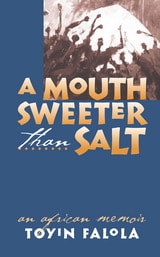
A Mouth Sweeter Than Salt
An African MemoirToyin Falola
University of Michigan Press, 2005
"Toyin Falola has given us what is truly rare in modern African writing: a seriously funny, racy, irreverent package of memories, and full of the most wonderful pieces of poetry and ordinary information. It is a matter of some interest, that the only other volume A Mouth Sweeter Than Salt reminds one of is Ake, by Wole Soyinka. What is it about these Yorubas?"
-Ama Ata Aidoo
"A splendid coming-of-age story so full of vivid color and emotion, the words seem to dance off the page. But this is not only Falola's memoir; it is an account of a new nation coming into being and the tensions and negotiations that invariably occur between city and country, tradition and modernity, men and women, rich and poor. A truly beautiful book."
-Robin D. G. Kelley
"More than a personal memoir, this book is a rich minihistory of contemporary Nigeria recorded in delicious detail by a perceptive eyewitness who grew up at the crossroads of many cultures."
-Bernth Lindfors
"The reader is irresistibly drawn into Falola's world. The prose is lucid. There is humor. This work is sweet. Period."
-Ngugi wa Thiongo'o
A Mouth Sweeter Than Salt gathers the stories and reflections of the early years of Toyin Falola, the grand historian of Africa and one of the greatest sons of Ibadan, the notable Yoruba city-state in Nigeria.
Redefining the autobiographical genre altogether, Falola miraculously weaves together personal, historical, and communal stories, along with political and cultural developments in the period immediately preceding and following Nigeria's independence, to give us a unique and enduring picture of the Yoruba in the mid-twentieth century. This is truly a literary memoir, told in language rich with proverbs, poetry, song, and humor.
Falola's memoir is far more than the story of one man's childhood experiences; rather, he presents us with the riches of an entire culture and community-its history, traditions, pleasures, mysteries, household arrangements, forms of power, struggles, and transformations.
[more]
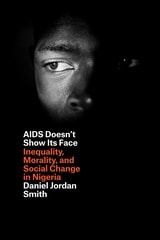
AIDS Doesn't Show Its Face
Inequality, Morality, and Social Change in NigeriaDaniel Jordan Smith
University of Chicago Press, 2014
AIDS and Africa are indelibly linked in popular consciousness, but despite widespread awareness of the epidemic, much of the story remains hidden beneath a superficial focus on condoms, sex workers, and antiretrovirals. Africa gets lost in this equation, Daniel Jordan Smith argues, transformed into a mere vehicle to explain AIDS, and in AIDS Doesn’t Show Its Face, he offers a powerful reversal, using AIDS as a lens through which to view Africa.
Drawing on twenty years of fieldwork in Nigeria, Smith tells a story of dramatic social changes, ones implicated in the same inequalities that also factor into local perceptions about AIDS—inequalities of gender, generation, and social class. Nigerians, he shows, view both social inequality and the presence of AIDS in moral terms, as kinds of ethical failure. Mixing ethnographies that describe everyday life with pointed analyses of public health interventions, he demonstrates just how powerful these paired anxieties—medical and social—are, and how the world might better alleviate them through a more sensitive understanding of their relationship.
Drawing on twenty years of fieldwork in Nigeria, Smith tells a story of dramatic social changes, ones implicated in the same inequalities that also factor into local perceptions about AIDS—inequalities of gender, generation, and social class. Nigerians, he shows, view both social inequality and the presence of AIDS in moral terms, as kinds of ethical failure. Mixing ethnographies that describe everyday life with pointed analyses of public health interventions, he demonstrates just how powerful these paired anxieties—medical and social—are, and how the world might better alleviate them through a more sensitive understanding of their relationship.
[more]
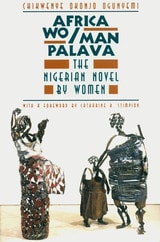
Africa Wo/Man Palava
The Nigerian Novel by WomenChikwenye Okonjo Ogunyemi
University of Chicago Press, 1995
Africa Wo/Man Palava offers the first close look at eight Nigerian women writers and proposes a new vernacular theory based on their work. Flora Nwapa, Adaora Lily Ulasi, Buchi Emecheta, Funmilayo Fakunle, Ifeoma Okoye, Zaynab Alkali, Eno Obong, and Simi Bedford are the writers Chikwenye Okonjo Ogunyemi considers. African womanism, an emerging model of female discourse, is at the heart of their writing. In their work, female resistance shifts from the idea of palava, or trouble, to a focus on consensus, compromise, and cooperation; it tackles sexism, totalitarianism, and ethnic prejudice. Such inclusiveness, Ogunyemi shows, stems from an emphasis on motherhood, acknowledging that everyone is a mother's child, capable of creating palava and generating a compromise.
Ogunyemi uses the novels to trace a Nigerian women's literary tradition that reflects an ideology centered on children and community. Of prime importance is the paradoxical Mammywata figure, the independent, childless mother, who serves as a basis for the new woman in these novels. Ogunyemi tracks this figure through many permutations, from matriarch to exile to woman writer, her multiple personalities reflecting competing loyalties—to self and other, children and nation. Such fragmented personalities characterize the postcolonial condition in their writing. Mapping geographies of pain and endurance, the work opens a space for addressing the palava between different groups of people. Valuable as the first sustained critical study of a substantial but little known body of literature, this book also counters the shortcomings of prevailing "masculinist" theories of black literature in a powerful narrative of the Nigerian world.
Ogunyemi uses the novels to trace a Nigerian women's literary tradition that reflects an ideology centered on children and community. Of prime importance is the paradoxical Mammywata figure, the independent, childless mother, who serves as a basis for the new woman in these novels. Ogunyemi tracks this figure through many permutations, from matriarch to exile to woman writer, her multiple personalities reflecting competing loyalties—to self and other, children and nation. Such fragmented personalities characterize the postcolonial condition in their writing. Mapping geographies of pain and endurance, the work opens a space for addressing the palava between different groups of people. Valuable as the first sustained critical study of a substantial but little known body of literature, this book also counters the shortcomings of prevailing "masculinist" theories of black literature in a powerful narrative of the Nigerian world.
[more]
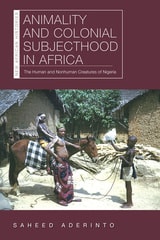
Animality and Colonial Subjecthood in Africa
The Human and Nonhuman Creatures of NigeriaSaheed Aderinto
Ohio University Press, 2022
With this multispecies study of animals as instrumentalities of the colonial state in Nigeria, Saheed Aderinto argues that animals, like humans, were colonial subjects in Africa. Animality and Colonial Subjecthood in Africa broadens the historiography of animal studies by putting a diverse array of species (dogs, horses, livestock, and wildlife) into a single analytical framework for understanding colonialism in Nigeria and Africa as a whole. From his study of animals with unequal political, economic, social, and intellectual capabilities, Aderinto establishes that the core dichotomies of human colonial subjecthood—indispensable yet disposable, good and bad, violent but peaceful, saintly and lawless—were also embedded in the identities of Nigeria’s animal inhabitants. If class, religion, ethnicity, location, and attitude toward imperialism determined the pattern of relations between human Nigerians and the colonial government, then species, habitat, material value, threat, and biological and psychological characteristics (among other traits) shaped imperial perspectives on animal Nigerians. Conceptually sophisticated and intellectually engaging, Aderinto’s thesis challenges readers to rethink what constitutes history and to recognize that human agency and narrative are not the only makers of the past.
[more]