Results by title
5 books match the query 'Nineteen seventies'
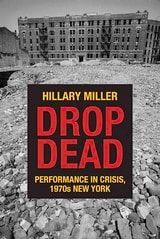
Drop Dead
Performance in Crisis, 1970s New YorkHillary Miller
Northwestern University Press, 2016
Winner, 2017 American Theater and Drama Society John W. Frick Book Award
Winner, 2017 ASTR Barnard Hewitt Award for Outstanding Research in Theater History
Hillary Miller’s Drop Dead: Performance in Crisis, 1970s New York offers a fascinating and comprehensive exploration of how the city’s financial crisis shaped theater and performance practices in this turbulent decade and beyond.
New York City’s performing arts community suffered greatly from a severe reduction in grants in the mid-1970s. A scholar and playwright, Miller skillfully synthesizes economics, urban planning, tourism, and immigration to create a map of the interconnected urban landscape and to contextualize the struggle for resources. She reviews how numerous theater professionals, including Ellen Stewart of La MaMa E.T.C. and Julie Bovasso, Vinnette Carroll, and Joseph Papp of The Public Theater, developed innovative responses to survive the crisis.
Combining theater history and close readings of productions, each of Miller’s chapters is a case study focusing on a company, a production, or an element of New York’s theater infrastructure. Her expansive survey visits Broadway, Off-, Off-Off-, Coney Island, the Brooklyn Academy of Music, community theater, and other locations to bring into focus the large-scale changes wrought by the financial realignments of the day.
Nuanced, multifaceted, and engaging, Miller’s lively account of the financial crisis and resulting transformation of the performing arts community offers an essential chronicle of the decade and demonstrates its importance in understanding our present moment.
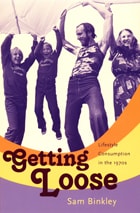
Getting Loose
Lifestyle Consumption in the 1970sSam Binkley
Duke University Press, 2007
Through a sociological analysis of the countercultural print culture of the 1970s, Sam Binkley investigates the dissemination of these self-loosening narratives and their widespread appeal to America’s middle class. He describes the rise of a genre of lifestyle publishing that emerged from a network of small offbeat presses, mostly located on the West Coast. Amateurish and rough in production quality, these popular books and magazines blended Eastern mysticism, Freudian psychology, environmental ecology, and romantic American pastoralism as they offered “expert” advice—about how to be more in touch with the natural world, how to release oneself into trusting relationships with others, and how to delve deeper into the body’s rhythms and natural sensuality. Binkley examines dozens of these publications, including the Whole Earth Catalog, Rainbook, the Catalog of Sexual Consciousness, Celery Wine, Domebook, and Getting Clear.
Drawing on the thought of Pierre Bourdieu, Zygmunt Bauman, and others, Binkley explains how self-loosening narratives helped the middle class confront the modernity of the 1970s. As rapid social change and political upheaval eroded middle-class cultural authority, the looser life provided opportunities for self-reinvention through everyday lifestyle choice. He traces this ethos of self-realization through the “yuppie” 1980s to the 1990s and today, demonstrating that what originated as an emancipatory call to loosen up soon evolved into a culture of highly commercialized consumption and lifestyle branding.
Happy Days
Images of the Pre-Sixties Past in Seventies AmericaBenjamin L. Alpers
Rutgers University Press, 2024
Happy Days investigates how 1970s popular culture was obsessed with America’s past but often offered radically different interpretations of the same historical events and icons. Even the figure of the greaser, once an icon of juvenile delinquency, was made family-friendly by Henry Winkler’s Fonzie at the same time that he was being appropriated in more threatening ways by punk and gay subcultures. The cultural historian Benjamin Alpers discovers similar levels of ambivalence toward the past in 1970s neo-noir films, representations of America’s founding, and neo-slave narratives by Alex Haley and Octavia Butler. By exploring how Americans used the 1970s to construct divergent representations of their shared history, he identifies it as a pivotal moment in the nation’s ideological fracturing.
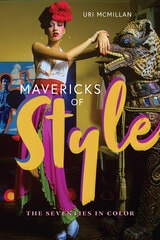
Mavericks of Style
The Seventies in ColorUri McMillan
Duke University Press, 2025
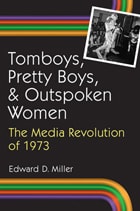
Tomboys, Pretty Boys, and Outspoken Women
The Media Revolution of 1973Edward D. Miller
University of Michigan Press, 2011
“Edward Miller has written a sharply observant, often revelatory, and stimulating book that explores the 1970s with gusto, showing all the intimacy and pleasure and startling richness of observation with which a scholar may sometimes approach a period in which he lived.”
—Martin Harries, New York University
Contemporary American media is awash with reality programs, faux documentaries, and user generated content. When did this fixation on real or feigned nonfictionality begin? Tomboys, Pretty Boys, and Outspoken Women argues that its origins can be found in the early 1970s, when American media discovered the entertainment value of documentaries, news programming, and other nonfiction forms. Edward D. Miller challenges preconceptions of the ’60s and ’70s through close readings of key events and important figures in the early 1970s: John Dean’s performance in front of the Senate during the Watergate Hearings; Billie Jean King popularizing tennis by taking on Bobby Riggs in a prime-time match; David Bowie experiencing “outer space” in his tours across America; An American Family and their gay son facing the public’s consternation; and Alison Steele, a female DJ who invited listeners to fly with her at night. Miller explores the early 1970s as a turning point in American culture, with nonfiction media of the time creating new possibilities for expressions of gender and sexuality, and argues that we are living in its aftermath.
In addition to readers attracted to media studies, this book will be of great interest to those involved in LGBT studies, feminism, and queer studies as well as students of contemporary media culture. The aim of the book is to demystify current media trends by providing an analysis of the recent past. Tomboys, Pretty Boys, and Outspoken Women is written for a large audience that extends beyond academia and embraces readers who have an interest in American pop culture and, in particular, the '70s.