Results by title
2 books match the query 'Nineteenth - Century American Culture'

Dependent States
The Child's Part in Nineteenth-Century American CultureKaren Sánchez-Eppler
University of Chicago Press, 2005
Because childhood is not only culturally but also legally and biologically understood as a period of dependency, it has been easy to dismiss children as historical actors. By putting children at the center of our thinking about American history, Karen Sánchez-Eppler recognizes the important part childhood played in nineteenth-century American culture and what this involvement entailed for children themselves.
Dependent States examines the ties between children's literacy training and the growing cultural prestige of the novel; the way children functioned rhetorically in reform literature to enforce social norms; the way the risks of death to children shored up emotional power in the home; how Sunday schools socialized children into racial, religious, and national identities; and how class identity was produced, not only in terms of work, but also in the way children played. For Sánchez-Eppler, nineteenth-century childhoods were nothing less than vehicles for national reform. Dependent on adults for their care, children did not conform to the ideals of enfranchisement and agency that we usually associate with historical actors. Yet through meticulously researched examples, Sánchez-Eppler reveals that children participated in the making of social meaning. Her focus on childhood as a dependent state thus offers a rewarding corrective to our notions of autonomous individualism and a new perspective on American culture itself.
Dependent States examines the ties between children's literacy training and the growing cultural prestige of the novel; the way children functioned rhetorically in reform literature to enforce social norms; the way the risks of death to children shored up emotional power in the home; how Sunday schools socialized children into racial, religious, and national identities; and how class identity was produced, not only in terms of work, but also in the way children played. For Sánchez-Eppler, nineteenth-century childhoods were nothing less than vehicles for national reform. Dependent on adults for their care, children did not conform to the ideals of enfranchisement and agency that we usually associate with historical actors. Yet through meticulously researched examples, Sánchez-Eppler reveals that children participated in the making of social meaning. Her focus on childhood as a dependent state thus offers a rewarding corrective to our notions of autonomous individualism and a new perspective on American culture itself.
[more]
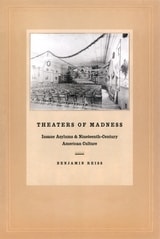
Theaters of Madness
Insane Asylums and Nineteenth-Century American CultureBenjamin Reiss
University of Chicago Press, 2008
In the mid-1800s, a utopian movement to rehabilitate the insane resulted in a wave of publicly funded asylums—many of which became unexpected centers of cultural activity. Housed in magnificent structures with lush grounds, patients participated in theatrical programs, debating societies, literary journals, schools, and religious services. Theaters of Madness explores both the culture these rich offerings fomented and the asylum’s place in the fabric of nineteenth-century life, reanimating a time when the treatment of the insane was a central topic in debates over democracy, freedom, and modernity.
Benjamin Reiss explores the creative lives of patients and the cultural demands of their doctors. Their frequently clashing views turned practically all of American culture—from blackface minstrel shows to the works of William Shakespeare—into a battlefield in the war on insanity. Reiss also shows how asylums touched the lives and shaped the writing of key figures, such as Emerson and Poe, who viewed the system alternately as the fulfillment of a democratic ideal and as a kind of medical enslavement. Without neglecting this troubling contradiction, Theaters of Madness prompts us to reflect on what our society can learn from a generation that urgently and creatively tried to solve the problem of mental illness.
[more]