Results by title

9 books match the query 'Nineteenth - Century Britain'
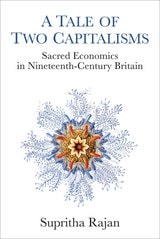
cover of A Tale of Two Capitalisms: Sacred Economics in Nineteenth-Century Britain

A Tale of Two Capitalisms

Sacred Economics in Nineteenth-Century Britain

Supritha Rajan

University of Michigan Press, 2015
No questions are more pressing today than the ethical dimensions of global capitalism in relation to an unevenly secularized modernity. A Tale of Two Capitalisms offers a timely response to these questions by reexamining the intellectual history of capitalist economics during the nineteenth century. Rajan’s ambitious book traces the neglected relationships between nineteenth-century political economy, anthropology, and literature in order to demonstrate how these discourses buttress a dominant narrative of self-interested capitalism that obscures a submerged narrative within political economy. This submerged narrative discloses political economy’s role in burgeoning theories of religion, as well as its underlying ethos of reciprocity, communality, and just distribution.

Drawing on an impressive range of literary, anthropological, and economic writings from the eighteenth through the twenty-first century, Rajan offers an inventive, interdisciplinary account of why this second narrative of capitalism has so long escaped our notice. The book presents an unprecedented genealogy of key anthropological and economic concepts, demonstrating how notions of sacrifice, the sacred, ritual, totemism, and magic remained conceptually intertwined with capitalist theories of value and exchange in both sociological and literary discourses.

Rajan supplies an original framework for discussing the ethical ideals that continue to inform contemporary global capitalism and its fraught relationship to the secular. Its revisionary argument brings new insight into the history of capitalist thought and modernity that will engage scholars across a variety of disciplines.


[more]
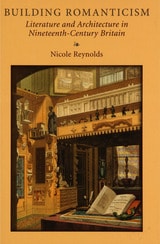
cover of Building Romanticism: Literature and Architecture in Nineteenth-Century Britain

Building Romanticism

Literature and Architecture in Nineteenth-Century Britain

Nicole Reynolds

University of Michigan Press, 2010
Building Romanticism sets the literary culture of Romantic Britain within the context of the period’s architectural productions in order to recover a relationship between these arts that, though deeply valued by writers and architects of the day, has been neglected by modern scholars in both fields. Toward this goal, Nicole Reynolds explores the centrality of architecture and architectural tropes to Romanticism’s dramatic reconceptualization of the individual subject and of the world that subject inhabits.Focusing on the correspondence between the period’s built environments and its literary pursuits, Building Romanticism argues that at this turbulent moment in British history a number of politically charged and aesthetically resonant architectural spaces, both real and imagined, negotiated intense anxieties about shifting notions of gender and sexuality, increased class mobility, the individual’s uncertain place in history, challenges to the British national character and to the project of nation building, and the very form and function of art itself. By tracing the reception of Romantic topoi—rhetorical and literal common places—through the nineteenth century, this book explores how Victorians remodeled Romanticism, its ideological preoccupations and cultural artifacts, according to their own era's social agendas.
[more]
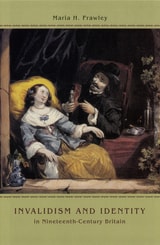
cover of Invalidism and Identity in Nineteenth-Century Britain

Invalidism and Identity in Nineteenth-Century Britain

Maria H. Frawley

University of Chicago Press, 2004

Nineteenth-century Britain did not invent chronic illness, but its social climate allowed hundreds of men and women, from intellectuals to factory workers, to assume the identity of "invalid." Whether they suffered from a temporary condition or an incurable disease, many wrote about their experiences, leaving behind an astonishingly rich and varied record of disability in Victorian Britain.

Using an array of primary sources, Maria Frawley here constructs a cultural history of invalidism. She describes the ways that Evangelicalism, industrialization, and changing patterns of doctor/patient relationships all converged to allow a culture of invalidism to flourish, and explores what it meant for a person to be designated—or to deem oneself—an invalid. Highlighting how different types of invalids developed distinct rhetorical strategies, her absorbing account reveals that, contrary to popular belief, many of the period's most prominent and prolific invalids were men, while many women found invalidism an unexpected opportunity for authority.

In uncovering the wide range of cultural and social responses to notions of incapacity, Frawley sheds light on our own historical moment, similarly fraught with equally complicated attitudes toward mental and physical disorder.
[more]
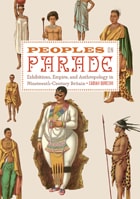
cover of Peoples on Parade: Exhibitions, Empire, and Anthropology in Nineteenth-Century Britain

Peoples on Parade

Exhibitions, Empire, and Anthropology in Nineteenth-Century Britain

Sadiah Qureshi

University of Chicago Press, 2011
In May 1853, Charles Dickens paid a visit to the “savages at Hyde Park Corner,” an exhibition of thirteen imported Zulus performing cultural rites ranging from songs and dances to a “witch-hunt” and marriage ceremony. Dickens was not the only Londoner intrigued by these “living curiosities”: displayed foreign peoples provided some of the most popular public entertainments of their day. At first, such shows tended to be small-scale entrepreneurial speculations of just a single person or a small group. By the end of the century, performers were being imported by the hundreds and housed in purpose-built “native” villages for months at a time, delighting the crowds and allowing scientists and journalists the opportunity to reflect on racial difference, foreign policy, slavery, missionary work, and empire.
 
Peoples on Parade provides the first substantial overview of these human exhibitions in nineteenth-century Britain. Sadiah Qureshi considers these shows in their entirety—their production, promotion, management, and performance—to understand why they proved so commercially successful, how they shaped performers’ lives, how they were interpreted by their audiences, and what kinds of lasting influence they may have had on notions of race and empire. Qureshi supports her analysis with diverse visual materials, including promotional ephemera, travel paintings, theatrical scenery, art prints, and photography, and thus contributes to the wider understanding of the relationship between science and visual culture in the nineteenth century.
 
Through Qureshi’s vibrant telling and stunning images, readers will see how human exhibitions have left behind a lasting legacy both in the formation of early anthropological inquiry and in the creation of broader public attitudes toward racial difference.
[more]
cover of Rhetoric and Resistance: The Literary Arts of Dissent in Nineteenth-Century Britain

Rhetoric and Resistance

The Literary Arts of Dissent in Nineteenth-Century Britain

Maeve Adams

Ohio University Press, 2025

A fresh perspective on the enduring relationship between literature, democracy, and dissent

Rhetoric and Resistance explores the transformative role of nineteenth-century literature in shaping modern concepts and practices of democratic dissent. By examining the works of Romantic and Victorian novelists, poets, and journalists, Maeve Adams identifies origins of modern theories and practices of resistance in nineteenth-century literary forms. Offering a literary history of dissent, the book recovers the intertwined development of democracy and aesthetics, revealing how narrative form became a potent tool for challenging authority.

Tracing the lineage of dissent from the radical fiction and journalism of the 1800s to contemporary movements like #MeToo, Adams offers a genealogy that highlights how literary texts experimented with political power, granting new and consequential voices to working-class individuals, women, colonized peoples, and other marginalized groups.

Adams takes an interdisciplinary approach, weaving together close readings of works by Thomas De Quincey, Walter Scott, Elizabeth Gaskell, and H. G. Wells, as well as lesser-known journalists, with insights from modern moral and political philosophy. Drawing on theories of democratic ethics and justice from scholars such as Miranda Fricker, Sharon Krause, Martha Nussbaum, and Philip Pettit, the book bridges literary history and contemporary debates about political agency and expression.
[more]
cover of Science Periodicals in Nineteenth-Century Britain: Constructing Scientific Communities

Science Periodicals in Nineteenth-Century Britain

Constructing Scientific Communities

Edited by Gowan Dawson, Bernard Lightman, Sally Shuttleworth, and Jonathan R. Topham

University of Chicago Press, 2020

Periodicals played a vital role in the developments in science and medicine that transformed nineteenth-century Britain. Proliferating from a mere handful to many hundreds of titles, they catered to audiences ranging from gentlemanly members of metropolitan societies to working-class participants in local natural history clubs. In addition to disseminating authorized scientific discovery, they fostered a sense of collective identity among their geographically dispersed and often socially disparate readers by facilitating the reciprocal interchange of ideas and information. As such, they offer privileged access into the workings of scientific communities in the period.
 
The essays in this volume set the historical exploration of the scientific and medical periodicals of the era on a new footing, examining their precise function and role in the making of nineteenth-century science and enhancing our vision of the shifting communities and practices of science in the period. This radical rethinking of the scientific journal offers a new approach to the reconfiguration of the sciences in nineteenth-century Britain and sheds instructive light on contemporary debates about the purpose, practices, and price of scientific journals.
[more]
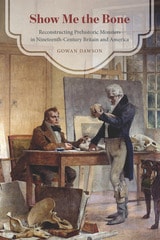
cover of Show Me the Bone: Reconstructing Prehistoric Monsters in Nineteenth-Century Britain and America

Show Me the Bone

Reconstructing Prehistoric Monsters in Nineteenth-Century Britain and America

Gowan Dawson

University of Chicago Press, 2016

Nineteenth-century paleontologists boasted that, shown a single bone, they could identify or even reconstruct the extinct creature it came from with infallible certainty—“Show me the bone, and I will describe the animal!” Paleontologists such as Georges Cuvier and Richard Owen were heralded as scientific virtuosos, sometimes even veritable wizards, capable of resurrecting the denizens of an ancient past from a mere glance at a fragmentary bone. Such extraordinary feats of predictive reasoning relied on the law of correlation, which proposed that each element of an animal corresponds mutually with each of the others, so that a carnivorous tooth must be accompanied by a certain kind of jawbone, neck, stomach, limbs, and feet.
 
Show Me the Bone tells the story of the rise and fall of this famous claim, tracing its fortunes from Europe to America and showing how it persisted in popular science and literature and shaped the practices of paleontologists long after the method on which it was based had been refuted. In so doing, Gowan Dawson reveals how decisively the practices of the scientific elite were—and still are—shaped by their interactions with the general public.
[more]
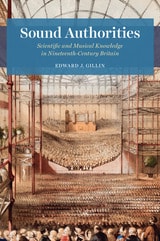
cover of Sound Authorities: Scientific and Musical Knowledge in Nineteenth-Century Britain

Sound Authorities

Scientific and Musical Knowledge in Nineteenth-Century Britain

Edward J. Gillin

University of Chicago Press, 2021

Sound Authorities shows how experiences of music and sound played a crucial role in nineteenth-century scientific inquiry in Britain.

In Sound Authorities, Edward J. Gillin focuses on hearing and aurality in Victorian Britain, claiming that the development of the natural sciences in this era cannot be understood without attending to the study of sound and music.

During this time, scientific practitioners attempted to fashion themselves as authorities on sonorous phenomena, coming into conflict with traditional musical elites as well as religious bodies. Gillin pays attention to sound in both musical and nonmusical contexts, specifically the cacophony of British industrialization. Sound Authorities begins with the place of acoustics in early nineteenth-century London, examining scientific exhibitions, lectures, spectacles, workshops, laboratories, and showrooms. He goes on to explore how mathematicians mobilized sound in their understanding of natural laws and their vision of a harmonious ordered universe. In closing, Gillin delves into the era’s religious and metaphysical debates over the place of music (and humanity) in nature, the relationship between music and the divine, and the tensions between spiritualist understandings of sound and scientific ones.
[more]
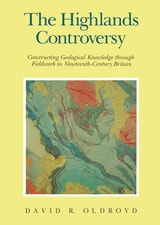
cover of The Highlands Controversy: Constructing Geological Knowledge through Fieldwork in Nineteenth-Century Britain

The Highlands Controversy

Constructing Geological Knowledge through Fieldwork in Nineteenth-Century Britain

David R. Oldroyd

University of Chicago Press, 1990

The Highlands Controversy is a rich and perceptive account of the third and last major dispute in nineteenth-century geology stemming from the work of Sir Roderick Murchison. The earlier Devonian and Cambrian-Silurian controversies centered on whether the strata of Devon and Wales should be classified by lithological or paleontological criteria, but the Highlands dispute arose from the difficulties the Scottish Highlands presented to geologists who were just learning to decipher the very complex processes of mountain building and metamorphism. David Oldroyd follows this controversy into the last years of the nineteenth century, as geology was transformed by increasing professionalization and by the development of new field and laboratory techniques. In telling this story, Oldroyd's aim is to analyze how scientific knowledge is constructed within a competitive scientific community—how theory, empirical findings, and social factors interact in the formation of knowledge.

Oldroyd uses archival material and his own extensive reconstruction of the nineteenth-century fieldwork in a case study showing how detailed maps and sections made it possible to understand the exceptionally complex geological structure of the Highlands

An invaluable addition to the history of geology, The Highlands Controversy also makes important contributions to our understanding of the social and conceptual processes of scientific work, especially in times of heated dispute.
[more]