Results by title
2 books match the query 'Nineteenth - Century Literature'
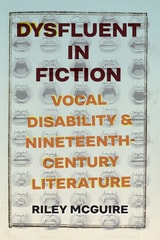
Dysfluent in Fiction
Vocal Disability and Nineteenth-Century LiteratureRiley McGuire
The Ohio State University Press, 2025
Honorable Mention, 2025 Victorian Popular Fiction Association First Book Prize
In Dysfluent in Fiction, Riley McGuire unspools a literary history of vocal disability in the nineteenth century, arguing that this underexamined literary trope helps us to understand vocal hierarchies that still structure our present. Adopting the term “dysfluency” to show departure from normative expectations of pace, pitch, and fluency, McGuire reveals how dysfluent speech populates an enormous number of nineteenth-century texts and played a formative role in the lives of some of the period’s most influential writers.
Dysfluent in Fiction examines anglophone literature during the long nineteenth century in both England and America by authors such as William Makepeace Thackeray, Charlotte Brontë, Lewis Carroll, Mary Elizabeth Braddon, and Frederick Douglass. Examples of dysfluencies across genres include lisping lovers, a baby-talking fairy, a mute detective, various disabilities in narratives of enslavement, and more. These representations show how disabled speech was both stigmatized and celebrated in ways that clarify our contemporary response to the spectrum of human articulation and that are a vocal corollary to current notions of neurodiversity. Dysfluency’s power, McGuire contends, lies in its denial that a single mode of articulation is possible, let alone desirable.

Macropolitics of Nineteenth-Century Literature
Nationalism, Exoticism, ImperialismJonathan Arac and Harriet Ritvo, eds.
Duke University Press, 0
The dozen essays gathered here span the entire era of colonization and discuss the British Isles, Europe, the United States, India, the Caribbean, and Africa. Addressing the works of Wordsworth, Shelley, Dickens, Melville, Flaubert, Conrad, and Charlotte Brontë, as well as explorers’ reports, Bible translations, popular theater, and folklore, the contributors consider such topics as the political function of aesthetic containment, the redefinitions of nationality under the pressure of imperial ambition, and the coexistence of imperial and revolutionary tendencies. New historical data and new interpretive perspectives alter our conception of established masterpieces and provoke new understandings of the political and cultural context within which these works emerged. This anthology demonstrates that the macropolitical concept of imperialism can provide a new understanding of nineteenth-century cultural production by integrating into a single process the well-established topics of nationalism and exoticism.
First published in 1991 (University of Pennsylvania Press), Macropolitics of Nineteenth-Century Literature is now available in paperback. Offering agenda-setting essays in cultural and Victorian studies, it will be of interest to students and scholars of British and American literature, literary theory, and colonial and postcolonial studies.
Contributors. Jonathan Arac, Chris Bongie, Wai-chee Dimock, Bruce Greenfield, Mark Kipperman, James F. Knapp, Loren Kruger, Lisa Lowe, Susan Meyer, Jeff Nunokawa, Harriet Ritvo, Marlon B. Ross, Nancy Vogeley, Sue Zemka