Results by title
3 books match the query 'Nineteenth - Century Women Writers'
MAKING THE “AMERICA OF ART”
Cultural Nationalism and Nineteenth-Century Women WritersNaomi Z. Sofer
The Ohio State University Press, 2005
By the end of the 19th century it had become possible for American women to identify themselves as serious Artists. This was a relatively new phenomenon, one that became possible only after American women writers had dismantled the conceptual frameworks that had authorized their artistic production since the early days of the Republic.
Making the “America of Art” demonstrates that beginning in the 1850s, women writers challenged the terms of the Scottish Common Sense philosophy, which had made artistic endeavors acceptable in the new Republic by subordinating aesthetic motivation to moral and educational goals. Harriet Beecher Stowe and Augusta Jane Evans drew on Ruskin to argue for the creation of a religiously based national aesthetic. In the postbellum years Louisa May Alcott, Rebecca Harding Davis, Elizabeth Stuart Phelps, and Constance Fenimore Woolson continued the process in a series of writings that revolved around three central areas of concern: the place of the popular in the realm of high art; the role of the genius; and the legacy of the Civil War.
Sofer significantly revises the history of 19th-century American women’s authorship by detailing the gradual process that produced women writers wholly identified with literary high culture at the century’s end. Sofer argues that, counter to conventional wisdom, American women writers produced a large body of theoretical writing on the central aesthetic questions of the day. Although the writers Sofer studies were finally unable to construct viable new models for women’s artistic production, their attempts to do so are an essential piece of American literary history.
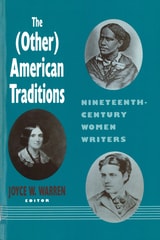
The (Other) American Traditions
Nineteenth-Century Women WritersWarren, Joyce W
Rutgers University Press, 1993
The American literary canon has been the subject of debate and change for at least a decade. As women writers and writers of color are being rediscovered and acclaimed, the question of whether they are worthy of inclusion remains open.
The (Other) American Traditions brings together for the first time in one place, essays on individual writers and traditions that begin to ask the harder questions. How do we talk about these writers once we get beyond the historical issues? How is their work related to their male counterparts? How is it similar: how is it different? Are differences related to gender or race or class? How has the selection of books in the literary canon (Melville, Hawthorne, Emerson, and James) led to a definition of the American tradition that was calculated to exclude women? Do we need a new critical vocabulary to discuss these works? Should we stop talking about a tradition and begin to talk about many traditions? How did black American women writers develop strategies for speaking out when they were doubly in jeopardy of being ignored as blacks and as women? The volume offers irrefutable proof that the writers, the critics who work on their texts, all these questions, and the expansion of the canon matter very much indeed.
Contributors: Nina Baym, Deborah Carlin, Joanne Dobson, Josephine Donovan, Judith Fetterley, Frances Smith Foster, Susan K. Harris, Karla F.C. Holloway, Paul Lauter, Diane Lichtenstein, Carla L. Peterson, Carol J. Singley, Jane Tompkins, Joyce W. Warren and Sandra A. Zagarell.
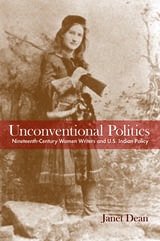
Unconventional Politics
Nineteenth-Century Women Writers and U.S. Indian PolicyJanet Dean
University of Massachusetts Press, 2016
Dean argues that in protesting U.S. Indian policy through popular genres, Wakefield, Sigourney, Callahan, and Eddleman also critiqued cultural protocols and stretched the contours of accepted modes of feminine discourse. Their acts of improvisation and reinvention tell a new story about the development of American women's writing and political expression.