Results by title
61 books match the query 'Nineteenth Century' and 11 start with a
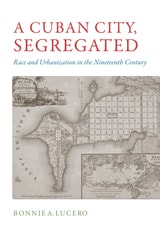
A Cuban City, Segregated
Race and Urbanization in the Nineteenth CenturyBonnie A. Lucero
University of Alabama Press, 2019
Founded as a white colony in 1819, Cienfuegos, Cuba, quickly became home to people of African descent, both free and enslaved, and later a small community of Chinese and other immigrants. Despite the racial, ethnic, and cultural diversity that defined the city’s population, the urban landscape was characterized by distinctive racial boundaries, separating the white city center from the heterogeneous peripheries. A Cuban City, Segregated: Race and Urbanization in the Nineteenth Century explores how the de facto racial segregation was constructed and perpetuated in a society devoid of explicitly racial laws.
Drawing on the insights of intersectional feminism, Bonnie A. Lucero shows that the key to understanding racial segregation in Cuba is recognizing the often unspoken ways specifically classed notions and practices of gender shaped the historical production of race and racial inequality. In the context of nineteenth-century Cienfuegos, gender, race, and class converged in the concept of urban order, a complex and historically contingent nexus of ideas about the appropriate and desired social hierarchy among urban residents, often embodied spatially in particular relationships to the urban landscape.
As Cienfuegos evolved subtly over time, the internal logic of urban order was driven by the construction and defense of a legible, developed, aesthetically pleasing, and, most importantly, white city center. Local authorities produced policies that reduced access to the city center along class and gendered lines, for example, by imposing expensive building codes on centric lands, criminalizing poor peoples’ leisure activities, regulating prostitution, and quashing organized labor. Although none of these policies mentioned race outright, this new scholarship demonstrates that the policies were instrumental in producing and perpetuating the geographic marginality and discursive erasure of people of color from the historic center of Cienfuegos during its first century of existence.
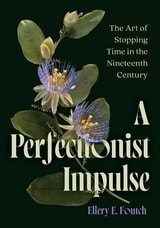
A Perfectionist Impulse
The Art of Stopping Time in the Nineteenth CenturyEllery E. Foutch
University of Minnesota Press, 2026
Exploring a collection of wondrous objects to understand the nineteenth-century desire to preserve the perfect moment
Cultural studies of the nineteenth century often categorize their subjects as being motivated by one of two opposing notions: a wholehearted embrace of progress or an antimodernist nostalgia. A Perfectionist Impulse centers a different kind of response to the period’s newly intensified awareness of temporality and history: an obsession with preserving perfection. Engaging a diverse set of case studies, Ellery E. Foutch explores the era’s desire to forestall the march of time and immortalize the fleeting moment through art and technology.
Beginning with an investigation of artist and naturalist Titian Peale’s butterfly illustrations and specimen boxes, Foutch assesses the implications of attempts to fix animal life in the “perfect state.” She then turns to Harvard’s Ware Collection of Glass Flowers, botanical models meticulously crafted to serve as instructional tools but most famous internationally as a spectacle for tourists. Finally, she scrutinizes the period’s preoccupation with the fragility of the human body, examining artistic representations of the legendary bodybuilder Eugen Sandow, widely known during his time as the “Perfect Man.” Highlighting the paradoxical way in which these attempts at preservation ultimately sap the vitality from the organic processes they seek to arrest, Foutch uses these curious objects to unpack a deep set of cultural anxieties around decay and death.
By analyzing objects of mass culture and natural history using methods typically reserved for works of art, A Perfectionist Impulse provides a unique window into how nineteenth-century scientists, technologists, artists, and entertainers rendered a common desire for perfection and immortality. Itself a wondrous collection of attempts to capture the idealized moment, this extensively illustrated book serves as a shining example of our enduring fascination with the ephemeral.
Retail e-book files for this title are screen-reader friendly with images accompanied by short alt text and/or extended descriptions.
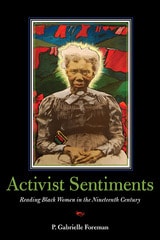
Activist Sentiments
Reading Black Women in the Nineteenth CenturyP. Gabrielle Foreman
University of Illinois Press, 2009
Activist Sentiments takes as its subject women who in fewer than fifty years moved from near literary invisibility to prolific productivity. Grounded in primary research and paying close attention to the historical archive, this book offers against-the-grain readings of the literary and activist work of Harriet Jacobs, Harriet Wilson, Frances E. W. Harper, Victoria Earle Matthews and Amelia E. Johnson.
Part literary criticism and part cultural history, Activist Sentiments examines nineteenth-century social, political, and representational literacies and reading practices. P. Gabrielle Foreman reveals how Black women's complex and confrontational commentary–often expressed directly in their journalistic prose and organizational involvement--emerges in their sentimental, and simultaneously political, literary production.

African-American Poetry of the Nineteenth Century
AN ANTHOLOGYEdited by Joan R. Sherman
University of Illinois Press, 1992
from first editions and are annotated in detail.
Against Exclusion
Disrupting Anti-Chinese Violence in the Nineteenth CenturyAudrey Wu Clark
The Ohio State University Press, 2024
In Against Exclusion, Audrey Wu Clark dramatically reframes Asian American resistance via the lives of five early Chinese American public figures. In contrast to later activists who sought to defy stereotypes, Ah Toy, Mary Tape, Wong Chin Foo, Yan Phou Lee, and Yung Wing deployed the model minority and yellow peril tropes to make themselves visible during a period of rampant anti-Chinese violence and legal exclusion. In making themselves visible, they sought to expose and dismantle the contradictory exceptionalism of nineteenth-century US liberalism that both required and “disavowed” the deaths of Chinese Americans. In examining these figures and the ways in which they fought their exclusion as Chinese Americans—via court cases, autobiographical writings, journalism, and other forms of activism—Clark contributes to prevailing scholarly conversations about stereotypes of Asian Americans but contextualizes them in the nineteenth century. She traces the twinned emergences of the model minority and the yellow peril, excavating the exceptionalism with which Chinese Americans were racialized and subject to death—whether by lynching, other forms of driving out, or loss of citizenship or rights—and mapping its reverberations into the present day.
Alexander Dallas Bache
Building the American Nation through Science and Education in the Nineteenth CenturyAxel Jansen
Campus Verlag, 2011
Alexander Dallas Bache (1806–1867) was one of the leaders of American science in the nineteenth century. Driven by a vision of science as a key component of an integrated U.S. nation-state, he guided the nascent American Association for the Advancement of Science and also led what was at that point the nation’s largest scientific enterprise, the U.S. Coast Survey. In this analytical biography, Axel Jansen explains and explores Bache’s efforts to build and shape public institutions as aids to his goal of creating a national foundation for a shared culture—efforts that culminated in his work during the Civil War as one of the founders of the National Academy of Sciences, which he saw as a key symbol of the continued viability of a unified American nation.
American Orchestras in the Nineteenth Century
Edited by John Spitzer
University of Chicago Press, 2012
Studies of concert life in nineteenth-century America have generally been limited to large orchestras and the programs we are familiar with today. But as this book reveals, audiences of that era enjoyed far more diverse musical experiences than this focus would suggest. To hear an orchestra, people were more likely to head to a beer garden, restaurant, or summer resort than to a concert hall. And what they heard weren’t just symphonic works—programs also included opera excerpts and arrangements, instrumental showpieces, comic numbers, and medleys of patriotic tunes.
American Women Poets of the Nineteenth Century
Edited by Cheryl Walker
Rutgers University Press, 1992

An Unarmed Woman
John Bennion
Signature Books, 2019
Angels and Absences
Child Deaths in the Nineteenth CenturyLaurence Lerner
Vanderbilt University Press, 1997
What is the difference between public and private feeling, and how far can we deduce past feelings from the words that have been left us? Why do child deaths figure so often and so prominently in the literature of the nineteenth century, and how was the theme of the death of a child used to elicit such poignant responses in the readers of that era? In this fascinating new book, Laurence Lerner vividly contrasts the contempt with which twentieth- century criticism so often dismisses such works as mere sentimentality with the enthusiasm and tears of nineteenth-century contemporaries.
Drawing examples from both real and literary deaths, Lerner delves into the writings of well-known authors such as Dickens, Coleridge, Shelley, Flaubert, Mann, Huxley, and Hesse, as well as lesser known writers like Felicia Hemans and Lydia Sigourney. In the process, he synthesizes fresh ideas about the thorny subjects of sentimentality, aesthetic judgment, and the function of religion in literature.
Lerner's forthright and evocative prose style is enjoyable reading, and he excels in teasing out the moral implications and the psychosocial entanglements of his chosen narrative and lyrical texts. This is a book that will illuminate an important aspect of the history of private life. It should have wide application for those interested in the history, sociology, and literature of the nineteenth century.

Art and the Academy in the Nineteenth Century
Rafael Cardoso Denis
Rutgers University Press, 2000
"Intellectually broad and carefully grounded in fundamental issues affecting the time, role, and place of the academy in society, this collection explores the ways in which art and tradition are either maintained or rearticulated late in the Victorian Era. Art and the Academy forges a distinctive new way to look at the broad range of academic creativity against a complex network of changing social patterns." -Gabriel P. Weisberg, department of art history, University of Minnesota
Throughout the nineteenth century, academies functioned as the main venues for the teaching, promotion, and display of art. Contemporary scholars have, for the most part, denigrated academic art, calling it formulaic, unoriginal, and repetitious. The contributors to Art and the Academy in the Nineteenth Century challenge this entrenched notion and consider how academies worldwide have represented an important system of artistic preservation and transmission. Their essays eschew easy binaries that have reigned in academia for over half a century and that simply oppose the avant-garde to academism.
The essayists uncover the institutional structures and artistic practices of academies in England, France, Germany, and Brazil. Investigating artistic protocols across national and cultural boundaries, the scholars examine the relationship between artistic training and cultural identity. Their essays provide new insights into the ways in which institutions of art helped shape the nineteenth century's view of itself as an age of civilization amidst the turmoil of rapid social and cultural change. With an engaging mix of works by leading scholars, Art and the Academy will be essential reading for anyone interested in the artistic, cultural, and social history of the nineteenth century.
Rafael Cardoso Denis is adjunct professor (visiting) at the Escola Superior de Desenho Industrial (Universidade do Estado do Rio de Janeiro). Colin Trodd is senior lecturer in art history at the University of Sunderland.
.