Results by title
3 books match the query 'Ninkovich, Frank'
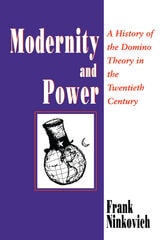
Modernity and Power
A History of the Domino Theory in the Twentieth CenturyFrank Ninkovich
University of Chicago Press, 1994
Modernity and Power provides a fresh conceptual overview of twentieth-century United States foreign policy, from the Roosevelt and Taft administrations through the presidencies of Kennedy and Johnson. Beginning with Woodrow Wilson, American leaders gradually abandoned the idea of international relations as a game of geopolitical interplays, basing their diplomacy instead on a symbolic opposition between "world public opinion" and the forces of destruction and chaos. Frank Ninkovich provocatively links this policy shift to the rise of a distinctly modernist view of history.
To emphasize the central role of symbolism and ideological assumptions in twentieth-century American statesmanship, Ninkovich focuses on the domino theory—a theory that departed radically from classic principles of political realism by sanctioning intervention in world regions with few financial or geographic claims on the national interest. Ninkovich insightfully traces the development of this global strategy from its first appearance early in the century through the Vietnam war.
Throughout the book, Ninkovich draws on primary sources to recover the worldview of the policy makers. He carefully assesses the coherence of their views rather than judge their actions against "objective" realities. Offering a new alternative to realpolitic and economic explanations of foreign policy, Modernity and Power will change the way we think about the history of U.S. international relations.
[more]
The Global Republic
America's Inadvertent Rise to World PowerFrank Ninkovich
University of Chicago Press, 2014
For decades the United States has been the most dominant player on the world’s stage. The country’s economic authority, its globally forceful foreign policy, and its leading position in international institutions tend to be seen as the result of a long-standing, deliberate drive to become a major global force. Furthermore, it has become widely accepted that American exceptionalism—the belief that America is a country like no other in history—has been at the root of many of the country’s political, military, and global moves. Frank Ninkovich disagrees.
One of the preeminent intellectual historians of our time, Ninkovich delivers here his most ambitious and sweeping book to date. He argues that historically the United States has been driven not by a belief in its destiny or its special character but rather by a need to survive the forces of globalization. He builds the powerful case that American foreign policy has long been based on and entangled in questions of global engagement, while also showing that globalization itself has always been distinct from—and sometimes in direct conflict with—what we call international society.
In the second half of the twentieth century, the United States unexpectedly stumbled into the role of global policeman and was forced to find ways to resolve international conflicts that did not entail nuclear warfare. The United States's decisions were based less in notions of exceptionalism and more in a need to preserve and expand a flourishing global society that had become essential to the American way of life.
Sure to be controversial, The Global Republic compellingly and provocatively counters some of the deepest and most common misconceptions about America’s history and its place in the world.
[more]
The Wilsonian Century
U.S. Foreign Policy since 1900Frank Ninkovich
University of Chicago Press, 1999
For most of this century, American foreign policy was guided by a set of assumptions that were formulated during World War I by President Woodrow Wilson. In this incisive reexamination, Frank Ninkovich argues that the Wilsonian outlook, far from being a crusading, idealistic doctrine, was reactive, practical, and grounded in fear. Wilson and his successors believed it absolutely essential to guard against world war or global domination, with the underlying aim of safeguarding and nurturing political harmony and commercial cooperation among the great powers. As the world entered a period of unprecedented turbulence, Wilsonianism became a "crisis internationalism" dedicated to preserving the benign vision of "normal internationalism" with which the United States entered the twentieth century.
In the process of describing Wilson's legacy, Ninkovich reinterprets most of the twentieth century's main foreign policy developments. He views the 1920s, for example, not as an isolationist period but as a reversion to Taft's Dollar Diplomacy. The Cold War, with its faraway military interventions, illustrates Wilsonian America's preoccupation with achieving a cohesive world opinion and its abandonment of traditional, regional conceptions of national interest.
The Wilsonian Century offers a striking alternative to traditional interest-based interpretations of U.S. foreign policy. In revising the usual view of Wilson's contribution, Ninkovich shows the extraordinary degree to which Wilsonian ideas guided American policy through a century of conflict and tension.
[more]