Results by title
4 books match the query 'Non -'
Aryan and Non-Aryan in India
Madhav M. Deshpande and Peter E. Hook, Editors
University of Michigan Press, 1979
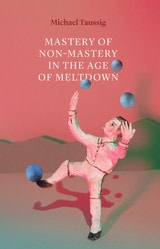
Mastery of Non-Mastery in the Age of Meltdown
Michael Taussig
University of Chicago Press, 2020
Taussig seeks to move us away from the manipulation of nature and reorient us to different metaphors and sources of inspiration to develop a new ethical stance toward the world. His ultimate goal is to undo his readers’ sense of control and engender what he calls “mastery of non-mastery.” This unique book developed out of Taussig’s work with peasant agriculture and his artistic practice, which brings performance art together with aspects of ritual. Through immersive meditations on Walter Benjamin, D. H. Lawrence, Emerson, Bataille, and Proust, Taussig grapples with the possibility of collapse and with the responsibility we bear for it.
Philosophy and Non-Philosophy
François Laruelle
University of Minnesota Press, 2013
Each generation invents new practices and new writings of philosophy. Ours should have been able to introduce certain mutations that would at least be equivalent with those of cubism, abstract art, and twelve-tone serialism: it has only partially done so. But after all the deconstructions, after Wittgenstein, Heidegger, and Derrida, this demand takes on a different dimension: What do we do with philosophy itself? How do we globally change our relation to this thought, which keeps indicating that it is increasingly conservative and repetitive? These two questions together have prompted what we call “non-philosophy.”
Non-philosophy is not the negation of philosophy. It is the suspension of philosophy’s claim to think the real (Principle of Sufficient Philosophy), and it is the invention of new usages of thought and language that disrupt the rational narrative of the real, which is precisely what every philosophy is. Non-philosophy should rather be understood à la the “non-Euclidean,” namely, as a generalization of the philosophical beyond its traditional limitation by the unitary or “Heraclitean” postulate. From then on, an infinite number of philosophical decisions that are no longer mutually exclusive will correspond with any real phenomenon.
Philosophy and Non-Philosophy is widely considered the first fully explicit elaboration of non-philosophy and one of its most important introductory texts.
Sense and Non-Sense
Maurice Merleau-Ponty
Northwestern University Press, 1992
The first part of Sense and Non-Sense, "Arts," is concerned with Merleau-Ponty's concepts of perception, which were advanced in his major philosophical treatise, Phenomenology of Perception. Here the analysis is focused and enriched in descriptions of the perceptual world of Cezanne, the encounter with the Other as expressed in the novels of Simone de Beauvoir and Sartre, and the gestalt quality of experience brought out in the film art form. In the second part, "Ideas," Merleau-Ponty shows how the categories of the phenomenology of perception can be understood as an outgrowth of the behavioral sciences and how a model of existence based on perception sensitizes us to the insights and limitations of previous philosophies and suggests constructive criticisms of contemporary philosophy. The third part, "Politics," clarifies the political dilemmas facing intellectuals in postwar France.