Results by title
9 books match the query 'Non-Formal Education'
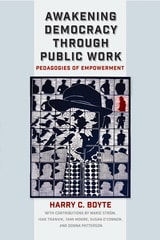
Awakening Democracy through Public Work
Pedagogies of EmpowermentHarry C. Boyte
Vanderbilt University Press, 2018
Awakening Democracy through Public Work begins with the story of Public Achievement, a youth civic education and empowerment initiative with roots in the civil rights movement. It describes Public Achievement's first home in St. Bernard's, a low-income Catholic elementary school in St. Paul, Minnesota, and how the program spread across the country and then abroad, giving birth to the larger concept of public work.
In Public Achievement, young people practice "citizen politics" as they tackle issues ranging from bullying, racism, and sexual harassment to playground improvements, curriculum changes, and better school lunches. They develop everyday political skills for working across differences and making constructive change. Such citizen politics, more like jazz than a set piece of music, involves the interplay and negotiation of diverse interests and views, sometimes contentious, sometimes harmonious. Public Achievement highlights young people's roles as co-creators—builders of schools, communities, and democratic society. They are not citizens in waiting, but active citizens who do public work.
Awakening Democracy through Public Work also describes how public work can find expression in many kinds of work, from education and health to business and government. It is relevant across the sweep of society. People have experimented with the idea of public work in hundreds of settings in thirty countries, from Northern Ireland and Poland to Ghana and Japan. In Burundi it birthed a national initiative to rework relations between villagers and police. In South Africa it helped people in poor communities to see themselves as problem solvers rather than simply consumers of government services.
In the US, at Denison University, public work is being integrated into dorm life. At Maxfield School in St. Paul, it is transforming special education. In rural Missouri, it led to the "emPowerU" initiative of the Heartland Foundation, encouraging thousands of young people to stay in the region. In Eau Claire, Wisconsin, it generated "Clear Vision," a program providing government support for citizen-led community improvements. Public work has expanded into the idea of "citizen professionals" working with other citizens, not on them or for them. It has also generated the idea of "civic science," in which scientists see themselves as citizens and science as a resource for civic empowerment.
Awakening Democracy through Public Work shows that we can free the productive powers of people to work across lines and differences to build a better society and create grounded hope for the future.
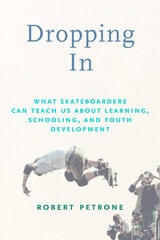
Dropping In
What Skateboarders Can Teach Us about Learning, Schooling, and Youth DevelopmentRobert Petrone
University of Massachusetts Press, 2023
The die-hard local skateboarders of Franklin Skatepark—a group of working-class, Latino and white young men in the rural Midwest—are typically classified by schools and society as “struggling,” “at-risk,” “failing,” and “in crisis.” But at the skatepark, they thrive and succeed, not only by landing tricks but also by finding meaning and purpose in their lives.
In Dropping In, Robert Petrone draws from multiple years of ethnographic research to bring readers into this rich environment, exploring how and why these young men engage more with skateboarding and its related cultural communities than with school. For them, it is in these alternative communities and spaces that they meet their intellectual, literate, and learning needs; cultivate meaningful and supportive relationships; and develop a larger understanding of their place in the world. By looking at what these skateboarders can teach us about what is right and working in their lives, Petrone asks educators and others committed to youth development to rethink schooling structures and practices to provide equitable education for all students.
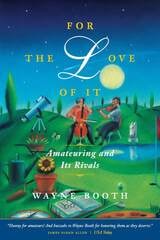
For the Love of It
Amateuring and Its RivalsWayne C. Booth
University of Chicago Press, 1999
"If, in truth, Booth is an amateur player now in his fifth decade of amateuring, he is certainly not an amateur thinker about music and culture. . . . Would that all of us who think and teach and care about music could be so practical and profound at the same time."—Peter Kountz, New York Times Book Review
"[T]his book serves as a running commentary on the nature and depth of this love, and all the connections it has formed in his life. . . . The music, he concludes, has become part of him, and that is worth the price."—Clea Simon, Boston Globe
"The book will be read with delight by every well-meaning amateur who has ever struggled. . . . Even general readers will come away with a valuable lesson for living: Never mind the outcome of a possibly vain pursuit; in the passion that is expended lies the glory."—John von Rhein, Chicago Tribune
"Hooray for amateurs! And huzzahs to Wayne Booth for honoring them as they deserve. For the Love of It celebrates amateurism with genial philosophizing and pointed cultural criticism, as well as with personal reminiscences and self-effacing wit."—James Sloan Allen, USA Today
"Wayne Booth, the prominent American literary critic, has written the only sustained study of the interior experience of musical amateurism in recent years, For the Love of It. [It] succeeds as a meditation on the tension between the centrality of music in Booth's life, both inner and social, and its marginality. . . . It causes the reader to acknowledge the heterogeneity of the pleasures involved in making music; the satisfaction in playing well, the pride one takes in learning a difficult piece or passage or technique, the buzz in one's fingertips and the sense of completeness with the bow when the turn is done just right, the pleasure of playing with others, the comfort of a shared society, the joy of not just hearing, but making, the music, the wonder at the notes lingering in the air."—Times Literary Supplement
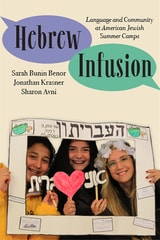
Hebrew Infusion
Language and Community at American Jewish Summer CampsSarah Bunin Benor, Jonathan B. Krasner, and Sharon Avni
Rutgers University Press, 2019
Each summer, tens of thousands of American Jews attend residential camps, where they may see Hebrew signs, sing and dance to Hebrew songs, and hear a camp-specific hybrid language register called Camp Hebraized English, as in: “Let’s hear some ruach (spirit) in this chadar ochel (dining hall)!” Using historical and sociolinguistic methods, this book explains how camp directors and staff came to infuse Hebrew in creative ways and how their rationales and practices have evolved from the early 20th century to today. Some Jewish leaders worry that Camp Hebraized English impedes Hebrew acquisition, while others recognize its power to strengthen campers’ bonds with Israel, Judaism, and the Jewish people. Hebrew Infusion explores these conflicting ideologies, showing how hybrid language can serve a formative role in fostering religious, diasporic communities. The insightful analysis and engaging descriptions of camp life will appeal to anyone interested in language, education, or American Jewish culture.
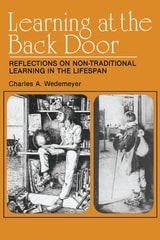
Learning at the Back Door
Reflections on Non-Traditional Learning in the LifespanCharles A. Wedemeyer
University of Wisconsin Press, 1981
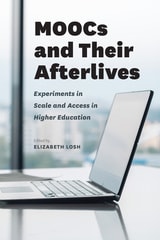
MOOCs and Their Afterlives
Experiments in Scale and Access in Higher EducationEdited by Elizabeth Losh
University of Chicago Press, 2017
Elizabeth Losh has gathered experts from across disciplines—education, rhetoric, philosophy, literary studies, history, computer science, and journalism—to tease out lessons and chart a course into the future of open, online education. Instructors talk about what worked and what didn’t. Students share their experiences as participants. And scholars consider the ethics of this education. The collection goes beyond MOOCs to cover variants such as hybrid or blended courses, SPOCs (Small Personalized Online Courses), and DOCCs (Distributed Open Collaborative Course). Together, these essays provide a unique, even-handed look at the MOOC movement and will serve as a thoughtful guide to those shaping the next steps for open education.
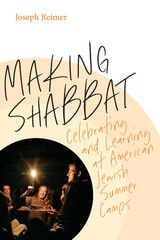
Making Shabbat
Celebrating and Learning at American Jewish Summer CampsJoseph Reimer
Brandeis University Press, 2022
This book tells the story of how Jewish camps have emerged as creators of positive spiritual experiences for Jewish youth in North America. When Jewish camps began at the dawn of the twentieth century, their leaders had little interest in creating Jewish spiritual experiences for their campers. Yet over the course of the past century, Jewish camps have gradually moved into providing primal Jewish experiences that diverse campers can enjoy, parents appreciate, and alumni fondly recall. Making Shabbat Real explores how Shabbat at camp became the focal point for these primal Jewish experiences, providing an interesting perspective on changing approaches to Jewish education and identity in North America.

Why Afterschool Matters
Nelson, Ingrid A.
Rutgers University Press, 2017
Why Afterschool Matters takes a different approach, closely following ten Mexican American students who attended the same extracurricular program in California, then chronicling its long-term effects on their lives, from eighth grade to early adulthood. Discovering that participation in the program was life-changing for some students, yet had only a minimal impact on others, sociologist Ingrid A. Nelson investigates the factors behind these very different outcomes. Her research reveals that while afterschool initiatives are important, they are only one component in a complex network of school, family, community, and peer interactions that influence the educational achievement of disadvantaged students.
Through its detailed case studies of individual students, this book brings to life the challenges marginalized youth en route to college face when navigating the intersections of various home, school, and community spheres. Why Afterschool Matters may focus on a single program, but its findings have major implications for education policy nationwide.
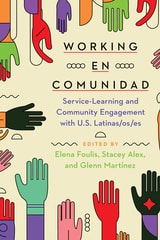
Working en comunidad
Service-Learning and Community Engagement with U.S. Latinas/os/esEdited by Elena Foulis, Stacey Alex, and Glenn Martínez
University of Arizona Press, 2024
The volume tackles three major themes: ethical approaches to working with Latina/o/e communities within language courses and beyond; preparing Latina/o/e students for working with their own communities in different environments; and ensuring equitable practices and building relationships that are mutually beneficial for students and community members. The editors forward two central arguments: (1) Equitable community engagement in higher education is a reflective and reciprocal process that develops empathy and personal and professional growth in students; and (2) service-learning is most transformative when it explicitly guides students and the community to build cultural humility and recognize Latina/o/e experiences and agency as foundational to the learning process.
Many of the contributors and editors are Latina/o/e-identified scholars, practitioners, and researchers, who lend a rich body of experience and a personal dedication to this work. They present distinct approaches and geographies, as well as range of institutions, to offer a wide scope of engaged work that builds on the concept of comunidad to advance a critical new conceptual framework of equitable education and racial justice.
Contributors
Stacey Alex
Elena Foulis
Christina García
Catherine Komisaruk
Kelly Lowther Pereira
Glenn Martínez
María Luisa Parra-Velasco