Results by title
6 books match the query 'None'

A Billion Black Anthropocenes or None
Kathryn Yusoff
University of Minnesota Press, 2018
Rewriting the “origin stories” of the Anthropocene
No geology is neutral, writes Kathryn Yusoff. Tracing the color line of the Anthropocene, A Billion Black Anthropocenes or None examines how the grammar of geology is foundational to establishing the extractive economies of subjective life and the earth under colonialism and slavery. Yusoff initiates a transdisciplinary conversation between feminist black theory, geography, and the earth sciences, addressing the politics of the Anthropocene within the context of race, materiality, deep time, and the afterlives of geology.
Forerunners is a thought-in-process series of breakthrough digital works. Written between fresh ideas and finished books, Forerunners draws on scholarly work initiated in notable blogs, social media, conference plenaries, journal articles, and the synergy of academic exchange. This is gray literature publishing: where intense thinking, change, and speculation take place in scholarship.

All of Us or None
Migrant Organizing in an Era of Deportation and DispossessionMonisha Das Gupta
Duke University Press, 2024
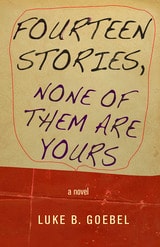
Fourteen Stories, None of Them Are Yours
A NovelLuke B. Goebel
University of Alabama Press, 2014

None a Stranger There
England and/in Europe on the Early Modern StageEdited by Scott Oldenburg and Matteo Pangallo
University of Alabama Press, 2025
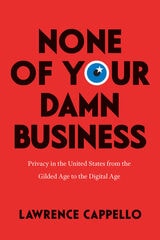
None of Your Damn Business
Privacy in the United States from the Gilded Age to the Digital AgeLawrence Cappello
University of Chicago Press, 2019
Every day, Americans surrender their private information to entities claiming to have their best interests in mind. This trade-off has long been taken for granted, but the extent of its nefariousness has recently become much clearer. As None of Your Damn Business reveals, the problem is not so much that data will be used in ways we don’t want, but rather how willing we have been to have our information used, abused, and sold right back to us. In this startling book, Lawrence Cappello targets moments from the past 130 years of US history when privacy was central to battles over journalistic freedom, national security, surveillance, big data, and reproductive rights. As he makes dismayingly clear, Americans have had numerous opportunities to protect the public good while simultaneously safeguarding our information, and we’ve squandered them every time. None of Your Damn Business is a rich and provocative survey of an alarming topic that grows only more relevant with each fresh outrage of trust betrayed.
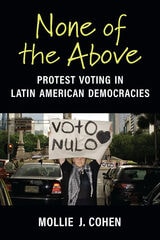
None of the Above
Protest Voting in Latin American DemocraciesMollie J. Cohen
University of Michigan Press, 2024
Winner of the 2025 International Society of Political Psychology David O. Sears Best Book on Mass Politics Award
Around the world each year, millions of citizens turn out to vote but leave their ballots empty or spoil them. Increasingly, campaigns have emerged that promote “invalid” votes like these. Why do citizens choose to cast blank and spoiled votes? And how do campaigns mobilizing the invalid vote influence this decision? None of the Above answers these questions using evidence from presidential and gubernatorial elections in eighteen Latin American democracies. Author Mollie J. Cohen draws on a broad range of methods and sources, incorporating data from electoral management bodies, nationally representative surveys, survey experiments, focus groups, semi-structured interviews, and news sources.
Contrary to received wisdom, this book shows that most citizens cast blank or spoiled votes in presidential elections on purpose. By participating in invalid vote campaigns, citizens can voice their concerns about low-quality candidates while also expressing a preference for high-quality democracy. Campaigns promoting blank and spoiled votes come about more often, and succeed at higher rates, when incumbent politicians undermine the quality of elections. Surprisingly, invalid vote campaigns can shore up the quality of democracy in the short term. None of the Above shows that swings in blank and spoiled vote rates can serve as a warning about the trajectory of a country’s democracy.