Results by title
9 books match the query 'North Africa'

Death and Life in the Big Red One
A Soldier’s World War II Journey from North Africa to GermanyJoseph P. Olexa
University of North Texas Press, 2023

Environmental Imaginaries of the Middle East and North Africa
Diana K. Davis
Ohio University Press, 2011
The landscapes of the Middle East have captured our imaginations throughout history. Images of endless golden dunes, camel caravans, isolated desert oases, and rivers lined with palm trees have often framed written and visual representations of the region. Embedded in these portrayals is the common belief that the environment, in most places, has been deforested and desertified by centuries of misuse. It is precisely such orientalist environmental imaginaries, increasingly undermined by contemporary ecological data, that the eleven authors in this volume question. This is the first volume to critically examine culturally constructed views of the environmental history of the Middle East and suggest that they have often benefitted elites at the expense of the ecologies and the peoples of the region. The contributors expose many of the questionable policies and practices born of these environmental imaginaries and related histories that have been utilized in the region since the colonial period. They further reveal how power, in the form of development programs, notions of nationalism, and hydrological maps, for instance, relates to environmental knowledge production.
Contributors: Samer Alatout, Edmund Burke III, Shaul Cohen, Diana K. Davis, Jennifer L. Derr, Leila M. Harris, Alan Mikhail, Timothy Mitchell, Priya Satia, Jeannie Sowers, and George R. Trumbull IV

Film in the Middle East and North Africa
Creative DissidenceEdited by Josef Gugler
University of Texas Press, 2011
This is the first study to cover cinemas from Iran to Morocco. Nine essays present the region's major national cinemas, devoting special attention to the work of directors who have given image and voice to dissent from political regimes, from patriarchal customs, from fundamentalist movements, and from the West. These country essays are complemented by in-depth discussions of eighteen films that have been selected for both their excellence and their critical engagement with pressing current issues. The introduction provides a comprehensive overview of filmmaking throughout the region, including important films produced outside the national cinemas. The long history of Iranian cinema, its international renown, and the politics of directors confronting the state, earns it a special place in this volume. The other major emphasis is on the Israel/Palestine conflict, featuring films by Palestinian directors, Israelis, and an Egyptian working in Syria.
Nineteen authors collaborated on this book, among them Walter Armbrust, Roy Armes, Kevin Dwyer, Eric Egan, Nurith Gertz, Lina Khatib, Florence Martin, and Nadia Yaqub. About half of the contributors are film scholars; the others range across literary studies and the social sciences to two film directors and a novelist. Beyond differences in disciplinary orientation, there is considerable variation among contributors in the perspectives that inform their writing. They offer an illuminating range of approaches to the cinemas of the region.
The book is richly illustrated with posters of the featured films, photos of their directors at work, and stills illustrating critical arguments in the film essays.

From North Africa to France
Family Migration in Text and FilmIsabel Hollis-Touré
University of London Press, 2015
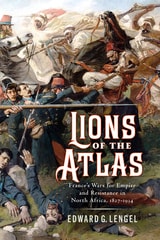
Lions of the Atlas
France's Wars for Empire and Resistance in North Africa, 1827–1934Edward G. Lengel
Westholme Publishing, 2026
France’s century-long wars of conquest in Algeria, Morocco, and Tunisia remain both understudied and symbolic of European imperialism. Launched to provide political legitimacy for the House of Bourbon during unstable times, these wars of empire ironically ended by generating nationalist sentiments that undermined French imperial aspirations, although France was successful on the battlefield after tremendous effort. The controversy both at the time and today about France’s North African ambitions has overshadowed the significant history of this conflict. Fought across some of the world’s most unforgiving, yet spectacular, terrain, these wars featured innovative military campaigns, epic battles, inspiring resistance leaders, and countless episodes of remarkable courage. Profoundly relevant, the French North African wars had a major global impact, influencing the development of military organization, tactics, and technology in the American Civil War, both world wars, and even modern Middle Eastern conflicts. Yet it is the human element that is most compelling. Based on extensive primary source research, Lions of the Atlas: France’s Wars for Empire and Resistance in North Africa, 1827–1934 is the first-ever comprehensive study, in any language, of these pivotal wars and those who fought them.
Beginning with the French naval blockade and amphibious invasion of Algeria in 1827–1830, the book tells the story of the large-scale campaigns and huge set-piece battles that ensued over the following several decades, across the highest peaks of the Atlas Mountains, in hills and valleys, along and over rivers, through scorching deserts, and even in fierce urban combat in town and city streets. Engagements include two unforgettable campaigns to capture the mountain fortress at Constantine, bold and devastating forays by Algerian cavalrymen and mountain warriors, and the pivotal 1844 Battle of Isly. The story continues with the French invasion of Tunisia in 1881, and then the thirty-year French campaign for the subjugation of Morocco, concluding with the Rif War of the 1920s that shocked the world. The narrative features charismatic resistance leaders such as Algeria’s Emir Abd-el-Kader, legendary military units such as the colorful Zouaves and the Foreign Legion, and changes in military technology, including the use of aircraft and armored vehicles. A major contribution to our understanding of one of the world’s most storied regions, Lions of the Atlas provides gripping and insightful reading while presenting the complex history of war and resistance in North Africa.

North Africa, Revised Edition
A History from Antiquity to the PresentBy Phillip C. Naylor
University of Texas Press, 2014
North Africa has been a vital crossroads throughout history, serving as a connection between Africa, Asia, and Europe. Paradoxically, however, the region's historical significance has been chronically underestimated. In a book that may lead scholars to reimagine the concept of Western civilization, incorporating the role North African peoples played in shaping "the West," Phillip Naylor describes a locale whose transcultural heritage serves as a crucial hinge, politically, economically, and socially.
Ideal for novices and specialists alike, North Africa begins with an acknowledgment that defining this area has presented challenges throughout history. Naylor's survey encompasses the Paleolithic period and early Egyptian cultures, leading readers through the pharonic dynasties, the conflicts with Rome and Carthage, the rise of Islam, the growth of the Ottoman Empire, European incursions, and the postcolonial prospects for Egypt, Libya, Tunisia, Algeria, Morocco, and Western Sahara.
Emphasizing the importance of encounters and interactions among civilizations, North Africa maps a prominent future for scholarship about this pivotal region.
Now with a new afterword that surveys the “North African Spring” uprisings that roiled the region from 2011 to 2013, this is the most comprehensive history of North Africa to date, with accessible, in-depth chapters covering the pre-Islamic period through colonization and independence.
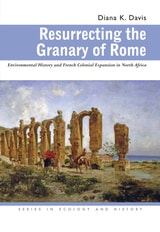
Resurrecting the Granary of Rome
Environmental History and French Colonial Expansion in North AfricaDiana K. Davis
Ohio University Press, 2007
Tales of deforestation and desertification in North Africa have been told from the Roman period to the present. Such stories of environmental decline in the Maghreb are still recounted by experts and are widely accepted without question today. International organizations such as the United Nations frequently invoke these inaccurate stories to justify environmental conservation and development projects in the arid and semiarid lands in North Africa and around the Mediterranean basin. Recent research in arid lands ecology and new paleoecological evidence, however, do not support many claims of deforestation, overgrazing, and desertification in this region.
Diana K. Davis’s pioneering analysis reveals the critical influence of French scientists and administrators who established much of the purported scientific basis of these stories during the colonial period in Algeria, Morocco, and Tunisia, illustrating the key role of environmental narratives in imperial expansion. The processes set in place by the use of this narrative not only systematically disadvantaged the majority of North Africans but also led to profound changes in the landscape, some of which produced the land degradation that continues to plague the Maghreb today.
Resurrecting the Granary of Rome exposes many of the political, economic, and ideological goals of the French colonial project in these arid lands and the resulting definition of desertification that continues to inform global environmental and development projects. The first book on the environmental history of the Maghreb, this volume reframes much conventional thinking about the North African environment. Davis’s book is essential reading for those interested in global environmental history.

Sex in the Middle East and North Africa
L. L. Wynn
Vanderbilt University Press, 2022
The book is organized into three sections: Single and Dating, Engaged and Married, and It's Complicated. The allusion to categories of relationship status on social media is at once a nod to the compulsion to categorize, recognition of the many ways that categorization is rarely straightforward, and acknowledgment that much of the intimate lives described by the contributors is mediated by online technologies.
Soldier of the Press
Covering the Front in Europe and North Africa, 1936-1943Henry T. Gorrell, Edited & Intro by Kenneth Gorrell, & Foreword by John C. McManus
University of Missouri Press, 2009