Results by title
3 books match the query 'North Atlantic Ocean'
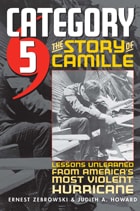
Category 5
The Story of Camille, Lessons Unlearned from America's Most Violent HurricaneErnest Zebrowski and Judith A. Howard
University of Michigan Press, 2005
"This highly readable account aimed at a general audience excels at telling the plight of the victims and how local political authorities reacted. The saddest lesson is how little the public and the government learned from Camille. Highly recommended for all public libraries, especially those on the Gulf and East coasts."
—Library Journal online
As the unsettled social and political weather of summer 1969 played itself out amid the heat of antiwar marches and the battle for civil rights, three regions of the rural South were devastated by the horrifying force of Category 5 Hurricane Camille.
Camille's nearly 200 mile per hour winds and 28-foot storm surge swept away thousands of homes and businesses along the Gulf Coast of Louisiana and Mississippi. Twenty-four oceangoing ships sank or were beached; six offshore drilling platforms collapsed; 198 people drowned. Two days later, Camille dropped 108 billion tons of moisture drawn from the Gulf onto the rural communities of Nelson County, Virginia-nearly three feet of rain in 24 hours. Mountainsides were washed away; quiet brooks became raging torrents; homes and whole communities were simply washed off the face of the earth.
In this gripping account, Ernest Zebrowski and Judith Howard tell the heroic story of America's forgotten rural underclass coping with immense adversity and inconceivable tragedy.
Category 5 shows, through the riveting stories of Camille's victims and survivors, the disproportionate impact of natural disasters on the nation's poorest communities. It is, ultimately, a story of the lessons learned-and, in some cases, tragically unlearned-from that storm: hard lessons that were driven home once again in the awful wake of Hurricane Katrina.
"Emergency responses to Katrina were uncoordinated, slow, and--at least in the early days--woefully inadequate. Politicians argued about whether there had been one disaster or two, as if that mattered. And before the last survivors were even evacuated, a flurry of finger-pointing had begun. The question most neglected was: What is the shelf life of a historical lesson?"
Ernest Zebrowski is founder of the doctoral program in science and math education at Southern University, a historically black university in Baton Rouge, Louisiana, and Professor of Physics at Pennsylvania State University's Pennsylvania College of Technology. His previous books include Perils of a Restless Planet: Scientific Perspectives on Natural Disasters. Judith Howard earned her Ph.D. in clinical social work from UCLA, and writes a regular political column for the Ruston, Louisiana, Morning Paper.
"Category 5 examines with sensitivity the overwhelming challenges presented by the human and physical impacts from a catastrophic disaster and the value of emergency management to sound decisions and sustainability."
--John C. Pine, Chair, Department of Geography & Anthropology and Director of Disaster Science & Management, Louisiana State University
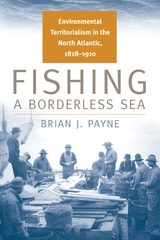
Fishing a Borderless Sea
Environmental Territorialism in the North Atlantic, 1818-1910Brian J. Payne
Michigan State University Press, 2010
Over the centuries, processing and distribution of products from land and sea has stimulated the growth of a global economy. In the broad sweep of world history, it may be hard to imagine a place for the meager little herring baitfish. Yet, as Brian Payne adeptly recounts, the baitfish trade was hotly contested in the Anglo-American world throughout the nineteenth century. Politicians called for wars, navies were dispatched with guns at the ready, vessels were seized at sea, and violence erupted at sea.
Yet, the battle over baitfish was not simply a diplomatic or political affair. Fishermen from hundreds of villages along the coastline of Atlantic Canada and New England played essential roles in the construction of legal authority that granted or denied access to these profitable bait fisheries.
Fishing a Borderless Sea illustrates how everyday laborers created a complex system of environmental stewardship that enabled them to control the local resources while also allowing them access into the larger global economy.
Seaweeds of the Northwest Atlantic
Arthur C. Mathieson
University of Massachusetts Press, 2017
The introductory chapter provides a historical review of seaweed studies as well as a description of 15 geographical sites designated in the text. Three chapters on the green, brown, and red alga include more than 256 genera, 510 species, 10 subspecies, 21 varieties, and 14 forms. New taxonomic combinations and descriptions of several previously undescribed taxa are also included in the text. The modern classification reviews molecular as well as reproductive, morphological, and biological data. The work represents more than forty years of research on Northwest Atlantic seaweeds and will aid researchers throughout the Northeast and Southwest Atlantic coasts. The authors detail the taxonomy, morphology, cytology, and name derivation of various taxonomic entities, as well as the ecology and distribution patterns of over 555 taxa. The text includes keys to genera and species, a glossary, and sources of further information.