Results by title
9 books match the query 'North Dakota'
Crafting History in the Northern Plains
A Political Economy of the Heart River Region, 1400–1750Mark D. Mitchell
University of Arizona Press, 2013
My Body To You
Elizabeth Searle
University of Iowa Press, 1993
A woman in love with a gay man she calls Sister Kin attempts to escape the bonds of her own body. An eighteen-year-old virgin enters into a passionate affair with an older man who turns out to be a virgin of a different sort. A special education teacher in a school for aggressive teenagers finds herself attracted to another teacher, also female. An intelligent outcast girl bonds with her mindlessly seductive mother to form “one person.”
Searle reveals other characters through inventive and often comic feats of narrative daring. A girl grows into womanhood during a single family dinner that spans twenty years. A middle-aged wife, once dubbed “The First Most Beautiful Woman in the World,” watches her former selves parade before her family in a lively evening of home movies. Two women—one recently divorced, the other a group home resident in love with The Who—join forces as they figure out “What to Do in an Emergency.” An old woman experiences both physical breakdown and spiritual breakdown in a supermarket's vegetable department. A young woman is drawn into the emotional and sexual life of an autistic boy obsessed with the number 8.
Each of these stories is written in a language that strives to match the intensity of Searle's characters; each gives the reader an exceptionally intimate portrait of a unique female and the central, sensual mystery of her body.
North American Icelandic
The Life of a LanguageBirna Arnbjornsdottir
University of Manitoba Press, 2006
Nothing to Do but Stay
My Pioneer MotherCarrie Young
University of Iowa Press, 1991
Carrine Gafkjen was, as her daughter remembers, at once the most liberated and unliberated of women. If she had considered the subject at all she would have thought it a waste of time. She firmly believed in destiny; what fate planned for her she dealt with head-on.
In the early 1900s the twenty-five-year-old Gafkjen boarded a train from Minneapolis to claim a homestead for herself on the western North Dakota prairies. She lived alone in her claim shack, barred her door at night against the coyotes, existed on potatoes and salt, and walked five miles to the nearest creek to wash her clothes. A decade later she had, by her own ingenuity, doubled her landholdings and became a secure women of property. Then, at an age when most other women would have been declared spinsters, Carrine Gafkjen married Sever Berg and had six children.
Nothing to Do but Stay tells the story of this uncommon woman with warmth and good humor. It gives testimony to the lasting spirit of our pioneer heritage and, in these uncertain times, to the staying power of family and tradition. This book will appeal to all those with an interest in the settlement of the West, the history of the Great Plains, women's studies, and the perseverance of the early-twentieth-century farmers.
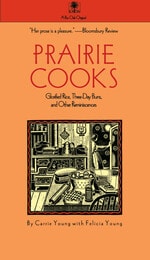
Prairie Cooks
Glorified Rice Three-Day BunsCarrie Young
University of Iowa Press, 1993
Growing up in a Norwegian American community imbued with the customs and foods of the Old Country, Carrie Young recalls how her mother and her neighbors skillfully blended Scandinavian with what they always called the American style of cooking. Young recounts how her mother, Carrine Gafkjen—after homesteading as a single woman in 1904—cooked for a large threshing crew during harvest season. Living and cooking around the clock in a cook car the size of a Pullman kitchen, she delighted the crew with her soda pancakes and her sour cream doughnuts, her fattigman (Poor Man's Cookies) and her fabulous North Dakota Lemon Meringue Pie.
During holidays lutefisk and lefse reigned supreme, but when the Glorified Rice fad swept the country in the thirties women broke new ground with inventive variations. And the short-lived but intensely experienced Three-Day Bun Era (when the buns became so ethereal they were in danger of floating off the plate) kept the Ladies Aid luncheons competitive. Whatever the times, in good years or bad, there was always the solace ofKaffe Tid, the forenoon and afternoon coffee time, when the table was set with smor og brod (butter and bread) and something sweet, like a Whipped Cream Cake or Devil's Food Cake with Rhubarb Sauce.
This book will appeal to those who feel nostalgia for a parent's or grandparent's cooking, to those who have a longing for the heartier fare of times past. The author's daughter, Felicia Young, who has "cooked Scandinavian since she was old enough to hold a lefse stick," has compiled and tested the seventy-two recipes accompanying this joyful memoir.
Salt Lantern
Traces of an American FamilyWilliam Towner Morgan
University of Iowa Press, 1997
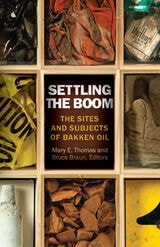
Settling the Boom
The Sites and Subjects of Bakken OilMary E. Thomas
University of Minnesota Press, 2023
Examines how settler colonial and sexist infrastructures and narratives order a resource boom
Over the past decade, new oil plays have unsettled U.S. energy landscapes and imaginaries. Settling the Boom studies how the disruptive forces of an oil boom in the northern Great Plains are contained through the extension of settler temporalities, reassertions of heteropatriarchy, and the tethering of life to the volatility of oil and its cruel optimisms.
This collection reveals the results of sustained research in Williston, North Dakota, the epicenter of the “Bakken Boom.” While the boom brought a rapid influx of capital and workers, the book questions simple timelines of before and after. Instead, Settling the Boom demonstrates how the unsettling forces of an oil play resolve through normative narratives and material and affective infrastructures that support settler colonialism’s violent extension and its gendered orders of time and space. Considering a wide range of evidence, from urban and regional policy, interviews with city officials, media, photography, and film, these essays analyze the ongoing material, aesthetic, and narrative ways of life and land in the Bakken.
Contributors: Morgan Adamson, Macalester College; Kai Bosworth, Virginia Commonwealth U; Thomas S. Davis, Ohio State U; Jessica Lehman, Durham U.
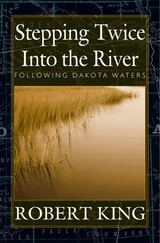
Stepping Twice Into the River
Following Dakota WatersRobert King
University Press of Colorado, 2005
Blending travel narrative and poetic reflection, Stepping Twice Into the River takes readers on a journey through time, revealing both stability and change and offering prairie wisdom. An affectionate and shrewd observer, King illuminates the ordinary from the perspectives of history, science, and literature. In the hands of this gifted thinker and writer, local facts yield universal metaphor.
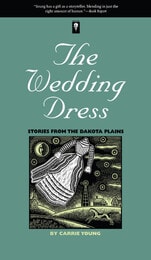
The Wedding Dress
Stories From The Dakota PlainsCarrie Young
University of Iowa Press, 1992
These finely wrought stories unfold in the Dakotas during the struggling pioneer days and bone-dry landscape of the thirties as well as the verdant years that followed, where the nighttime plains are bathed by softly radiant harvest moons shining down from dazzling northern skies. Young's absorbing narratives begin with the pleasant sense of “Once upon a time…” anticipation, but the firmly sketched details, warm humor, and vivid characterizations reveal an unanticipated and satisfying realism.
The haunting title story is about a beautiful and tragic pioneer woman and her wedding dress; her gown takes on a life of its own and turns into an enduring symbol for the grace and compassion of homesteading women on the plains. In “Bank Night,” a hired hand working during the midst of the Depression wins $250 at the movies, careening him into a single night of notoriety that becomes a legend in its time. “The Nights of Ragna Rundhaug” tells the tale of a woman who wants only to be left alone with her white dog, Vittehund, and her crocheting but instead is propelled into a life of midwifery “because there was no one else to do it.” The babies have predilection for arriving during blizzards and always at night, when she must be transported across the dark plains by frantic husbands who have fortified themselves with strong drink and headstrong horses.
All the stories in The Wedding Dress are linked by the enigmatic Nordic characters who people them and by the skill with which Young draws them. Emotions run so deep that they are seldom able to surface; when they do the interaction is extraordinarily luminous, both for the characters themselves and for the fortunate reader. The Wedding Dress is for all readers, young and old.