Results by title
4 books match the query 'Northern Rockies'
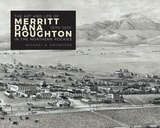
Art and Life of Merritt Dana Houghton in the Northern Rockies, 1878-1919
by Michael A. Amundson
University of Wyoming Press, 2022
This lavishly illustrated biography details Houghton’s life and work from his birth in Michigan in 1846 to his death in 1919 in Spokane through extensive genealogical records, newspaper accounts, and his illustrations—including historic ranches and bird’s-eye views of Fort Collins, Colorado; Dillon, Montana; and Spokane, Washington and the only known illustrations of long-lost places like Pearl, Colorado, and Rambler, Wyoming. Also included is reproduction of a four-foot-by-eight-foot view of Sheridan, Wyoming and a sixty-image sample portfolio of his best-preserved illustrations organized by type.
Houghton’s work depicts the infrastructure of the new settler society that was remaking the West in the late nineteenth century and early twentieth century, and Amundson demonstrates how Houghton’s vision of the American West remains active today.
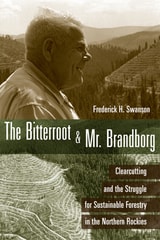
The Bitterroot and Mr. Brandborg
Clearcutting and the Struggle for Sustainable Forestry in the Northern RockiesFrederick H. Swanson
University of Utah Press, 2011
Winner of the Wallace Stegner Prize in American Environmental or Western History
Fredrick Swanson tells the story of Guy M. Brandborg and his impact on the practices of the U.S. Forest Service. As supervisor of Montana’s Bitterroot National Forest from 1935 to 1955, Brandborg engaged in a management style that promoted not only the well-being of the forest community but also the social and economic welfare of the local people. By relying on selective cutting, his goal was to protect the watersheds and wildlife habitats that are devastated by clear-cutting, and to prevent the job losses that follow such practices. Following his retirement, he became concerned that his agency was deviating from the practice of sustained-yield management of the forest’s timber lands, and led a highly visible public outcry that became known as the Bitterroot controversy. Brandborg’s behind-the-scenes lobbying contributed materially to the passage of the National Forest Management Act of 1976, the single most important law affecting public forestry since the creation of the Forest Service.
Winner of the Western Writers of America Spur Award for Best Western Nonfiction-Contemporary.
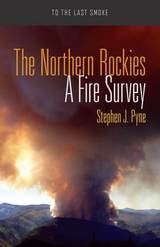
The Northern Rockies
A Fire SurveyStephen J. Pyne
University of Arizona Press, 2016
The Northern Rockies remain one of three major hearths for America’s fire culture. They hold a major fire laboratory, an equipment development center, an aerial fire depot, and a social engagement with fire—even a literature. Missoula is to fire in the big backcountry what Tallahassee is to prescribed burning and what Southern California is to urban-wildland hybrids. On its margins, Boise hosts the National Interagency Fire Center. In this structured collection of essays on the region, Stephen J. Pyne explores what makes the Northern Rockies distinctive and what sets it apart from other regions of the country. Surprisingly, perhaps, the story is equally one of big bureaucracies and of generations that encounter the region’s majestic landscapes through flame.
The Northern Rockies is part of a multivolume series describing the nation’s fire scene region by region. The volumes in To the Last Smoke also cover Florida, the Northern Rockies, the Great Plains, the Southwest, and several other critical fire regions. The series serves as an important punctuation point to Pyne’s 50-year career with wildland fire—both as a firefighter and a fire scholar. These unique surveys of regional pyrogeography are Pyne’s way of “keeping with it to the end,” encompassing the directive from his rookie season to stay with every fire “to the last smoke.”
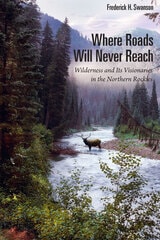
Where Roads Will Never Reach
Wilderness and Its Visionaries in the Northern RockiesFrederick H. Swanson
University of Utah Press, 2015
The Rocky Mountains of Idaho and Montana are home to some of the most important remaining American wilderness areas, preserved because of citizens who stood against massive development schemes that would have diminished important wildlife habitat and the abiding sense of remoteness found in such places. Where Roads Will Never Reach tells the stories of hunters, anglers, outfitters, scientists, and other concerned citizens who devoted themselves to protecting remnant wild lands and ecosystems in the Northern Rockies. Environmental historian Frederick Swanson argues that their heartfelt, dedicated work helped boost the American wilderness movement to its current prominence.
Based on newly available archival sources and interviews with many of the participants, this groundbreaking study explores for the first time the grassroots campaigns that yielded some of the largest designated wilderness areas in America.