Results by title
42 books match the query 'Norway'
Accidental Shepherd
How a California Girl Rescued an Ancient Mountain Farm in NorwayLiese Greensfelder
University of Minnesota Press, 2024
A summer job turns serious when a young woman takes the reins on a remote farm—and learns far more than how to herd sheep
In May 1972, Liese Greensfelder arrived in the small Norwegian town of Øystese to startling news: Johannes, the farmer who hired her for the summer, had just been hospitalized after a stroke. Could she please watch over his place for a month or so, until he got back on his feet? Twenty years old and with no farming experience, Liese was dropped off the next day at a centuries-old mountain farm at the end of a dirt road high above the magnificent Hardanger Fjord—with 115 sheep, two cows, one calf, a draft horse, and a Norwegian herding dog to care for.
Armed with a command of Danish that enabled rudimentary communication, Liese began learning from neighbors who spoke an ancient Norwegian dialect—how to feed the animals, milk by hand, and supervise her first lambing. The farm was run in the old way: horses and wagons instead of tractors, haymaking in the rain, and hikes into the mountains to check on the sheep that ranged free over those wild peaks all summer. And, she was quick to discover, the farm was on the brink of ruin, for Johannes was a heartless man who had abused his animals and neglected his buildings and equipment for decades.
Although her employer had alienated his neighbors, they immediately welcomed the American newcomer and offered her help. As “a month or so” stretched to a year and Liese struggled for the survival of the farm, she joined this tight-knit enclave of farmers, learning their stories and history, adopting their dialect, and growing intimately familiar with the grass-based farming practices that had sustained them for generations.
From moments of levity, such as sampling a neighbor’s fruit wines, Christmas parties, and skiing; to soul-battering challenges, including the directive to kill a fox, sending sheep to slaughter, rotten silage, and vicious weather; to the yearnings of a young woman awash in a sea of masculinity, Accidental Shepherd is a candid account of Liese’s year in a remote farmhouse. Confronted with dangers and obstacles for which she was utterly unprepared, she tells a story of remarkable resilience and records the fascinating but rapidly vanishing traditions of the community that took her in.
Accidental Shepherd
How a California Girl Rescued an Ancient Mountain Farm in NorwayLiese Greensfelder
University of Minnesota Press, 2024
A summer job turns serious when a young woman takes the reins on a remote farm—and learns far more than how to herd sheep
In May 1972, Liese Greensfelder arrived in the small Norwegian town of Øystese to startling news: Johannes, the farmer who hired her for the summer, had just been hospitalized after a stroke. Could she please watch over his place for a month or so, until he got back on his feet? Twenty years old and with no farming experience, Liese was dropped off the next day at a centuries-old mountain farm at the end of a dirt road high above the magnificent Hardanger Fjord—with 115 sheep, two cows, one calf, a draft horse, and a Norwegian herding dog to care for.
Armed with a command of Danish that enabled rudimentary communication, Liese began learning from neighbors who spoke an ancient Norwegian dialect—how to feed the animals, milk by hand, and supervise her first lambing. The farm was run in the old way: horses and wagons instead of tractors, haymaking in the rain, and hikes into the mountains to check on the sheep that ranged free over those wild peaks all summer. And, she was quick to discover, the farm was on the brink of ruin, for Johannes was a heartless man who had abused his animals and neglected his buildings and equipment for decades.
Although her employer had alienated his neighbors, they immediately welcomed the American newcomer and offered her help. As “a month or so” stretched to a year and Liese struggled for the survival of the farm, she joined this tight-knit enclave of farmers, learning their stories and history, adopting their dialect, and growing intimately familiar with the grass-based farming practices that had sustained them for generations.
From moments of levity, such as sampling a neighbor’s fruit wines, Christmas parties, and skiing; to soul-battering challenges, including the directive to kill a fox, sending sheep to slaughter, rotten silage, and vicious weather; to the yearnings of a young woman awash in a sea of masculinity, Accidental Shepherd is a candid account of Liese’s year in a remote farmhouse. Confronted with dangers and obstacles for which she was utterly unprepared, she tells a story of remarkable resilience and records the fascinating but rapidly vanishing traditions of the community that took her in.
Across the West and Toward the North
Norwegian and American Landscape PhotographyEdited by Shannon Egan and Marthe Tolnes Fjellestad
University of Utah Press, 2021
In this edited volume, Norwegian and American scholars offer the first study of the striking parallels in the production, distribution, and reception of these modern expressions of landscape and nationhood. In recognizing how landscape photographs were made meaningful to international audiences—such as tourists, visitors to world’s fairs, scientists, politicians, and immigrants—the authors challenge notions of American exceptionalism and singularly nationalistic histories.
The book includes stunning photographs of mountainous landscapes, glaciers, and forests, punctuated by signs of human development and engineering, with more than one hundred rarely seen plates by photographers Knud Knudsen, Anders Beer Wilse, Timothy O’Sullivan, Charles R. Savage, and others.
Arctic Naval Combat in Support of Ground Operations
Soviet Naval Support of the Petsamo-Kirkenes Operation, October 1944James F Gebhardt
University of Alaska Press, 2025
The largest Arctic battle on record, involving 133,500 Soviets and 45,000 Germans and Quisling Norwegians, the Petsamo-Kirkenes Operation sought to liberate the northernmost part of Norway from German occupation during World War II. The Soviet navy played a previously unrecognized crucial role in the operation by providing fire support and transportation, as well as conducting raids and combat landings on the enemy-held coast. The harsh Arctic environment, including extreme cold, ice, and limited daylight, posed significant challenges to the Soviet and German forces. Despite these hardships, the Soviet forces achieved their objectives, defeated the German Army, and successfully liberated the area.
Arctic Naval Combat in Support of Ground Operations is a powerful companion to Gebhardt’s previous translation, The Petsamo-Kirkenes Operation: Soviet Breakthrough and Pursuit in the Arctic, October 1944, which details this operation’s ground offensive. Providing a starting point for the study and understanding of combined arms and services combat in the Arctic, an increasingly important and accessible part of the planet where military concerns are rapidly expanding, this work is a valuable addition to the literature of World War II military history and a significant additional perspective on the Soviet military.
Between History and Myth
Stories of Harald Fairhair and the Founding of the StateBruce Lincoln
University of Chicago Press, 2014
Taking the story of how Harald Fairhair unified Norway in the ninth century as its central example, Bruce Lincoln illuminates the way a state’s foundation story blurs the distinction between history and myth and how variant tellings of origin stories provide opportunities for dissidence and subversion as subtle—or not so subtle—modifications are introduced through details of character, incident, and plot structure. Lincoln reveals a pattern whereby texts written in Iceland were more critical and infinitely more subtle than those produced in Norway, reflecting the fact that the former had a dual audience: not just the Norwegian court, but also Icelanders of the twelfth and thirteenth centuries, whose ancestors had fled from Harald and founded the only non-monarchic, indeed anti-monarchic, state in medieval Europe.
Between History and Myth will appeal not only to specialists in Scandinavian literature and history but also to anyone interested in memory and narrative.
Eugenics and the Welfare State
Norway, Sweden, Denmark, and FinlandGunnar Broberg
Michigan State University Press, 2005
In 1997 Eugenics and the Welfare State caused an uproar with international repercussions. This edition contains a new introduction by Broberg and Roll-Hansen, addressing events that occurred following the original publication. The four essays in this book stand as a chilling indictment of mass sterilization practices, not only in Scandinavia but in other European countries and the United States--eugenics practices that remained largely hidden from the public view until recently. Eugenics and the Welfare State also provides an in-depth, critical examination of the history, politics, science, and economics that led to mass sterilization programs in Norway, Sweden, Denmark, and Finland; programs put in place for the "betterment of society" and based largely on the "junk science" of eugenics that was popular before the rise of Nazism in Germany. When the results of Broberg's and Roll-Hansen's book were widely publicized in August 1997, the London Observer reported, "Yesterday Margot Wallstrom, the Swedish Minister for Social Policy, issued a belated reaction to the revelations. She said: 'What went on is barbaric and a national disgrace.' She pledged to create a law ensuring that involuntary sterilisation would never again be used in Sweden, and promised compensation to victims." Ultimately, the Swedish government not only apologized to the many thousands who had been sterilized without their knowledge or against their will, but also put in place a program for the payment of reparations to these unfortunate victims.

Fiddling for Norway
Revival and IdentityChris Goertzen
University of Chicago Press, 1997
The book begins with an investigation of the people and events important to Norwegian folk fiddling, tracing the history of Norwegian folk music and the growth and diversification of the folk music revival. The narrative takes us to fiddle clubs, concerts and competitions on the local, regional, and national levels, and shows how conflicting emphases—local vs. national identity, tradition vs. aesthetic qualities—continue to transform Norwegian folk music. Goertzen utilizes a large anthology of meticulously transcribed tunes to illustrate personal and regional repertoires, aspects of performance practice, melodic gesture and form, and tune relationships. Ethnomusicologists and readers who fiddle will enjoy both the music and the stories it tells.

Folklore Fights the Nazis
Humor in Occupied Norway, 1940–1945Kathleen Stokker
University of Wisconsin Press, 1997
In relating this dramatic story, Kathleen Stokker draws upon her many interviews with survivors of the Occupation and upon the archives of the Norwegian Resistance Museum and the University of Oslo. Central to the book are four “joke notebooks” kept by women ranging in age from eleven to thirty, who found sufficient meaning in this humor to risk recording and preserving it. Stokker also cites details from wartime diaries of three other women from East, West, and North Norway. Placing the joking in historical, cultural, and psychological context, Stokker demonstrates how this seemingly frivolous humor in fact contributed to the development of a resistance mentality among an initially confused, paralyzed, and dispirited population, stunned by the German invasion of their neutral country.
For this paperback edition, Stokker has added a new preface offering a comparative view of resistance through humor in neighboring Denmark.
Folktales of Norway
Edited by Reidar Christiansen
University of Chicago Press, 1964
"The translation is excellent, retaining the traditional Norwegian style . . . the tales themselves will also appeal to the interested layman."—Library Journal
For the Love of Cod
A Father and Son's Search for Norwegian HappinessEric Dregni
University of Minnesota Press, 2021
A journey to find Norway’s supposed bliss makes for a comic travelogue that asks, seriously, what makes Norwegians so damn happy—and does it translate?
Norway is usually near or at the top of the World Happiness Report. But is it really one of the happiest countries on Earth? Eric Dregni had his doubts. Years ago he and his wife had lived in this country his great-great-grandfather once fled. When their son Eilif was born there, the Norwegian government paid for the birth, gave them $5,000, and deposited $150 into their bank account every month, but surely happiness was more than a generous health care system. What about all those grim months without sun? When Eilif turned fifteen, father and son decided to go back together and investigate. For the Love of Cod is their droll report on the state of purported Norwegian bliss.
Arriving in May, a month of festivals and eternal sun, the Dregnis are thrust into Norway at its merriest—and into the reality of the astronomical cost of living, which forces them to find lodging with friends and relatives. But this gives them an inside look at the secrets to a better life. It’s not the massive amounts of money flowing from the North Sea oil fields but how these funds are distributed that fuels the Norwegian version of democratic socialism—resulting in miniscule differences between rich and poor. Locals introduce them to the principles underlying their avowed contentment, from an active environmentalism that translates into flyskam (flight shame), which keeps Norwegians in the family cabin for the long vacations prescribed by law and charges a 150 percent tax on gas guzzlers (which, Eilif observes, means more Teslas seen in one hour than in a year in Minnesota!).
From a passion for dugnad or community volunteerism and sakte or “slow,” a rejection of the mad pace of modernity, to the commodification of Viking history and the dark side of Black Metal music that turns the idea of quaint, traditional Norway upside down, this idiosyncratic father and son tour lets readers, free of flyskam, see how, or whether, Norwegian happiness translates.

Fredrik Barth
An Intellectual BiographyThomas Hylland Eriksen
Pluto Press, 2015
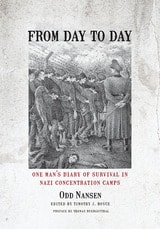
From Day to Day
One Man's Diary of Survival in Nazi Concentration CampsOdd Nansen
Vanderbilt University Press, 2016
Nansen, a Norwegian, was arrested in 1942 by the Nazis, and spent the remainder of World War II in concentration camps--Grini in Oslo, Veidal above the Arctic Circle, and Sachsenhausen in Germany. For three and a half years, Nansen kept a secret diary on tissue-paper-thin pages later smuggled out by various means, including inside the prisoners' hollowed-out breadboards.
Unlike writers of retrospective Holocaust memoirs, Nansen recorded the mundane and horrific details of camp life as they happened, "from day to day." With an unsparing eye, Nansen described the casual brutality and random terror that was the fate of a camp prisoner. His entries reveal his constantly frustrated hopes for an early end to the war, his longing for his wife and children, his horror at the especially barbaric treatment reserved for Jews, and his disgust at the anti-Semitism of some of his fellow Norwegians. Nansen often confronted his German jailors with unusual outspokenness and sometimes with a sense of humor and absurdity that was not appreciated by his captors.
After the Putnam's edition received rave reviews in 1949, the book fell into obscurity. In 1956, in response to a poll about the "most undeservedly neglected" book of the preceding quarter-century, Carl Sandburg singled out From Day to Day, calling it "an epic narrative," which took "its place among the great affirmations of the power of the human spirit to rise above terror, torture, and death." Indeed, Nansen witnessed all the horrors of the camps, yet still saw hope for the future. He sought reconciliation with the German people, even donating the proceeds of the German edition of his book to German refugee relief work. Nansen was following in the footsteps of his father, Fridtjof, an Arctic explorer and humanitarian who was awarded the Nobel Peace Prize in 1922 for his work on behalf of World War I refugees. (Fridtjof also created the "Nansen passport" for stateless persons.)
Forty sketches of camp life and death by Nansen, an architect and talented draftsman, provide a sense of immediacy and acute observation matched by the diary entries. The preface is written by Thomas Buergenthal, who was "Tommy," the ten-year-old survivor of the Auschwitz Death March, whom Nansen met at Sachsenhausen and saved using his extra food rations. Buergenthal, author of A Lucky Child, formerly served as a judge on the International Court of Justice at The Hague and is a recipient of the 2015 Elie Wiesel Award from the US Holocaust Memorial Museum.
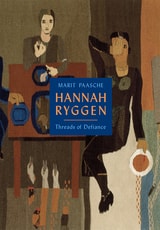
Hannah Ryggen
Threads of DefianceMarit Paasche
University of Chicago Press, 2019
A widely recognized authority on Ryggen, Marit Paasche brings this important Scandinavian artist to the foreground in this biography, the first published on Ryggen in English. Paasche looks at Ryggen within the social, political, and cultural contexts of her time and explores how these issues informed her work, from her anti-fascist tapestry that depicted a spear piercing Mussolini’s head to one protesting the war in Vietnam. Published to correspond with a major retrospective in Frankfurt, of which Paasche is one of the curators, Hannah Ryggen is a foundational book that will provide a crucial introduction of this artist to a broader audience.
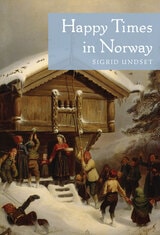
Happy Times in Norway
Sigrid Undset
University of Minnesota Press, 2013
Happy Timesin Norway is a moving and delicately humorous picture of Undset’s own blissful home life before her nation fell to the Nazi occupation. Captured here is the excitement of a Norwegian Christmas, the Seventeenth of May, and summer in the idyllic mountains, as well as the chaotic adventure of raising two energetic boys. With vivid detail and illuminating descriptions of the landscape, Happy Times in Norway is infused with the wish that those cherished days could come again.
History Of Scandinavia
Norway, Sweden, Denmark, Finland, And IcelandT.K. Derry
University of Minnesota Press, 2000
This concise account traces the history of the Scandinavian countries from earliest times to the present, emphasizing common features in their heritage and in their contribution to the modern world. The author’s aim is to describe each country’s history, traditions, and way of life and to examine the political development of the five nations in the context of the whole Nordic region.

I Talk about It All the Time
Camara Lundestad Joof
University of Wisconsin Press, 2024
“I regularly decide to quit talking to white people about racism,” writes Joof. Such discussions often feel unproductive, the occasional spark of hope coming at enormous personal cost. But not talking about it is impossible, a betrayal of self. The book is a self-examination as well as societal indictment. It is an open challenge to readers, to hear her as she talks about it, all the time.

Ibsen Apocalypse
Vegard Vinge and Ida Müller’s Six-Hundred-Year Mission to Raise the Ghosts of ModernityAndrew Friedman
Northwestern University Press, 2026
Presenting a groundbreaking account of an audacious theatrical undertaking
Created by the Norwegian/German duo of Vegard Vinge and Ida Müller, the Ibsen-Saga (2006–present) is a six-hundred-year project to restage Henrik Ibsen’s entire oeuvre. Andrew Friedman presents a groundbreaking historical narrative of this project’s development and dramaturgy, through the theories and practices of modernism’s most influential and controversial artists, including Henrik Ibsen, Richard Wagner, F. T. Marinetti, Erwin Piscator, and Jackson Pollock. Vinge and Müller treat Ibsen’s plays as the urtexts of a mythical struggle between artistic vision and material limits, which they explore through analogous narratives ranging from Hamlet to World Cup soccer matches, all unified by a singular aesthetic that juxtaposes totalizing fiction and extreme reality. As Friedman shows, they mythologize Ibsen’s themes of artistic ambition to resurrect and test modernism’s fantasies of artistic autonomy, totality, creative license, and provocation.
By reading Vinge and Müller’s project through its modernist inspirations, Friedman demonstrates the material and ethical limits of modernist ideals in current theatrical practice, providing new perspectives on the legacy of these pioneering figures. Ibsen Apocalypse is a bold, cross-disciplinary reappraisal of the persistent power of modernity in contemporary performance.
Ice Ship
The Epic Voyages of the Polar Adventurer FramCharles W. Johnson
University Press of New England, 2014
Impasse Poetics at the Nordic Oil Coast
Contemporary Petrofiction from Denmark and NorwayKarl Emil Rosenbaek Reetz
West Virginia University Press, 2026

Is It Painful To Think
Conversations with Arne NaessDavid Rothenberg
University of Minnesota Press, 1992
Life in Language
Mission Feminists and the Emergence of a New Protestant SubjectIngie Hovland
University of Chicago Press, 2025
The language of the Bible is a powerful lens through which many Protestants understand themselves and their world, and its prohibitions on women’s speech pose complicated challenges to women. Nevertheless, women frequently serve as vocal leaders in Protestant organizations, including the early twentieth-century Norwegian Mission Society. In Life in Language, Ingie Hovland offers a unique biography of Henny Dons, a leader of the society’s so-called mission feminists, that grapples with ways Protestant women crafted innovative, expansive self-understandings through Christian language. More than their male peers, the mission feminists turned to religious speech to express material, as well as heavenly, desires for paid work, voting rights, and more, and Hovland argues that these experiments in women speaking, reading, writing, and listening paved the way for a new way of being in the world.
Mapping Indigenous Presence
North Scandinavian and North American PerspectivesEdited by Kathryn W. Shanley and Bjørg Evjen; Foreword by S. James Anaya
University of Arizona Press, 2015
Mapping Indigenous Presence presents a set of comparative Indigenous studies essays with contemporary perspectives, attesting to the importance of the roles Indigenous people have played as overseers of their own lands and resources, as creators of their own cultural richness, and as political entities capable of governing themselves. This interdisciplinary collection explores the Indigenous experience of Sámi peoples of Norway and Native Americans of Montana in their respective contexts—yet they are in many ways distinctly different within the body politic of their respective countries. Although they share similarities as Indigenous peoples within nation-states and inhabit somewhat similar geographies, their cultures and histories differ significantly.
Sámi people speak several languages, while Indigenous Montana is made up of twelve different tribes with at least ten distinctly different languages; both peoples struggle to keep their Indigenous languages vital. The political relationship between Sámi people and the mainstream Norwegian government and culture has historically been less contentious that that of the Indigenous peoples of Montana with the United States and with the state of Montana, yet the Sámi and the Natives of Montana have struggled against both the ideology and the subsequent assimilation policy of the savagery-versus-civilization model. The authors attempt to increase understanding of how these two sets of Indigenous peoples share important ontological roots and postcolonial legacies, and how research may be used for their own self-determination and future directions.
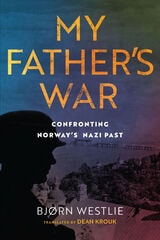
My Father's War
A True Story of Nazism and Treasonby Bjørn Westlie, translated by Dean Krouk
University of Wisconsin Press, 2023
With an insightful introduction from translator Dean Krouk, My Father’s War is a contemporary classic of war literature. Committed to genuine understanding without falling into undue sympathizing, this sober and reflective book presents an eye-opening, moving, intense, and necessary account of the allure of fascism in a world at war—and its personal costs.
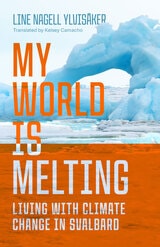
My World Is Melting
Living with Climate Change in SvalbardLine Nagell Ylvisåker, Translated by Kelsey Camacho
University of Wisconsin Press, 2026
In 2015, in a tragic natural disaster, a massive avalanche descended on the small Arctic Norwegian city of Longyearbyen, Svalbard, leveling eleven houses and killing a child and a young father. In this arresting book, journalist Line Nagell Ylvisåker explores the effects of a warming planet up close and personal, from inside a remote community intimately attuned to its environment.
Ylvisåker introduces readers to her friends and neighbors, including dedicated meteorologists racing to anticipate future disasters and a veteran trapper who harbors doubts about climate change even as he bears witness to a constantly shifting landscape. Blending memoir, long-form journalism, and scientific reportage, she provides an intimate picture of life in a place where the effects of climate change can be seen in all their startling reality—and a compelling and hopeful argument for collective and cooperative action across the globe.
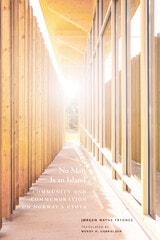
No Man Is An Island
Community and Commemoration on Norway's UtøyaJørgen Watne Frydnes, translated by Wendy H. Gabrielsen
University of Massachusetts Press, 2025
On July 22, 2011, a white supremacist killed eight people at Oslo’s Government Center in Norway and then terrorized the idyllic island of Utøya, where he executed sixty-nine more people, mostly teenagers. The country had never suffered such a massacre, and in the aftermath, the entire population was reeling.
Utøya, the Norwegian Labor Party’s summer camp for youth, a beloved place where many Norwegians learned about democratic values and processes, made lifelong friendships, and developed a vision for a just society, became mired in grief and discord. When Jørgen Watne Frydnes took on the daunting task of rebuilding the island and charting its future, he had to figure out a compassionate and just way forward. He made a radical decision: he set out to talk with each family of a murdered person, seeking to understand their needs and their hopes so that the future of the island could include their wishes and concerns. This emotionally grueling work, which was never considered in the scholarly literature on commemoration, led to a true renewal of Utøya, resulting in a meaningful memorial to those who were lost as well as beautiful surroundings for campers who come there to study democracy and peace.
Frydnes’s narrative, originally published in Norwegian, is structured around the seasons of the year and the landscape of the island, and tracks one person’s account of learning how to remember, commemorate, and honor the dead, and acknowledge a mass tragedy, and yet also create a nurturing, aspirational space for hope.
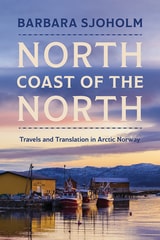
North Coast of the North
Travels and Translation in Arctic NorwayBarbara Sjoholm
University of Minnesota Press, 2027
A traveler and translator explores the multiethnic cultures, histories, and landscapes of Norway's high north
A companionable travel memoir about Arctic Norway, North Coast of the North details Barbara Sjoholm’s trip in the summer of 2024 to the northernmost region of the Scandinavian peninsula, a borderland that is home to a richly multicultural society, an expanding tourist industry, and landscapes bearing the marks of colonization, environmental damage, and climate change. A writer with decades of experience in the Nordic countries, Sjoholm flew from her home in the Pacific Northwest to Norway’s high north to research a collection of Sámi folktales and witness firsthand the settings from which the stories emerged.
Sjoholm’s journey takes her from Kirkenes, the final port on the Hurtigruten coastal route and an outpost on the Russian border, to the fertile farmlands of the Pasvik River Valley and to Indigenous archaeological sites and historic trading posts around the Varangerfjord. She voyages west along the Barents Sea coastline and south to Tromsø, past islands and inlets of surpassing beauty (as well as liquid gas plants and wind farms), and writes about the ongoing resource exploitation and local resistance to Norwegian and global corporate interests. North Coast of the North intertwines Sjoholm’s observations on the tragedies of World War II and the literature and folklore of the Sámi with her own warm memories of Norway, a country that never ceases to intrigue her.
An absorbing and expansive blend of travel writing, memoir, and reflections on translation, history, and literature, North Coast of the North is a vivid look at an often exoticized, frequently overlooked, yet increasingly important environmental and geopolitical region of Northern Europe.
Retail e-book files for this title are screen-reader friendly with images accompanied by short alt text and/or extended descriptions.

Norway To America
A History of the MigrationIngrid Semmingsen
University of Minnesota Press, 1980
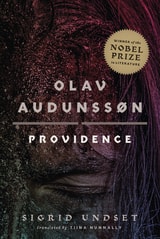
Olav Audunssøn
II. ProvidenceSigrid Undset
University of Minnesota Press, 2021
The second volume in the Nobel Prize–winning writer’s epic of medieval Norway, finely capturing Undset’s fluid, natural style in a new English translation, the first in nearly a century
As Norway moves into the fourteenth century, the kingdom continues to be racked by political turmoil and bloody family vendettas that serve as the backdrop for Sigrid Undset’s masterful story about Olav Audunssøn and Ingunn Steinfinnsdatter. Betrothed as children and raised as foster siblings, their unbridled love for each other sets in motion a series of dire events—with a legacy of betrayal, murder, and disgrace that will echo for generations. In Providence, the second of Olav Audunssøn’s four volumes, Olav settles in at his ancestral estate of Hestviken and soon brings Ingunn home as his wife. Both hope to put their troubles behind them as they start a new life together, but the crimes and shameful secrets of the past have a long reach and a tenacious hold. The consequences of sin, suspicion, and familial obligations may prove a greater threat to the pair’s happiness than even their long years of separation.
Set in a time when royalty and religion vie for power, and bloodlines and loyalties are effectively law, Providence summons a powerful picture of Northern life in the medieval era, as the Swedish Academy noted in awarding Undset the Nobel Prize. Conveying both the intimate drama of Olav and Ingunn’s marriage and the epic sweep of their story, it is at once a moving and vivid recreation of a vanished world tainted by bloodshed and haunted by sin and retribution.
As with her classic Kristin Lavransdatter, Sigrid Undset immersed herself in legal, religious, and historical writings to create in Olav Audunssøn an astoundingly authentic and compelling portrait of Norwegian life in the Middle Ages. And as in her translation of Kristin Lavransdatter, Tiina Nunnally does full justice to Undset’s fluid prose. Undset’s writing style is by turns straightforward and delicately lyrical, conveying the natural world, the complex culture, and the fraught emotional territory against which Olav’s story inexorably unfolds.
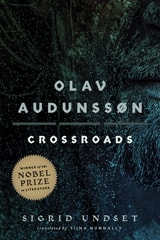
Olav Audunssøn
III. CrossroadsSigrid Undset
University of Minnesota Press, 2022
The third volume in the Nobel Prize–winning writer’s epic story of medieval Norway, finely capturing Undset’s fluid, natural style in the first English translation in nearly a century
In the early fourteenth century, Norway is a kingdom in political turmoil, struggling with opposing forces within its own borders and drawn into strife with neighboring Sweden and Denmark. Bloody family vendettas and conflicting loyalties sparked by the irrepressible passion of a boy and his foster sister (also his betrothed) have now set in motion a series of terrible consequences—with a legacy of betrayal, murder, and disgrace that will echo down through the generations. Crossroads, the third of Olav Audunssøn’s four volumes, finds Olav heartbroken by loss and further estranged from his son. To escape his grief, Olav leaves his home estate of Hestviken and agrees to serve as captain on a small merchant ship headed to London. There, separated from everything familiar to him, Olav begins a visionary journey that will send him far into the forest and deep into his soul. Questioning past decisions and future plans, Olav must grapple with his own perceptions of love and guilt, sin and penitence, vengeance and forgiveness.
Set in a time and place where royalty and religion vie for power, and bloodlines and loyalties are law, Crossroads summons a powerful picture of Northern life in medieval times, as the Swedish Academy noted in awarding Sigrid Undset the Nobel Prize in 1928. Conveying both the intimate drama and epic sweep of Olav’s story as grief and guilt drive him to ever more desperate action, Crossroads is a moving and masterly re-creation of a vanished world tainted by bloodshed and haunted by sin and retribution.
As with Kristin Lavransdatter, her earlier medieval epic, Undset immersed herself in the legal, religious, and historical documents of the time while writing Olav Audunssøn to create astoundingly authentic and compelling portraits of Norwegian life in the Middle Ages. And as in her translation of Kristin Lavransdatter, Tiina Nunnally does full justice to Undset’s natural, fluid prose, in a style that delicately and lyrically conveys the natural world, the complex culture, and the fraught emotional territory against which Olav’s story inexorably unfolds.
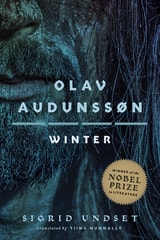
Olav Audunssøn
IV. WinterSigrid Undset
University of Minnesota Press, 2023
The fourth and final volume in the Nobel Prize–winning writer’s epic of one man’s fateful life in medieval Norway
Set in thirteenth-century Norway, a land racked by political turmoil, bloody family vendettas, and rising tensions between secular powers and an ascendant church, Sigrid Undset’s spellbinding masterpiece now follows the fortunes of Olav Audunssøn to the final, dramatic chapter of his life as it unfolds in Winter, the last volume of the tetralogy. When the orphaned Olav and his foster sister Ingunn became betrothed in their youth, a chain of events was set in motion that eventually led to violence, banishment, and a family separation lasting years. The consequences fracture their marriage and threaten the lineage for generations. Now, at the end of his life, Olav continues to grapple with the guilt of his sins as he watches his children, especially Eirik, make disastrous choices and struggle to find their rightful place in a family haunted by the past.
With its precise details and sweeping vision, Olav Audunssøn summons a powerful picture of Northern life in medieval times, as noted by the Swedish Academy in awarding Undset the Nobel Prize in 1928. Conveying both the intimate drama and the epic proportions of Olav’s story at its conclusion, Winter is a moving and masterly recreation of a vanished world tainted by bloodshed and haunted by sin and retribution—yet one that might still offer a chance for redemption.
As with Kristin Lavransdatter, her earlier medieval epic, Sigrid Undset wrote Olav Audunssøn after immersive research in the legal, religious, and historical writings of the time to create an astoundingly authentic and compelling portrait of Norwegian life in the Middle Ages. And as in her translation of Kristin Lavransdatter, Tiina Nunnally does full justice to Undset’s natural, fluid prose—in a style by turns plainspoken and delicately lyrical—to convey the natural world, the complex culture, and the fraught emotional territory against which Olav’s story inexorably unfolds.
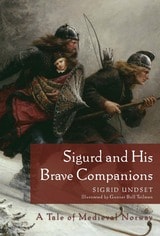
Sigurd and His Brave Companions
A Tale of Medieval NorwaySigrid Undset
University of Minnesota Press, 2013
Inspired by tales of the hero Vilmund Vidutan and his fellow knights, Sigurd Jonsson and his young friends Ivar and Helge set out to reenact these exploits on their medieval Norwegian farm. They carve swords and lances and spend hours making shields. With a little imagination, a pasture becomes a battlefield, an old boar their greatest foe, and they pass many hours jousting and dueling. But when the summer is nearly over, the three boys stumble into real trouble and must prove their courage in an adventure all their own.
Written during Sigrid Undset’s time in New York, Sigurd and His Brave Companions will make medieval Norway come alive for young and old readers alike.

Slow TV
An Analysis of Minute-by-Minute Television in NorwayRoel Puijk
Intellect Books, 2020
“Slow TV” refers to a form of broadcasting long events for their entire duration, preferably in real time. Popularized by the Norwegian Broadcasting Corporation (NRK), the form became a phenomenon in 2009 after NRK’s broadcast of a seven-hour train ride between Bergen and Oslo. Since then, slow TV programming has gained traction outside of Norway on television stations around the world and via streaming services like Netflix.
In this academic study, Roel Puijk combines quantitative and qualitative research methods to explore different aspects of the Norwegian slow TV phenomenon, from the programming’s production and development to its viewing and ultimate reception. Puijk relates slow TV to media events and media tourism, discussing its effects on cultural and economic developments and its evolving relationship to local and national identity. The result is an illuminating interdisciplinary study of media innovation and its effects on contemporary culture.
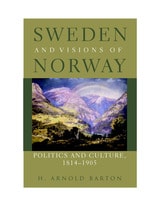
Sweden and Visions of Norway
Politics and Culture 1814-1905H. Arnold Barton
Southern Illinois University Press, 2002
H. Arnold Barton investigates Norwegian political and cultural influences in Sweden during the period of the Swedish-Norwegian dynastic union from 1814 to 1905.
Although closely related in origins, indigenous culture, language, and religion, Sweden and Norway had very different histories, resulting in strongly contrasting societies and forms of government before 1814. After a proud medieval past, Norway had come under the Danish crown in the fourteenth century and had been reduced to virtually a Danish province by the sixteenth.
In 1814, as a spin-off of the Napoleonic Wars, Denmark relinquished Norway, which became a separate kingdom, dynastically united with Sweden with its own government under a constitution independently framed that year. Disputes during the next ninety-one years caused Norway unilaterally to dissolve the tie.
Seeing the union a failure, most historians have concentrated on its conflicts. Barton, however, examines the impact of the union on internal developments, particularly in Sweden. Prior to 1814, Norway, unlike Sweden, had no constitution and only the rudiments of higher culture, yet paradoxically, Norway exerted a greater direct influence on Sweden than vice versa.
Reflecting a society lacking a native nobility, Norway’s 1814 constitution was—with the exception of that of the United States—the most democratic in the world. It became the guiding star of Swedish liberals and radicals striving to reform the antiquated system of representation in their parliament. Norway’s cultural void was filled with a stellar array of artists, writers, and musicians, led by Bjørnsjerne Børnson, Henrik Ibsen, and Edvard Grieg. From the 1850s through the late 1880s, this wave of Norwegian creativity had an immense impact on literature, art, and music in Sweden. By the 1880s, however, August Strindberg led a revolt against an exaggerated “Norvegomania” in Sweden. Barton sees this reaction as a fundamental inspiration to Sweden’s intense search for its own cultural character in the highly creative Swedish National Romanticism of the 1890s and early twentieth century.
Thirty-three illustrations of art and architecture enhance Sweden and Visions of Norway.
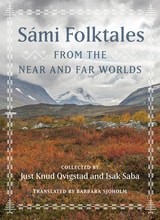
Sámi Folktales from the Near and Far Worlds
Just Knud Qvigstad
University of Minnesota Press, 2026
The most comprehensive collection of Sámi folktales ever translated into English
From the vast region of Northern Sápmi comes Sámi Folktales from the Near and Far Worlds, the most extensive compilation of Sámi narratives recorded from Sámi storytellers ever published in English translation. Comprising more than 300 folktales and legends from Northern Norway, including many from the coastal Sámi and the Skolt Sámi of Eastern Finnmark, this volume illuminates an oral storytelling tradition and shares narratives told by fishers, farmers, reindeer herders, lay preachers, and teachers from the interior plateaus and valleys to the Arctic fjords.
Originally recorded in the late nineteenth and early twentieth centuries by the Norwegian philologist Just Knud Qvigstad and the Sámi politician and folklorist Isak Saba, this collection spans centuries of storytelling in multiple genres, from migratory fairytales with kings and princesses to legends of ghosts and the Devil to fables with talking animals. A young lad from a poor family embarks on a quest through the wilderness to find treasure, receiving help from a wise female elder along his path. A Sámi boy falls in love with a háldi girl from another world, and they find a way to marry. A man carries sickness out of a village and stops the plague from spreading. Cunning foxes outsmart bears and humans alike. The villainous Chudes are tricked, foiled in their plans to steal from and kill the Sámi. People are turned into wolves, able to turn back only if they don’t taste the blood of a reindeer or if they are given cooked food. The ogre Stállu appears again and again, terrorizing the community until he’s outwitted or subdued. Rávgas, undead creatures of the sea, drag themselves out of the depths to lure others to their demise.
With historical context that reveals the cultural resilience of the Sámi people, Sámi Folktales from the Near and Far Worlds honors these traditional narratives, often overlooked in other folktale anthologies from the Nordic countries. Translator Barbara Sjoholm’s insightful introduction describes Qvigstad’s and Saba’s backgrounds and their work in gathering and translating these essential texts, and she introduces Sámi storytellers Johan Aikio, Efraim Pedersen, and Elen Utsi, who contributed dozens of stories.
An unprecedented trove of Sámi narratives, this expansive collection brings most of these tales to English readers for the first time, marking a major contribution to Indigenous folk literature and enhancing a broader understanding of Sámi and Nordic cultures.
Retail e-book files for this title are screen-reader friendly with images accompanied by short alt text and/or extended descriptions.
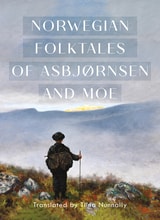
The Complete and Original Norwegian Folktales of Asbjørnsen and Moe
Peter Christen Asbjørnsen
University of Minnesota Press, 2019
The definitive English translation of the celebrated story collection regarded as a landmark of Norwegian literature and culture—now in paperback
The extraordinary folktales collected by Peter Christen Asbjørnsen and Jørgen Moe began appearing in Norway in 1841. Over the next two decades the publication of subsequent editions under the title Norske folkeeventyr made the names Asbjørnsen and Moe synonymous with Norwegian storytelling traditions. Tiina Nunnally’s vivid translation of their monumental collection is the first new English translation in more than 150 years—and the first ever to include all sixty original tales.
Magic and myth inhabit these pages in figures both familiar and strange. Giant trolls and talking animals are everywhere. The winds take human form. A one-eyed old woman might seem reminiscent of the Norse god Odin. We meet sly aunts, resourceful princesses, and devious robbers. The clever and fearless boy Ash Lad often takes center stage as he ingeniously breaks spells and defeats enemies to win half the kingdom. These stories, set in Norway’s majestic landscape of towering mountains and dense forests, are filled with humor, mischief, and sometimes surprisingly cruel twists of fate. All are rendered in the deceptively simple narrative style perfected by Asbjørnsen and Moe—now translated into an English that is as finely tuned to the modern ear as it is true to the original Norwegian.
Included here—for the very first time in English—are Asbjørnsen and Moe’s Forewords and Introductions to the early Norwegian editions of the tales. Asbjørnsen gives us an intriguing glimpse into the actual collection process and describes how the stories were initially received, both in Norway and abroad. Equally fascinating are Moe’s views on how central characters might be interpreted and his notes on the regions where each story was originally collected. Nunnally’s informative Translator’s Note places the tales in a biographical, historical, and literary context for the twenty-first century.
The Norwegian folktales of Asbjørnsen and Moe are timeless stories that will entertain, startle, and enthrall readers of all ages.
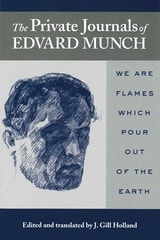
The Private Journals of Edvard Munch
We Are Flames Which Pour Out of the EarthEdvard Munch, edited and translated by J. Gill Holland
University of Wisconsin Press, 2005
This English translation of Edvard Munch's private diaries, the most extensive edition to appear in any language, captures the eloquent lyricism of the original Norwegian text. The journal entries in this volume span the period from the 1880s, when Munch was in his twenties, until the 1930s, reflecting the changes in his life and his work. The book is illustrated with fifteen of Munch's drawings, many of them rarely seen before. While these diaries have been excerpted before, no translation has captured the real passion and poetry of Munch's voice. This is a translation that lets Munch speak for himself and evokes the primal passion of his diaries. J. Gill Holland's exceptional work adds a whole new level to our understanding of the artist and the depth of his scream.
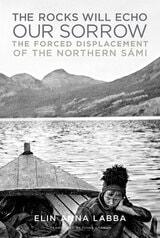
The Rocks Will Echo Our Sorrow
The Forced Displacement of the Northern SámiElin Anna Labba
University of Minnesota Press, 2023
The deep and personal story—told through history, poetry, and images—of the forced displacement of the Sámi people from their homeland in northern Norway and Sweden and its reverberations today
More than a hundred years have passed since the Sámi were forcibly displaced from their homes in northern Norway and Sweden, a hundred years since Elin Anna Labba’s ancestors and relations drove their reindeer over the strait to the mainland for the last time. The place where they lived has remained empty ever since. We carry our homes in our hearts, Labba shares, citing the Sámi poet Áillohaš. How do you bear that weight if you were forced to leave? In a remarkable blend of historical reportage, memoir, and lyrical reimagining, Labba travels to the lost homeland of her ancestors to tell of the forced removal of the Sámi in the early twentieth century and to reclaim a place in history, and in today’s world, for these Indigenous people of northern Scandinavia.
When Norway became a country independent from Sweden in 1905, the two nations came to an agreement that called for the displacement of the Northern Sámi, who spent summers on the Norwegian coast and winters in Sweden. This “dislocation,” as the authorities called it, gave rise to a new word in Sámi language, bággojohtin, forced displacement. The first of the sirdolaččat, or “the displaced,” left their homes fully believing they would soon return. Through stories, photographs, letters, and joik lyrics, Labba gathers a chorus of Sámi expression that resonates across the years, evoking the nomadic life they were required to abandon and the immense hardship and challenges they endured: children left behind with relatives, reindeer lost when they returned to familiar territory, sorrow and estrangement that linger through generations.
Starkly poetic and emotionally heart-wrenching, this dark history is told through the voices of the sirdolaččat, echoing the displacements of other Indigenous people around the world as it depicts the singular experience of the Northern Sámi. For her extraordinary work, Labba was awarded Sweden’s most important national book prize in 2020, the August Prize for Best Nonfiction.
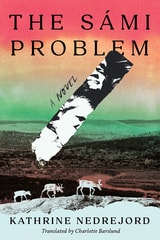
The Sámi Problem
A NovelKathrine Nedrejord
University of Minnesota Press, 2027
An incisive novel illuminating a young mother’s reckoning with her own identity and Sámi lineage through the lives and struggles of her ancestors
As a freelance journalist living in France, Marie Engmo has traveled far and wide to write about languages and local cultures threatened with extinction. But when she returns home to Norway for her áhkku’s (grandmother’s) funeral, she recognizes how far she has strayed from her own sense of self and her Sámi identity. Kathrine Nedrejord’s acclaimed novel—winner of Norway’s national book award—is the lucid and compelling story of Marie’s emotional search through her family’s past for a history and legacy that she might bequeath to her own infant daughter.
In spare and elegant prose, Nedrejord illuminates a young woman’s fierce and clear-eyed reckoning with the sacrifice and oppression that has marked the women and men in her family and generations of Indigenous Sámi communities in the northern reaches of Norway. As Marie awakens to the lengths her mother, grandmother, and great-grandmother traversed to survive discrimination and displacement, she uncovers and embodies their strength and dignity that are her—and her daughter’s—inheritance. What emerges is an unflinching examination of belonging to a minority that can never dominate, that will always have to negotiate and compromise its place in the world. As stirring as it is troubling, The Sámi Problem is itself an awakening and a literary triumph.
Retail e-book files for this title are screen-reader friendly.
The Valet
Thorvald Steen
Seagull Books, 2026
The year is 1204. Stripped of his power and held captive, Massimo Gasparino, once the most trusted aide to the Doge of Venice, pens a desperate secret letter to Pope Innocent III. His confession? He has witnessed the most egregious crime in human history: the deliberate diversion of the Fourth Crusade from Jerusalem to the heart of Christian Europe, Constantinople. As the city is ruthlessly plundered and its treasures shipped to Venice, Gasparino’s letter exposes the Doge’s shocking betrayal, a sin that irrevocably alters the course of history. But with his life and the fate of this explosive truth hanging precariously in the balance, can he get his message to Pope Innocent III before the Doge silences him forever?
The Valet is a tense, intimate drama of ambition, guilt, and the enduring shadows of a war that still resonates in today’s world.
The Weather Changed, Summer Came and So On
Pedro Carmona-Alvarez
Seagull Books, 2015
The Weather Changed, Summer Came and So On is a haunting novel about love, loss, and identity that focuses on the survival of trauma. Translated beautifully from its original Norwegian by Diane Oatley, it constructs and inhabits a liminal world as the protagonists seek to stay afloat amid grief and estrangement. This is a gripping, heartbreaking story that will move readers with its timelessness and universal relevance.
Vikings across the Atlantic
Emigration and the Building of a Greater Norway, 1860-1945Daron W. Olson
University of Minnesota Press, 2013
Around the year 1000 a Viking ship landed on the Atlantic coast of what would one day be North America. Nearly a millennium later, on June 7, 1945, Norway’s King Haakon VII returned from exile under guard of the American Ninety-ninth—or “Viking”—Battalion. In Vikings across the Atlantic, Daron W. Olson reveals how these two moments form narrative poles for the vision of a Greater Norway that expanded the boundaries of the Norwegian nation.
Looking at matters of religion, literature, media, and ethnicity, Olson explores how Norwegian Americans’ myths about themselves changed over time in relation to a broader Anglo-American culture, while at the same time influencing and being influenced by the burgeoning national culture of their homeland. Beginning in the 1920s, homeland Norwegian identity-makers framed the concept of the Greater Norway, which viewed the Norwegian nation as having two halves: Norwegians who resided in the homeland and those who had emigrated from Norway, especially those in America. Far from being merely symbolic, this idea, Olson shows, was actually tested by the ordeal of World War II, when Norwegians the world over demonstrated their willingness to sacrifice and even die for the Greater Norway.
In its transnational approach, Olson’s book brings a new perspective to immigrant studies and theories of nationalism; Vikings across the Atlantic depicts the nation as a larger community in which membership is constructed or imagined, a status of belonging defined not by physical proximity but through qualities such as culture and shared traditions.
Wisdom In The Open Air
The Norwegian Roots of Deep EcologyPeter Reed
University of Minnesota Press, 1992
Wisdom in the Open Air traces the Norwegian roots of the strain of thinking called “deep ecology”—the search for the solutions to environmental problems by examining the fundamental tenets of our culture. Although Arne Naess coined the term in the 1970s, the insights of deep ecology actually reflect a tradition of thought that can be seen in the history of Norwegian culture, from ancient mountain myths to the radical ecoactivism of today.
Beginning with an introduction to Norway’s emphasis on nature and the wild, Reed and Rothenberg explore the birth of the environmental movement in the 1960s and 1970s. What follows is a collection of writings by prominent Norwegian thinkers on humanity and nature, most never before published in English. From Peter Wessel Zapffe, a twentieth-century Kierkegaardian figure, the list goes on to include Norwegian philosopher Arne Naess, activist-critic-artist Sigmund Kvaloy, wilderness educator Nils Faarland, novelist Finn Alneas, sociologist Johan Galtung, and social reformer Erik Dammann. Their fascinating points of view offer thoughts on the significance of modern life and what it means to be human in the face of the deteriorating global environment of the twentieth century. Wisdom in the Open Air asks and answers a fundamental question concerning the ecomovement: what is the role of deep, often abstract, thinking in the attempt to avert a very real ecological crisis?