Results by title
6 books match the query 'Norwegians'

For the Love of Cod
A Father and Son's Search for Norwegian HappinessEric Dregni
University of Minnesota Press, 2021
A journey to find Norway’s supposed bliss makes for a comic travelogue that asks, seriously, what makes Norwegians so damn happy—and does it translate?
Norway is usually near or at the top of the World Happiness Report. But is it really one of the happiest countries on Earth? Eric Dregni had his doubts. Years ago he and his wife had lived in this country his great-great-grandfather once fled. When their son Eilif was born there, the Norwegian government paid for the birth, gave them $5,000, and deposited $150 into their bank account every month, but surely happiness was more than a generous health care system. What about all those grim months without sun? When Eilif turned fifteen, father and son decided to go back together and investigate. For the Love of Cod is their droll report on the state of purported Norwegian bliss.
Arriving in May, a month of festivals and eternal sun, the Dregnis are thrust into Norway at its merriest—and into the reality of the astronomical cost of living, which forces them to find lodging with friends and relatives. But this gives them an inside look at the secrets to a better life. It’s not the massive amounts of money flowing from the North Sea oil fields but how these funds are distributed that fuels the Norwegian version of democratic socialism—resulting in miniscule differences between rich and poor. Locals introduce them to the principles underlying their avowed contentment, from an active environmentalism that translates into flyskam (flight shame), which keeps Norwegians in the family cabin for the long vacations prescribed by law and charges a 150 percent tax on gas guzzlers (which, Eilif observes, means more Teslas seen in one hour than in a year in Minnesota!).
From a passion for dugnad or community volunteerism and sakte or “slow,” a rejection of the mad pace of modernity, to the commodification of Viking history and the dark side of Black Metal music that turns the idea of quaint, traditional Norway upside down, this idiosyncratic father and son tour lets readers, free of flyskam, see how, or whether, Norwegian happiness translates.
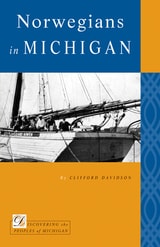
Norwegians in Michigan
Clifford Davidson
Michigan State University Press, 2010
In Norwegians in Michigan, Clifford Davidson shows how Norwegians took advantage of opportunities when they began settling in Michigan in the nineteenth century. Norwegians sailed Lake Michigan, joined the lumber trade, farmed the northwest part of the state, and mined copper and iron in the Upper Peninsula. At the same time, they brought a unique culture that came to be associated with Michigan and the Midwest. The first generations of Norwegians in Michigan maintained close cultural ties with their homeland.
Some Norwegian immigrants adjusted to life in a new land more quickly than others. Among these, according to Davidson, were engineers trained in Norway who developed Michigan's bridges, tunnels, and eventually even the cars that used them.
Illustrated with photographs, maps, and documents, Norwegians in Michigan vividly chronicles a now-familiar pattern of immigrants' cultural understandings prodding and shaping the culture of an emerging region and nation.
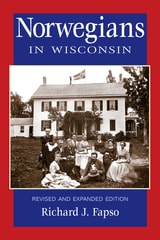
Norwegians in Wisconsin
Richard J. Fapso
Wisconsin Historical Society Press, 2001
This perennially popular book, now revised and expanded with additional historical photos and documents, offers a concise introduction to Wisconsin's Norwegian immigrants. The narrative examines the mass migration of Norwegians from 1837, when Ole Nattestad became the first Norwegian settler in Wisconsin, to the late nineteenth century, when Norwegian immigration largely came to a close. This volume demonstrates the efforts of immigrants to balance newfound American customs with the most treasured traditions of their homeland.
New to this edition are selected letters of Ole Munch Ræder, a scholar sent by the Norwegian government in 1847 to study the American legal system. Ræder visited several Wisconsin cities and villiages and paid special attention to the Norwegian community. His compelling accounts, which appeared in newspapers in Norway, offer a contemporary view of Norwegian life in Wisconsin.
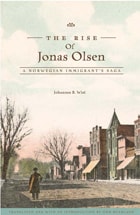
The Rise of Jonas Olsen
A Norwegian Immigrant’s SagaJohannes Wist
University of Minnesota Press, 2005
The Rise of Jonas Olsen is at once an immigrant novel, business novel, political novel, and a western, offering a rich and panoramic view of Scandinavian immigrant life in the Upper Midwest. Wist combines realism and satire to depict the role Norwegian Americans played in the economic, political, and cultural life of the Upper Midwest.
Originally published serially in the Norwegian-language newspaper the Decorah Posten in the 1920s, The Rise of Jonas Olsen illustrates an immigrant’s struggle to preserve his identity and heritage while striving to become fully accepted as an American.
Johannes B. Wist (1864–1923) was a journalist and editor of the Decorah Posten from 1900 to 1923.
Orm Øverland is professor of American literature at the University of Bergen, Norway, and the author of The Western Home: A Literary History of Norwegian America and Immigrant Minds, American Identities: Making the United States Home, 1870-1930.
Todd W. Nichol is editor of the Norwegian-American Historical Association publication program.
Published in cooperation with the Norwegian-American Historical Association.

Vikings across the Atlantic
Emigration and the Building of a Greater Norway, 1860-1945Daron W. Olson
University of Minnesota Press, 2013
Around the year 1000 a Viking ship landed on the Atlantic coast of what would one day be North America. Nearly a millennium later, on June 7, 1945, Norway’s King Haakon VII returned from exile under guard of the American Ninety-ninth—or “Viking”—Battalion. In Vikings across the Atlantic, Daron W. Olson reveals how these two moments form narrative poles for the vision of a Greater Norway that expanded the boundaries of the Norwegian nation.
Looking at matters of religion, literature, media, and ethnicity, Olson explores how Norwegian Americans’ myths about themselves changed over time in relation to a broader Anglo-American culture, while at the same time influencing and being influenced by the burgeoning national culture of their homeland. Beginning in the 1920s, homeland Norwegian identity-makers framed the concept of the Greater Norway, which viewed the Norwegian nation as having two halves: Norwegians who resided in the homeland and those who had emigrated from Norway, especially those in America. Far from being merely symbolic, this idea, Olson shows, was actually tested by the ordeal of World War II, when Norwegians the world over demonstrated their willingness to sacrifice and even die for the Greater Norway.
In its transnational approach, Olson’s book brings a new perspective to immigrant studies and theories of nationalism; Vikings across the Atlantic depicts the nation as a larger community in which membership is constructed or imagined, a status of belonging defined not by physical proximity but through qualities such as culture and shared traditions.
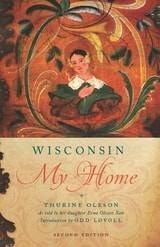
Wisconsin My Home
Thurine Oleson; As told to her daughter Erna Oleson Xan; Introduction by Odd Lovoll
University of Wisconsin Press, 2012