Results by title
2 books match the query 'Notebook'
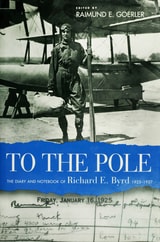
TO THE POLE
The Diary and Notebook of Richard E. Byrd, 1925–1927Edited by Raimund E. Goerler
The Ohio State University Press, 1998
On May 9, 1926, Richard E. Byrd announced to the world that he and copilot Floyd Bennett were the first to fly an airplane over the North Pole. Documents published here for the first time provide new insights into this most controversial accomplishment of Byrd's career.
Some journalists at the time questioned whether Byrd's airplane, the Josephine Ford, could have reached the North Pole and returned in less than sixteen hours. More questions arose after Byrd's death in 1957. A Swedish meteorologist concluded that the Josephine Ford would have needed a beneficial wind to accomplish the feat, and his study of weather data indicated that there had been no such wind. In 1973 another author reported that Byrd's pilot had later confessed to Bernt Balchen, a Norwegian pilot who had assisted Byrd, that they had only circled on the horizon out of sight of reporters and landed when enough time had passed to claim the North Pole.
To the Pole presents transcriptions of Byrd's handwritten diary and notebook, which were discovered by Ohio State University archivist Raimund Goerler in 1996 when he was cataloging Byrd's papers for the university. In his diary Byrd recorded his preparations for the North Pole flight, and he used it as a message pad to communicate with his pilot when the deafening noise from the plane's engines rendered verbal communication impossible.
Byrd also wrote his navigational calculations on the leaves of his diary, and photographs of these crucial pages are presented in the book as well, along with a copy of Byrd's official report on the expedition to the National Geographic Society.
The Poet's Freedom
A Notebook on MakingSusan Stewart
University of Chicago Press, 2011
Why do we need new art? How free is the artist in making? And why is the artist, and particularly the poet, a figure of freedom in Western culture? The MacArthur Award–winning poet and critic Susan Stewart ponders these questions in The Poet’s Freedom. Through a series of evocative essays, she not only argues that freedom is necessary to making and is itself something made, but also shows how artists give rules to their practices and model a self-determination that might serve in other spheres of work.