Results by title
5 books match the query 'Novalis'

Between Heidegger and Novalis
Peter Hanly
Northwestern University Press, 2021
An entirely new approach to both Novalis and Heidegger, this book will interest scholars and students engaged with continental philosophy and the legacy of German Romanticism.

Novalis, Spinoza, and the Limits of Romantic Materialism
Siarhei Biareishyk
Northwestern University Press, 2026
Offering an innovative and illuminating new reading of Spinoza and Novalis
This rigorously researched study reframes our understanding of the intellectual currents in Germany around 1800 through a careful reinterpretation of its key thinker, Novalis, in conversation with Spinoza’s philosophy. Siarhei Biareishyk presents an alternative to the standard narrative that resolutely links emergent modernity and secularization to philosophical “idealism” by showing how Spinozan materialism informs the scientific experiments, metaphysical inquiries, and political debates of Novalis and his contemporaries. Shifting our focus away from the historical interpretation of Novalis as a mystic and theorist of subjectivity, Biareishyk elaborates on the Spinozan materialist strain in Novalis in three key domains: ontology and the conception of nature, theories of singularity and individuation, and the concept of the political. He brings current romanticist scholarship into conversation with contemporary discussions of Spinoza in continental philosophy, in the Marxist tradition particularly, demonstrating that the Spinoza–Novalis encounter provides a viable alternative—in its articulation of causality, dialectics, and the political—to the dominant conceptual apparatuses of both Kant and Hegel.

Novalis
Signs of RevolutionWilliam Arctander O Brien
Duke University Press, 1994
A member of the generation of the 1770s that included Hegel, Hölderlin, and Schelling, Hardenberg was an avid follower of the French Revolution, a semiotician avant la lettre, and a prescient critic of religion. Yet in 1802, only a year after his death, the writer who had scandalized the Prussian court was marketed to a nation at war as a reactionary patriot, a sweet versifier of Idealism, and a morbid mystic. Identifying the break between Hardenberg’s own early Romanticism and the late Romanticism that falsified it, Novalis shows us a writer fully engaged in revolutionary politics and examines his semiotic readings of philosophy and of the political, scientific, and religious institutions of the day. Drawing on the full range of Novalis’s writings, including his poetry, notebooks, novels, and journals, O’Brien situates his semiotics between those of the eighteenth century and those of the twentieth and demonstrates the manner in which a concern for signs and language permeated all aspects of his thought.
The most extensive study of Hardenberg available in English, Novalis makes this revolutionary theoretician visible for the first time. Mining a crucial chapter in the history of semiotics and social theory, it suggests fruitful, sometimes problematic connections between semiotic, historical, "deconstructive," and philological practices as it presents a portrait of one of the most complex figures in literary history. Indispensable for scholars of German Romanticism, Novalis will also be of interest to students of comparative literature and European intellectual history.
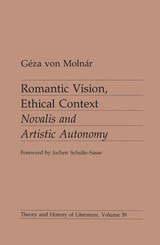
Romantic Vision, Ethical Context
Novalis and Artistic AutonomyGeza Molnar
University of Minnesota Press, 1987
Exploring the full range of Novalis's (the pen name of the German poet and philosopher Friedrich von Hardenberg) work, von Molnar shows how he dealt, in theory and practice, with a central issue in Romanticism-the emerging concept of the autonomous self and its relation.
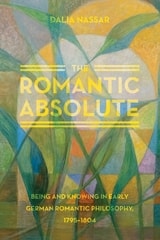
The Romantic Absolute
Being and Knowing in Early German Romantic Philosophy, 1795-1804Dalia Nassar
University of Chicago Press, 2013
Scholars today interpret philosophical romanticism along two competing lines: one emphasizes the romantics’ concern with epistemology, the other their concern with metaphysics. Through careful textual analysis and systematic reconstruction of the work of three major romantics—Novalis, Friedrich Schlegel, and Friedrich Schelling—Nassar shows that neither interpretation is fully satisfying. Rather, she argues, one needs to approach the absolute from both perspectives. Rescuing these philosophers from frequent misunderstanding, and even dismissal, she articulates not only a new angle on the philosophical foundations of romanticism but on the meaning and significance of the notion of the absolute itself.