Results by title
5 books match the query 'Novelists'
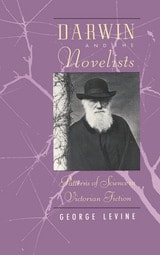
Darwin and the Novelists
Patterns of Science in Victorian FictionGeorge Levine
University of Chicago Press, 1991
Levine shows how Darwin's ideas affected nineteenth-century novelists—from Dickens and Trollope to Conrad. "Levine stands in our day as the premier critic and commentator on Victorian prose."—Frank M. Turner, Nineteenth-Century Literature. "Magnificently written, with a care and delicacy worthy of its subject."—Nina Auerbach, University of Pennsylvania
[more]

On Novels and Novelists
Jean-Paul Sartre
Seagull Books, 2021
A collection of essays on renowned French writers, including Sarraute, Renard, and Gide.
Iconic French novelist, playwright, and essayist Jean-Paul Sartre is widely recognized as one of the most important philosophers of the twentieth century, and his work has remained relevant and thought-provoking through the decades. The Seagull Sartre Library now presents some of his most incisive philosophical, cultural, and literary critical essays in twelve newly designed and affordable editions.
In this collection of brief, insightful essays, we find ourselves face to face with Sartre the literary critic, as he carefully examines the works of renowned French writers such as François Mauriac, Nathalie Sarraute, Jean Giraudoux, and Jules Renard. Most moving is an essay on André Gide, written right after his death, in which Sartre writes, “We thought him scared and embalmed; he dies and we discover how alive he was.”
[more]

The Blond Box
Toby Olson
University of Alabama Press, 2003
El Malabarista, pianist and juggler for a troupe of sexual performance artists, is found dead in the dusty wilderness, his fingers crushed. Beginning like a murder mystery, The Blond Box then defies all the usual expectations of a murder mystery plot, by juxtaposing "real" events in two different decades with a draft version of a hack sci-fi novella. This mixed narrative serves as a meta-fictional commentary on the efforts of a retired sex-theater artist, a hairstylist/pulp writer, a doctoral student, and a host of other characters to, not only solve the murder, but uncover its motivation, which seems to be linked to El Malabarista's knowledge of the whereabouts of a certain boxed treasure. By turns lyrical and scatological, puerile and cerebral, The Blond Box is at once a daring formal experiment and a good yarn.
[more]

The Composition of Herman Melville
Rick Mitchell
Intellect Books, 2002
How do writers compose, and how are they in turn composed?
This play, which contains biographical information relating to Herman Melville, is fundamentally an exploration of the ways in which these two things take place.
The play admits the truth of Walter Benjamin's view of history as, "time filled by the presence of the now." Parallels between past and present (e.g., racism, domestic abuse, and the plight of the visionary American artist) are clearly implied, but the play also utilizes new technologies, in particular video, in order to represent the kind of dialectical history and representation promoted by Benjamin.
During Melville's lifetime, and in his own creative imagination, the archaic was undergoing its transformation into modernity. Thus Melville is an especially apt subject for an exploration of modernity and representation that utilizes both the modern &endash; i.e., video, montage &endash; and elements of the archaic &endash; i.e., the performing body, allusions to whaling, 'discovery' in the South Seas.
The Composition of Herman Melville utilizes performance strategies in an effort to embody the complex textuality of a writer who haunts the landscape of America, from the mid-nineteenth century to the present. This book is believed to represent the only work of historical fiction &endash; albeit in dramatic form &endash; that focuses primarily on Herman Melville, considered by many to be America's greatest writer.
[more]
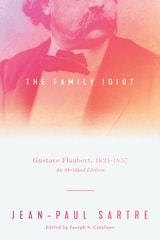
The Family Idiot
Gustave Flaubert, 1821–1857, An Abridged EditionJean-Paul Sartre
University of Chicago Press, 2023
An approachable abridgment of Sartre’s important analysis of Flaubert.
From 1981 to 1994, the University of Chicago Press published a five-volume translation of Jean-Paul Sartre’s The Family Idiot: Gustave Flaubert, 1821-1857, a sprawling masterwork by one of the greatest intellects of the twentieth century. This new volume delivers a compact abridgment of the original by renowned Sartre scholar, Joseph Catalano.
Sartre claimed that his existential approach to psychoanalysis required a new Freud, and in his study of Gustave Flaubert, Sartre becomes that Freud. The work summarizes Sartre’s overarching aim to reveal that human life is a meaningful adventure of freedom. In discussing Flaubert’s work, particularly his classic novel Madame Bovary, Sartre unleashes a fierce critique of modernity as nihilistic and demeaning of human dignity.
[more]